Critically Endangered
Halavi guitarfish
Glaucostegus halavi
The halavi guitarfish (Glaucostegus halavi) is a large, flat-bodied ray of shallow seabeds from the Red Sea and Arabian Sea to western India. The IUCN Red List rates it Critically Endangered (assessed 2019) because fishing has driven numbers down steeply across its range.
How to recognise it
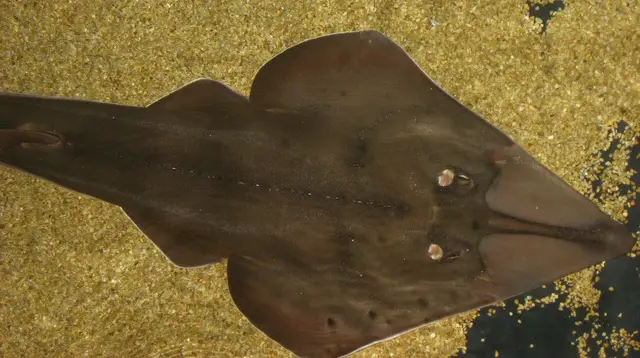
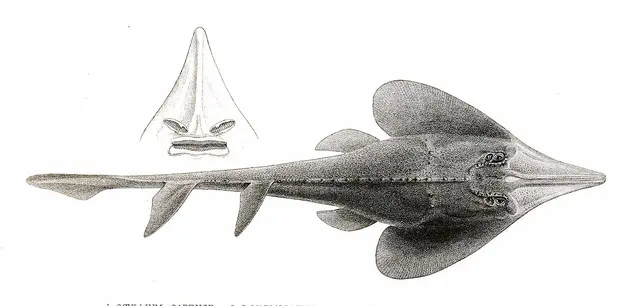
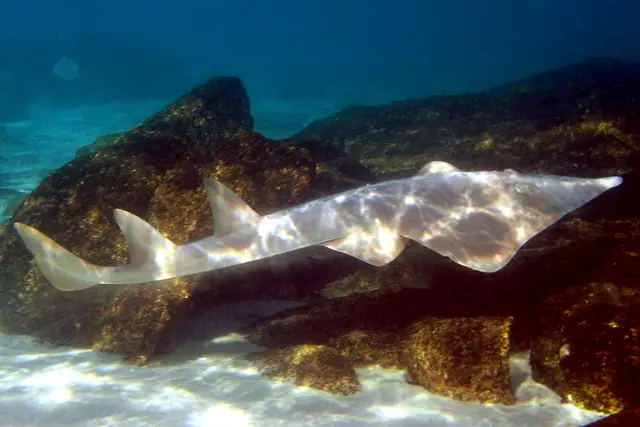
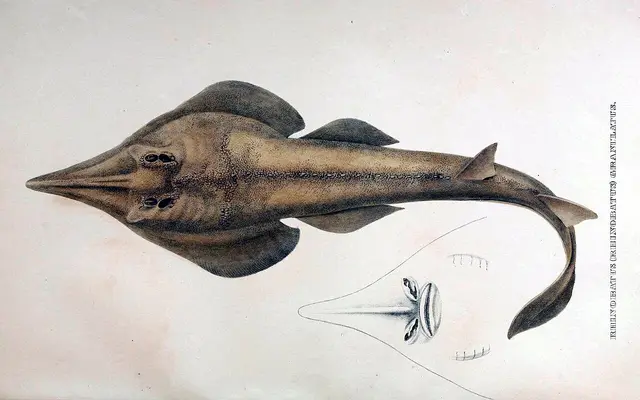
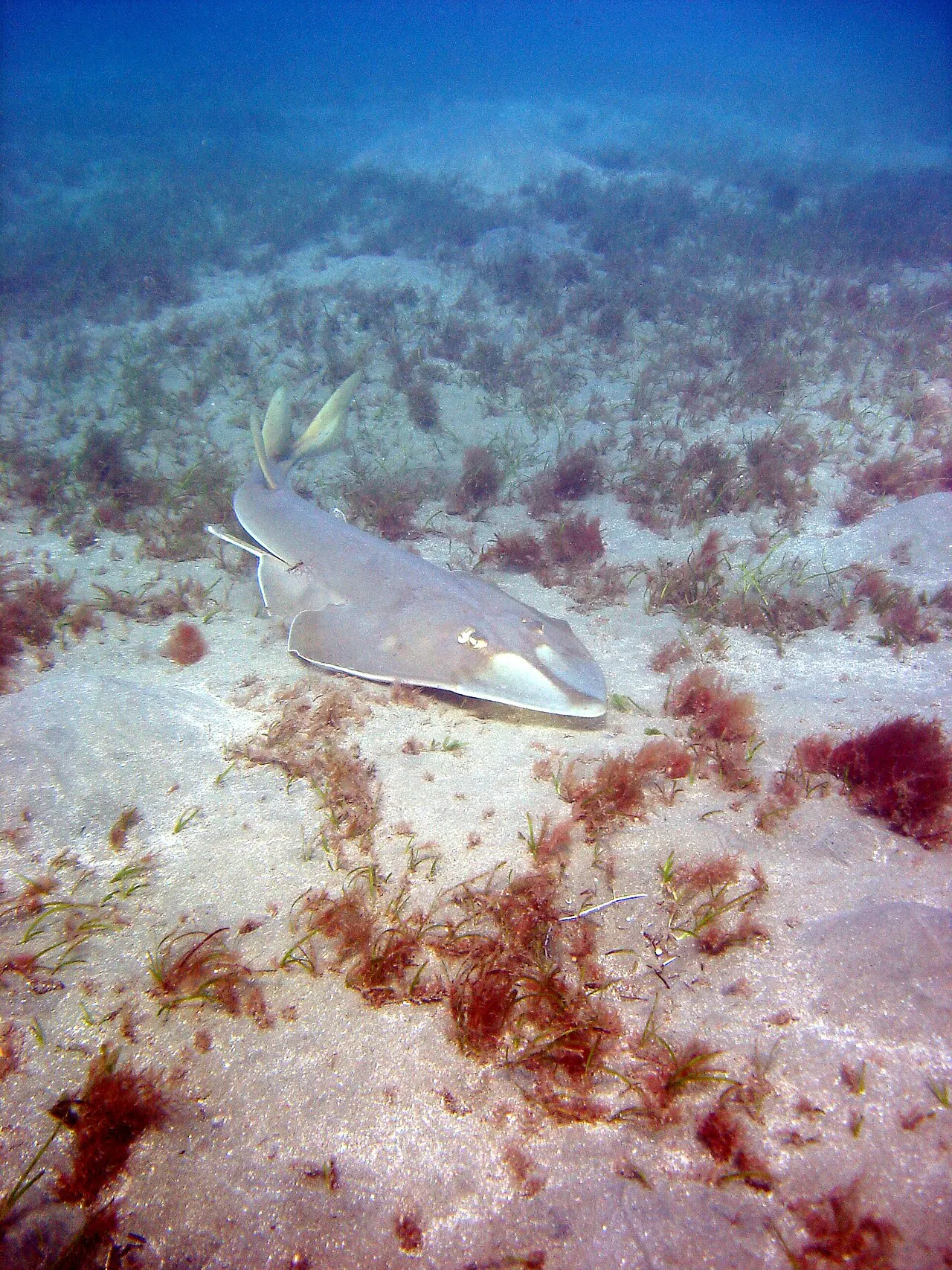
Guitarfish are rays with a long, shark-like body and a flat head. This one has a short, wide snout with a rounded tip, and its back is yellow or grey, which blends with the seabed. Pups are born around 29 centimetres long. The maximum length is given as 171 centimetres in one source and at least 187 centimetres in another. Size at maturity is about 83 centimetres.
The English name comes from the Arabic halawi, and the species was first named by Forsskål in 1775.
Where it lives
It is found from the Red Sea through the Gulf of Oman and the Arabian Gulf to Gujarat in India. The IUCN lists 16 countries and areas, from Egypt, Eritrea and Kenya to Israel, Pakistan, India and the United Arab Emirates. It lives on muddy, sandy and sandy-mud bottoms and in estuaries, from the surface down to about 100 metres, though in the UAE it is usually found in shallow water under 5 metres. It has reportedly been recorded only twice in the Levantine Mediterranean, in 1997 and 2004.
Pins are Wikidata “endemic to” fields. Orange dots, when present, are GBIF occurrence tiles — survey bias included.
How it lives
It eats small molluscs and bony fish. Mature females give birth to litters of up to 10 pups. Its reproductive rate is described as low, and the age at which it matures is unknown. The IUCN uses a generation length of 10 years, borrowed from the larger giant guitarfish, so that figure is a rough estimate.
Why it is in trouble
Guitarfish are caught on purpose and by accident in gillnet and trawl fisheries, by small and large operators alike, and the IUCN rates this harvest as a high-impact, ongoing threat. Fins and meat are traded. In the UAE, landings fell by about 80 to 90 percent over a decade, although fishing limits in 2008 and 2012 account for some of that drop. Coastal building, dredging and sea-filling also damage the shallow seabed it uses. The IUCN lists the global trend as decreasing.
What is being done
The UAE bans fishing for the species year-round, with a total ban in force from 2019, and the fish is listed on CITES Appendix II. A UAE national assessment (2019) rated it Vulnerable inside that country. In Saudi Arabia, a Red Sea Global team reported in 2024 that it was tracking rays with acoustic tags at the Al Wajh lagoon and building nursery areas for young fish. The UAE assessment calls for regional fisheries monitoring and more research on its life history, and the IUCN records no recovery plan or systematic monitoring scheme for the species.
Sources
Written for this catalog in our own words from the sources below, checked against them on 12 November 2026. Population figures are estimates and carry the year they were made. Status and assessment year: IUCN. 2026. The IUCN Red List of Threatened Species. Version 2026-1. iucnredlist.org.