Critically Endangered
Clubnose guitarfish
Glaucostegus thouin
The clubnose guitarfish (Glaucostegus thouin) is a large ray found in shallow Indian and western Pacific coastal waters and the Red Sea. The IUCN Red List assessed it as Critically Endangered in 2021, after an estimated drop of about 80 percent, driven by fishing for its meat and valuable fins.
How to recognise it
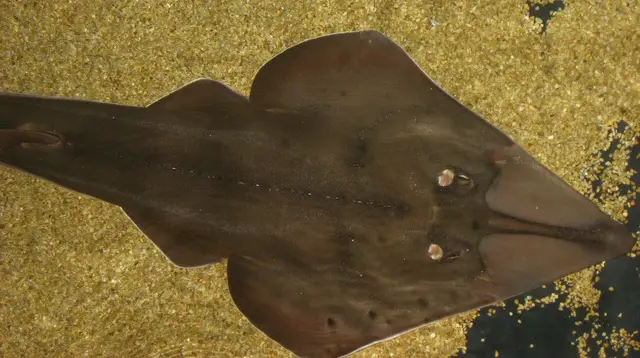
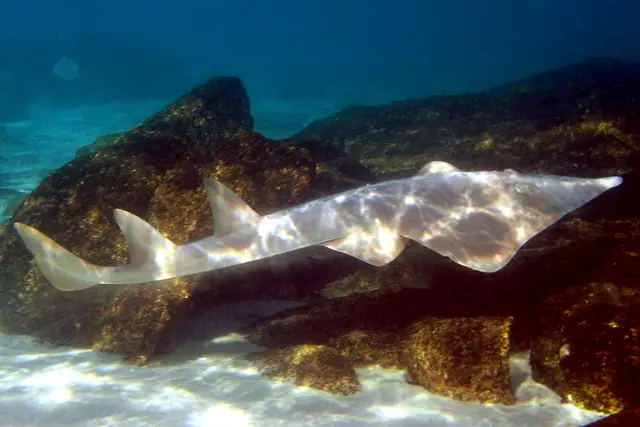
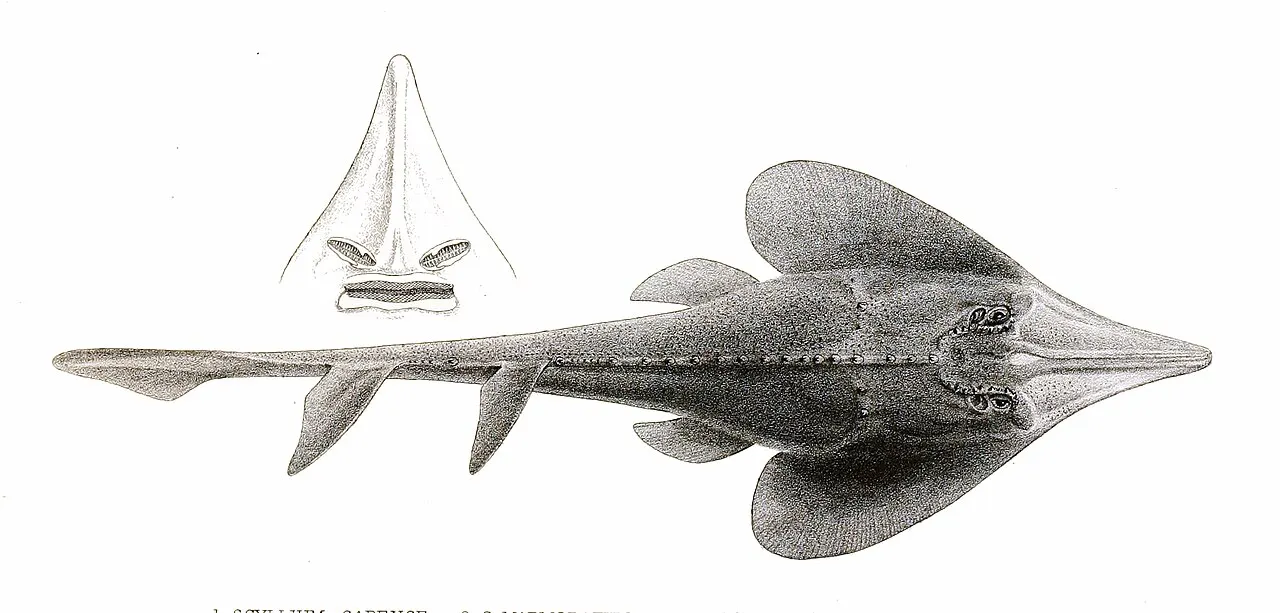
This species grows up to about 3 m long, though most are under 2.5 m. It is pale yellowish or brownish with a pale snout.
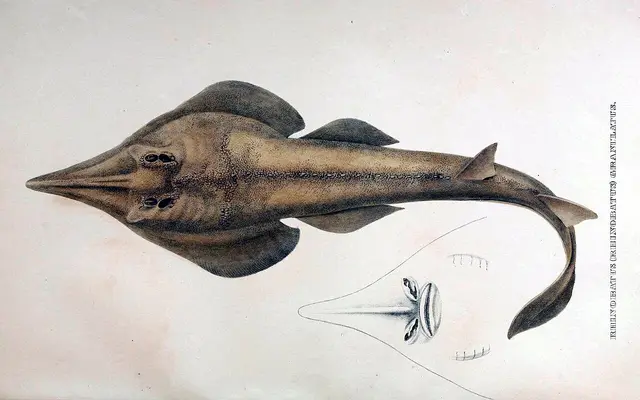
The snout tip is the feature that sets it apart from other members of its genus. It ends in a club-like thickening, which gives the species its common name.
Where it lives
The species lives in the Indo-West Pacific, from the Red Sea and India east to New Guinea, and north to Japan. The IUCN lists it as native to 11 countries: Bangladesh, Brunei, Cambodia, India, Indonesia, Malaysia, Myanmar, Singapore, Sri Lanka, Thailand and Viet Nam. Old records from the Mediterranean and Suriname have not been confirmed, and Australian records also need checking.
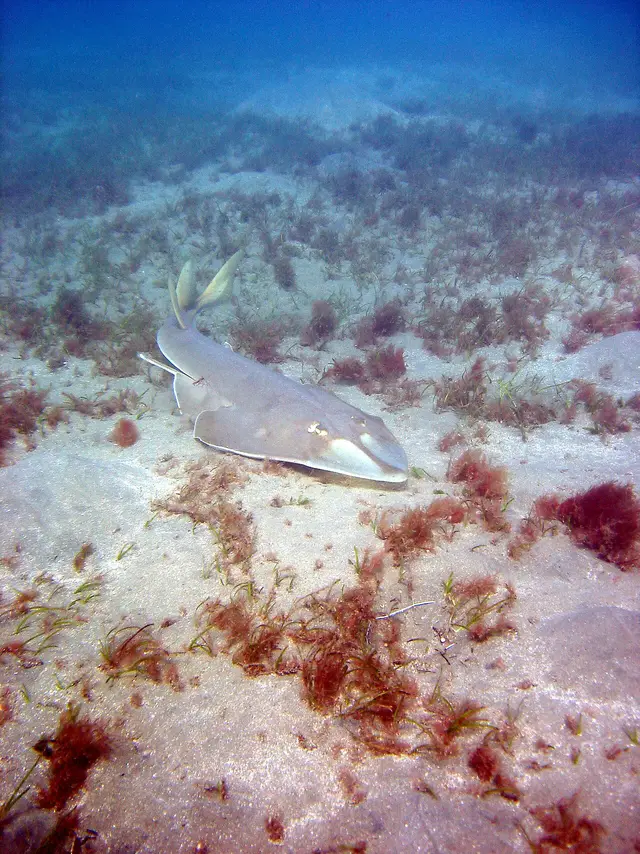
It is a marine animal of shallow coastal water, from the surface down to about 60 m, found both inshore and offshore. The IUCN names sandy, sandy-mud and muddy sea floors and estuaries as its habitat.
Pins are Wikidata “endemic to” fields. Orange dots, when present, are GBIF occurrence tiles — survey bias included.
How it lives
Its biology is little known. It is a carnivore that feeds on large shellfish. It is ovoviviparous: the embryos develop inside the mother, feeding first on yolk and then on nourishing uterine fluid.
Large, slow-breeding fish recover slowly from losses. FishBase rates its resilience as low, with a minimum population doubling time of 4.5 to 14 years. The IUCN uses a generation length of 15 years.
Why it is in trouble
Fishing is the threat the IUCN lists. It records harvest, both deliberate and as bycatch, by small-scale and large-scale fisheries, as ongoing across more than 90 percent of the range and causing rapid declines. The assessment estimates a reduction of about 80 percent, judged from an abundance index and the level of exploitation.
FishBase describes the meat and fins as very high value, with the skin and cartilage also used. It says the fish are caught occasionally in bottom-set tangle nets and sold fresh or, probably, dried and salted. The species is named after the French botanist André Thouin.
What is being done
Protection so far is mostly on paper. In 2019 the parties to CITES voted 109 to 30, with 4 abstentions, to place six species of giant guitarfish on Appendix II, which means international trade is regulated. Shark-References and FishBase list this species on Appendix II, and Shark-References also lists it in Annex B of an EU regulation (2017/160).
The IUCN assessment records no harvest management plan, no recovery plan, no monitoring scheme and no identified conservation sites for this species. Its recommended actions include harvest and trade management, site protection and education.
Sources
Written for this catalog in our own words from the sources below, checked against them on 12 November 2026. Population figures are estimates and carry the year they were made. Status and assessment year: IUCN. 2026. The IUCN Red List of Threatened Species. Version 2026-1. iucnredlist.org.