Endangered
Sado wrinkled frog
Sado wrinkled frog
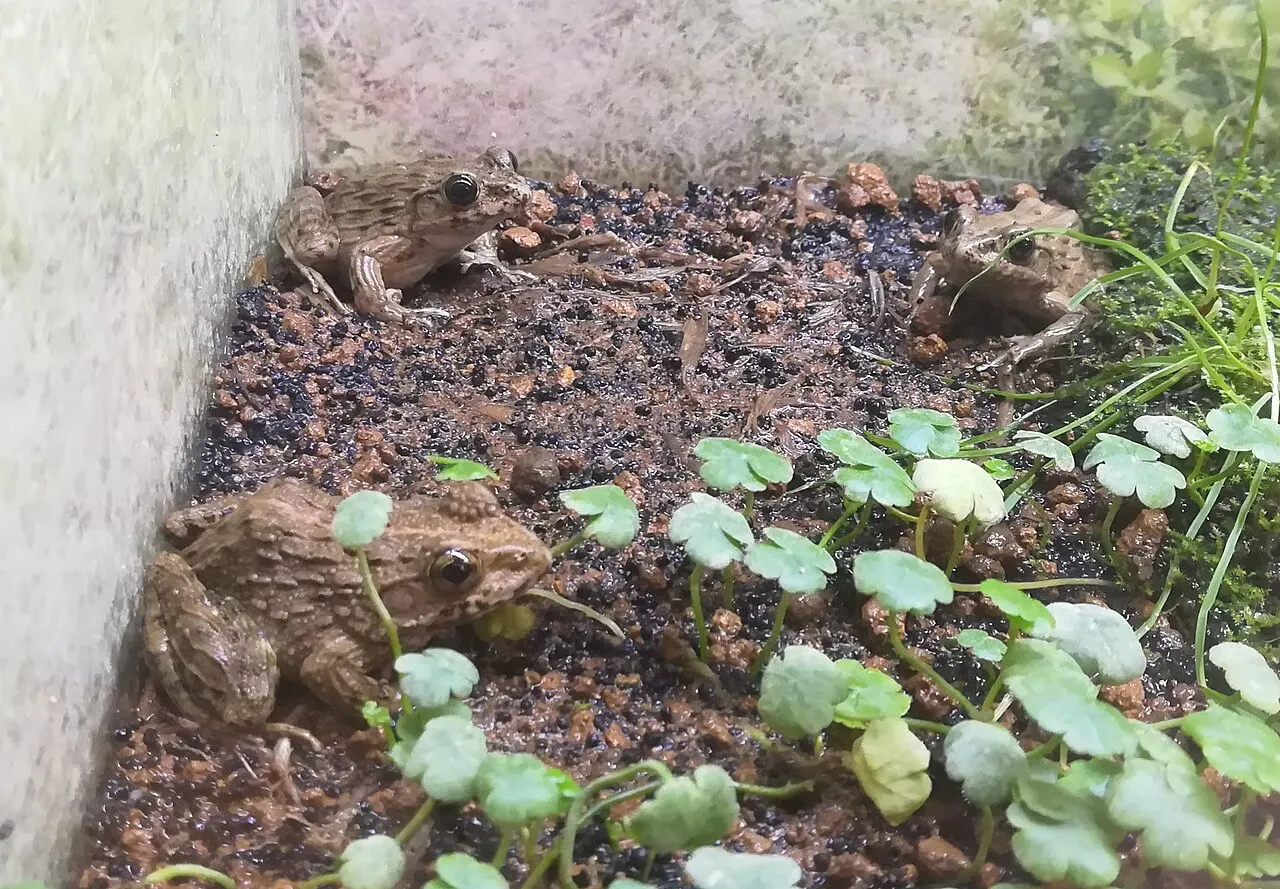
The Sado wrinkled frog is a small, rough-skinned frog found only on Sado Island, off the coast of Japan, and reportedly the island's only endemic amphibian. The IUCN Red List rated it Endangered in 2021. It lives in rice paddies, irrigation channels, streams and ponds in the island's lowlands.
How to recognise it
This is a small frog. Males measure about 33 to 44 mm from snout to vent and females about 38 to 50 mm, according to its original 2012 description. The back is khaki to grayish brown and ridged with small folds of skin, and some frogs have a stripe down the middle. The belly is yellow toward the rear.
The toes are well webbed. Males lack the vocal sac that its mainland relative has. The name susurra comes from a Latin word for whispering, because its call is quiet compared with other frogs at the same sites.
Where it lives
It occurs only on Sado Island. The Red List gives an extent of occurrence of about 232 square kilometers, two locations, and a height range of about 11 to 187 m. It lives around rice paddies, irrigation channels, small streams and ponds.
Its range reportedly covers the central part of the island, while a close relative, the wrinkled frog (Glandirana rugosa), occupies the north and south. The two are genetically close but can be told apart by body form, and experiments suggest they are almost completely unable to produce healthy offspring together.
Pins are Wikidata “endemic to” fields. Orange dots, when present, are GBIF occurrence tiles — survey bias included.
How it lives
Spawning takes place in ponds from mid-May to early August, and the egg masses are attached to short dead branches or water plants. Adults and at least some tadpoles spend the winter in mud under water. The Red List classes it as not a migrant.
A 2024 study of introduced bullfrogs found that the Sado wrinkled frog mainly lives in relatively deep ponds surrounded by rice paddies.
Why it is in trouble
Farming practice is the main concern. A 2020 study in the journal Wetlands counted frogs at 42 paddy sites on Sado in early and late June 2014. Numbers fell sharply once paddies were drained in mid-June, and were lower where paddies were bordered by deep concrete irrigation ditches. Conservation ditches built into the paddies softened the effect and appear to act as refuges. The Red List also lists water abstraction for agriculture and other changes to the habitat.
A second worry is the American bullfrog, an introduced species. A 2024 survey of 41 ponds on Sado, published in Current Herpetology, found that bullfrogs overlap with the native frog in both habitat and season of pond use, and the researchers strongly recommended bullfrog eradication to protect it.
A 2022 genetic study in Wetlands found three separate regional groups, eastern, central and western. The eastern and western groups have less genetic variety, and many central populations show signs of recent sharp drops in numbers.
What is being done
The Red List records that conservation sites have been identified over part of the range, though the frog does not occur in a protected area. The 2022 genetic study recommends managing the three regional groups as separate units, enlarging the eastern and western populations, and improving habitat connections in the center. The 2024 bullfrog study recommends removal of bullfrogs.
Sources
Written for this catalog in our own words from the sources below, checked against them on 12 November 2026. Population figures are estimates and carry the year they were made. Status and assessment year: IUCN. 2026. The IUCN Red List of Threatened Species. Version 2026-1. iucnredlist.org.
- IUCN Red List assessment, Sado wrinkled frog (2021)
- IUCN Red List taxon record, Sado wrinkled frog
- Sado wrinkled frog (encyclopedia article)
- Sekiya, Miura and Ogata 2012, description of Rugosa susurra, Zootaxa 3575
- Modern farming practices in paddy fields negatively affect an endemic frog, Sado wrinkled frog (Wetlands 40, 2020)
- Conservation genetics of the endangered Sado wrinkled frog (Wetlands 42, 2022)
- Seasonal emergence and habitat pond use of invasive American bullfrog on Sado Island (Current Herpetology 43, 2024)




