Critically Endangered
Galapagos damsel
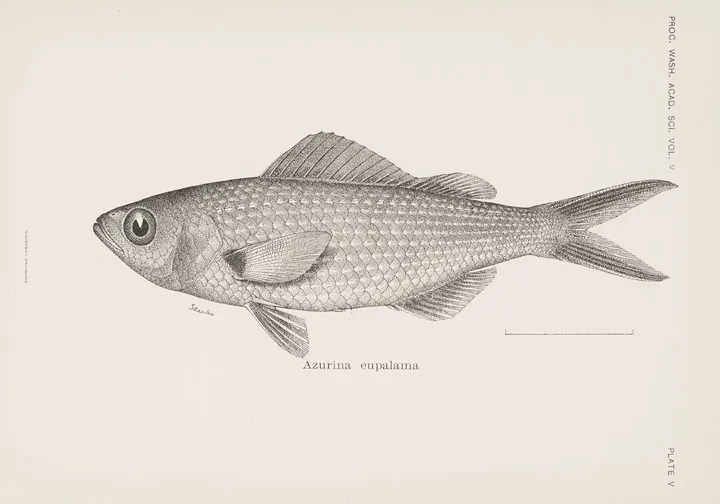
Azurina eupalama
The Galapagos damsel (Azurina eupalama) is a small reef fish once collected around many of the Galapagos Islands. It has not been seen since the 1982 to 1983 El Nino. The IUCN Red List rated it Critically Endangered, possibly extinct, in 2023, and a 2025 paper argues it is likely gone.
How to recognise it
It's a damselfish (family Pomacentridae), also called the blackspot chromis, that grew to about 15 cm. Its body was olive-gray with a bluish tinge and silvery sides, and a black spot sat at the base of each pectoral fin. The lateral line was easy to see.
Heller and Snodgrass described the species in 1903.
Where it lived
The Red List treats it as native to Ecuador, specifically the Galapagos, in shallow rocky reef from the surface down to about 30 m. Museum collections hold specimens from many islands, including Floreana, Isabela, Santa Cruz, San Cristobal and Santa Fe. One old specimen was reportedly collected near Cocos Island.
It fed on plankton, and a 2025 paper by Grove and Victor describes it as adapted to cooler sea surface temperatures.
Pins are Wikidata “endemic to” fields. Orange dots, when present, are GBIF occurrence tiles — survey bias included.
Why it is in trouble
Before 1982 the fish was regularly seen, and collecting expeditions gathered numerous specimens. The very strong El Nino of 1982 to 1983 brought long spells of warm water. Cold upwelling and the plankton boom that comes with it stopped, and plankton-feeding fish that depend on cool water fell sharply. This species has not been recorded since.
The 2023 assessment lists temperature extremes and habitat shifting as the threats, and gives a population bracket of 0 to 249 individuals in a single location. Divers have searched for about four decades without success.
What is being done
The Red List records that the species' range overlaps at least one protected area. Beyond that, the work is mostly about finding out whether any survive. The Red List assessors speculate that a population might persist on warm-temperate islands off Peru, such as the Lobos Islands, but no evidence has turned up in survey data so far.
In 2025 Grove and Victor, writing in the Journal of the Ocean Science Foundation, concluded the species should now be considered likely extinct. They suggested sampling environmental DNA in Galapagos waters to test that.
Sources
Written for this catalog in our own words from the sources below, checked against them on 12 November 2026. Population figures are estimates and carry the year they were made. Status and assessment year: IUCN. 2026. The IUCN Red List of Threatened Species. Version 2026-1. iucnredlist.org.




