Endangered
Gabela Bushshrike
Laniarius amboimensis
The Gabela bushshrike (Laniarius amboimensis) is a black-and-white forest bird found only on the western escarpment of Angola. The IUCN Red List rated it Endangered in 2020, with an estimated 1,000 to 2,499 mature individuals and a shrinking range as forest is cleared for farming.
How to recognise it
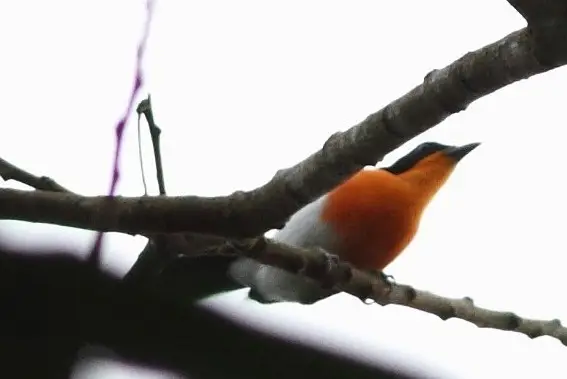
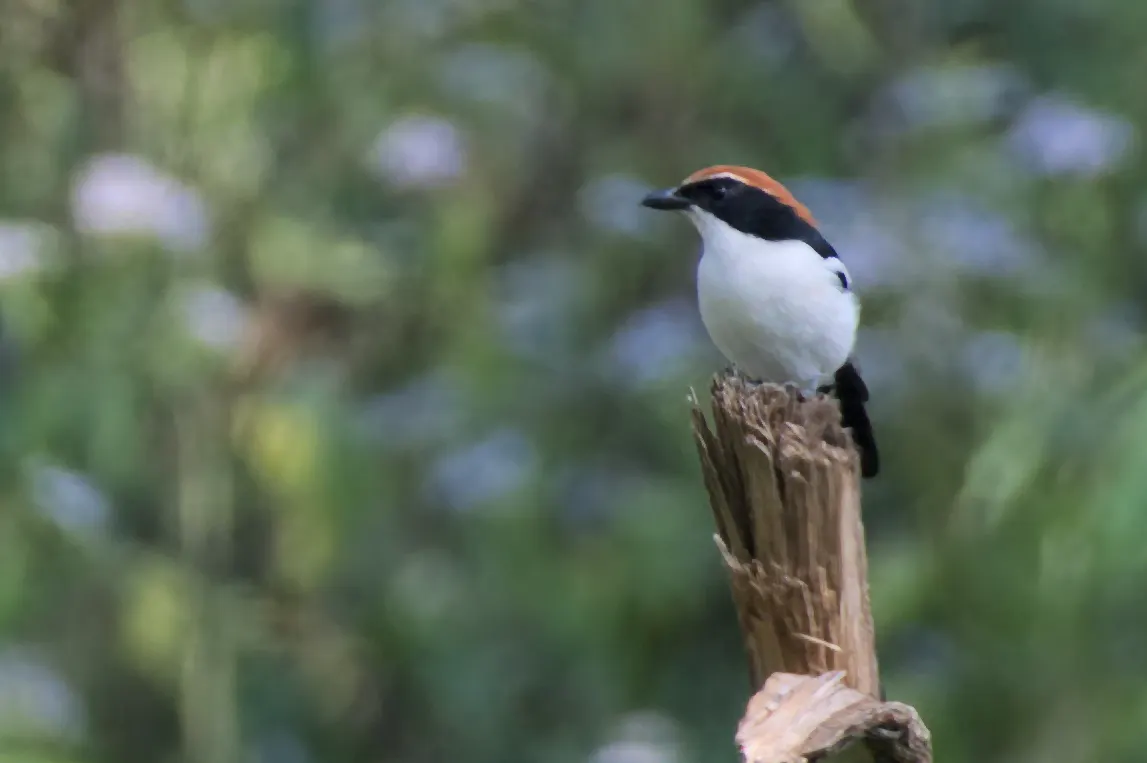
It's a shrike about 17 to 20 cm long (sources differ), mostly black above and white below, with a rusty cap. The clear white underparts help separate it from two close relatives, Lühder's bushshrike and the orange-breasted bushshrike.
Its call is a throaty series of notes, written as waaark and whook, much like the call of Lühder's bushshrike. The bird has been treated as a form of that species, and whether it deserves full species status is still unresolved.
Where it lives
The bird is endemic to Angola, living in moist montane forest at roughly 730 to 1,100 m above sea level. The IUCN puts its extent of occurrence at about 5,000 square km and its area of occupancy at about 3,600 square km. Kumbira Forest is the best-known site.
It doesn't migrate and makes only short flights, with little dispersal.
Pins are Wikidata “endemic to” fields. Orange dots, when present, are GBIF occurrence tiles — survey bias included.
How it lives
It eats invertebrates, which it gleans from foliage, and lives in dense forest vegetation.
Its use of altered habitat is not settled. The IUCN lists plantations among its habitats. A 2010 survey in Kumbira Forest, reported in Oryx, recorded it at 42 of 203 sample points (21 percent) but never in secondary forest. It occurred in two well-defined zones and was absent from most of the study area.
Why it is in trouble
In that study area, total forest cover rose from 53.8 percent in 1989 to 65.2 percent in 2010, but forest present since 1989 fell by 45.5 percent, replaced largely by regrowth. If the bushshrike avoids regrowth, that trade is bad news for it.
The IUCN names small-holder farming and shifting agriculture as ongoing threats, and large-scale agriculture and road building as future ones. Its population is judged to be decreasing.
What is being done
Conservation sites have been identified across its whole range, but the assessment records no protected area covering it, no recovery plan, and no monitoring scheme. Recommended steps include official protection and community-based conservation for Kumbira Forest, ecotourism as a supplement to farming, and more surveys of its habitat needs, distribution and numbers.
Sources
Written for this catalog in our own words from the sources below, checked against them on 12 November 2026. Population figures are estimates and carry the year they were made. Status and assessment year: IUCN. 2026. The IUCN Red List of Threatened Species. Version 2026-1. iucnredlist.org.