Endangered
Braun's Bushshrike
Laniarius brauni
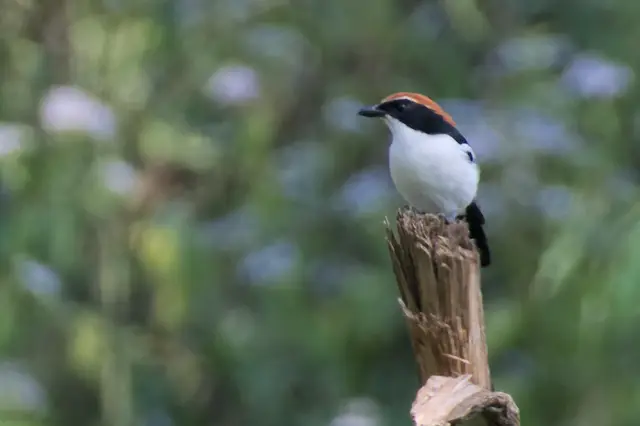
Braun's bushshrike (Laniarius brauni) is a skulking forest shrike found only in northern Angola, in the Cuanza Norte and Uige provinces. The IUCN Red List assessed it as Endangered in 2021, with a range of under 5,000 square kilometres and a decreasing population. Its bright orange breast sets it apart from its close relatives.
How to recognise it
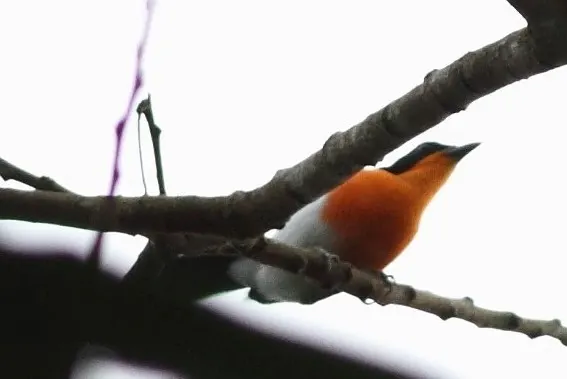
The bright orange breast is the quickest way to tell Braun's bushshrike from the very similar Luehder's bushshrike, which has a chestnut breast. It's also known as the orange-breasted bushshrike, a name shared with an unrelated species.
It's easier to hear than to see. A 1958 account describes a skulking bird with a low, far-carrying growl, a duet phrase of two soft notes then two loud ones, and sharp warning notes. A 2025 birding tour heard one calling a short distance off the road near Uige and, after some effort, saw it on an exposed perch some way off.
Where it lives
It lives only in Angola. Most records come from a stretch of forest about 150 km long, running north to south from about 40 km northwest of Uige town to about 20 km south of Quiculungo. The Red List gives its elevation as 600 to 870 m, counts 1 to 5 locations and puts its extent of occurrence at about 3,900 square kilometres.
The species was first collected on 17 April 1936 near Quiculungo by the German collector Rudolf Braun. David Bannerman described it in 1939 and the name honours Braun. The last 20th-century record was in November 1957, and a bird was found again in January 2003 south of Uige, after 48 years. Before 2005 the species was known only from the records of two collectors, Braun and Gerd Heinrich.
Pins are Wikidata “endemic to” fields. Orange dots, when present, are GBIF occurrence tiles — survey bias included.
How it lives
It favours densely overgrown forest. Heinrich described liana-rich gallery forest and thickets at the edges of clearings, and a 2011 review in the Bulletin of the African Bird Club found that modern sightings came from secondary forest and forest edge. That suggests it tolerates some disturbance, though few areas of primary forest were surveyed.
Abundance is hard to judge. Heinrich found one or several pairs in each strip of forest west of Camabatela, and 3 to 4 pairs have been found within small areas more recently. Playback of recorded calls has drawn excited responses from birds in the field.
Why it is in trouble
Its range is small and the forest in it is shrinking. The Red List names small-holder farming, small-scale harvesting and wider habitat change as threats, and a report from the FitzPatrick Institute says the northern escarpment forests where it lives face commercial logging.
Clearing the understorey for crops makes forest unusable for it, even where some trees are left. Population estimates differ. The 2011 review put it at 3,500 to 7,000 birds, assuming 1 to 2 per square kilometre. The 2021 Red List gives 2,100 to 4,700 mature individuals. Both are rough.
What is being done
It isn't known from any protected area, and the Red List records no recovery plan, monitoring scheme or captive programme. Its listed conservation action is to increase the area of suitable habitat with protected status. Research priorities named are its population size, distribution and trends, and its life history and ecology. The 2011 review suggests satellite imagery to find forest blocks that should be surveyed.
Sources
Written for this catalog in our own words from the sources below, checked against them on 12 November 2026. Population figures are estimates and carry the year they were made. Status and assessment year: IUCN. 2026. The IUCN Red List of Threatened Species. Version 2026-1. iucnredlist.org.
- IUCN Red List assessment, Laniarius brauni (BirdLife International, 2021)
- Mills et al. 2011, The Endangered Braun's Bushshrike: a summary, Bulletin of the African Bird Club 18(2)
- Angola birding tour report, 23 June to 9 July 2025 (Birding Ecotours)
- The FitzPatrick Report, African Birdlife (Juliet Mills)
- Braun's bushshrike (Wikipedia)