Endangered
Gran Canaria blue chaffinch
Fringilla polatzeki
The Gran Canaria blue chaffinch (Fringilla polatzeki) is a small finch found only in the pine forests of Gran Canaria, in Spain's Canary Islands. The IUCN Red List rated it Endangered in 2021. About 430 birds were counted in 2019, most of them in one reserve, and the trend is rising.
How to recognise it
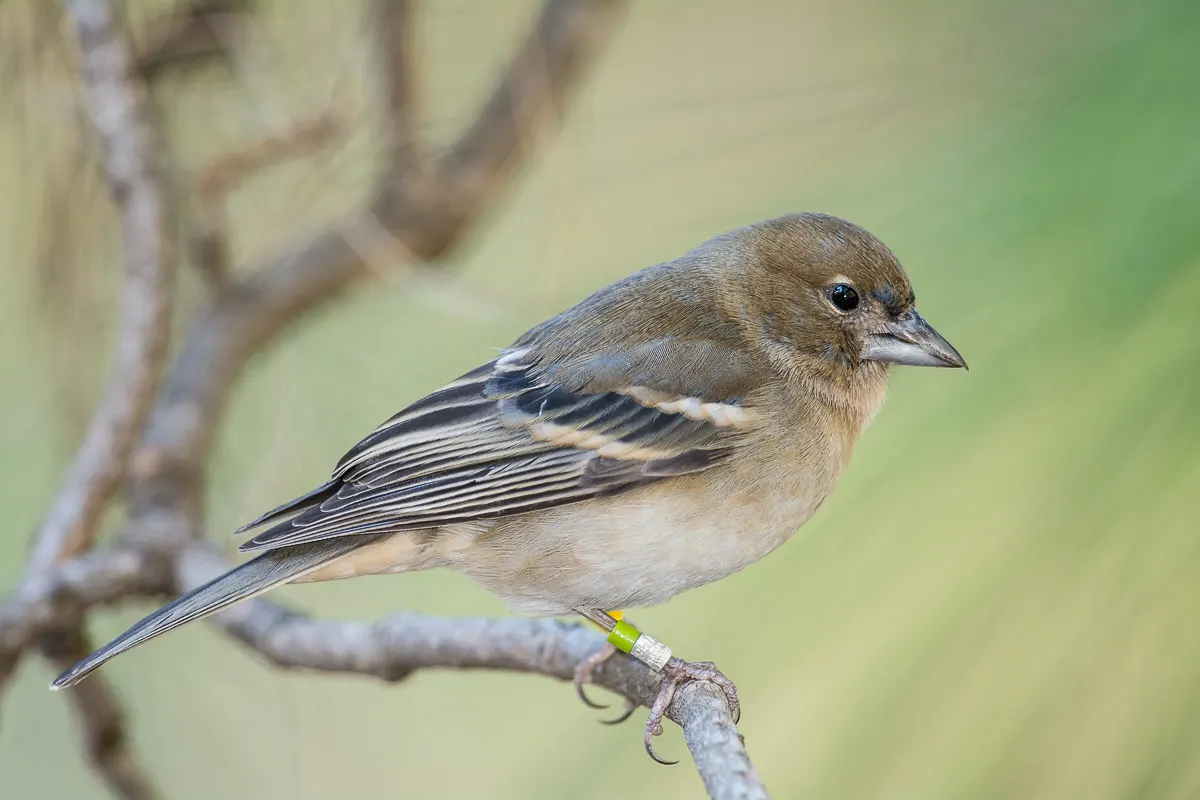
It is a compact, mostly blue-grey finch with two pale wing bars and a whiter belly than its close relative on Tenerife. Males weigh roughly 27 to 29 g and females 26 to 28 g, a little less than Tenerife birds. Females are a dull grey-brown.
It was long treated as a subspecies of the Tenerife blue chaffinch (Fringilla teydea). A 2016 study supported splitting the two, and the Gran Canaria bird is now listed as its own species.
Where it lives
The species is endemic to Gran Canaria and lives only in forest of Canary Island pine (Pinus canariensis). The IUCN gives its elevation range as 700 to 1,800 m, while a Spanish encyclopedia entry puts it at 1,000 to 1,900 m. Most birds live in the Inagua reserve.
In the first half of the 20th century the finch lost ground to logging, repeated fires and collecting for museums. Today the IUCN counts two locations, and a 2019 census found about 362 birds in Inagua and 68 in the Cumbre pinewoods.
Pins are Wikidata “endemic to” fields. Orange dots, when present, are GBIF occurrence tiles — survey bias included.
How it lives
Pine seeds are the staple food. Unlike many finches, this one also relies heavily on insects and other invertebrates in the breeding season, and they are the main food parents bring to their chicks.
Breeding runs from late April to late July or early August. Pairs build a nest of pine needles and broom twigs and lay two eggs. Mature forest with dense, old trees is favoured for nesting. The bird does not migrate.
Why it is in trouble
The population is tiny and confined to two pinewood areas. The IUCN names wildfire, now more frequent and larger, as the greatest threat. A summer 2007 fire damaged the Inagua forest and halved the birds there by 2008, though numbers recovered to earlier levels by 2011.
Predators include great spotted woodpeckers, Eurasian sparrowhawks, long-eared owls and introduced cats, and breeding success is low. Summer water is scarce and temperatures are high in the pine belt. The IUCN also lists capture for the cage-bird trade, disturbance from recreation and inbreeding as pressures.
What is being done
A captive-breeding programme began in 1993 at the Tafira forestry nursery. An EU-funded LIFE project ran from 1999 to 2002. It reversed a decline of roughly 15% a year and left about 185 birds, up from around 150, though its breeding centre did not raise enough birds for release.
From 2010 to 2012, 48 captive-bred birds were released in the Cumbre pinewoods. Later LIFE+ projects restored fire-damaged forest and continued releases there. The IUCN recommends thinning overly dense pine, protecting drinking sites, keeping up captive breeding and considering moves to Tamadaba, where the species once occurred.
Sources
Written for this catalog in our own words from the sources below, checked against them on 12 November 2026. Population figures are estimates and carry the year they were made. Status and assessment year: IUCN. 2026. The IUCN Red List of Threatened Species. Version 2026-1. iucnredlist.org.




