Critically Endangered
New Zealand storm petrel
Fregetta maoriana
The New Zealand storm petrel (Fregetta maoriana) is a tiny seabird, about 18 cm long, once known only from three 19th century specimens and presumed extinct. Seen again in 2003, it breeds on Hauturu (Little Barrier Island). The IUCN Red List rated it Critically Endangered in 2018.
How to recognise it
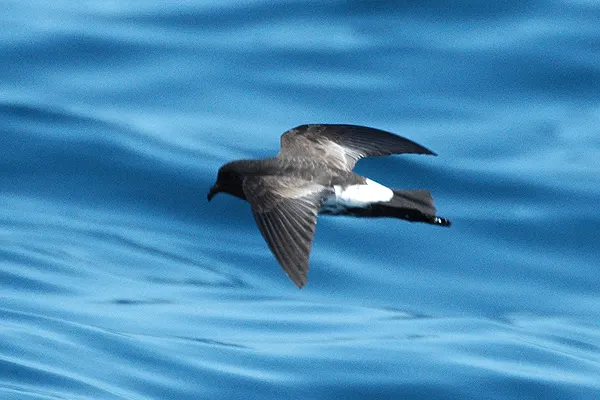
It weighs around 35 g. The head, breast and upperparts are dark blackish-brown, with a sharply defined white rump. The belly is white with variable dark streaks along the flanks. Bill, legs and feet are black, and in flight the feet trail beyond the tail.
The underwing has a white central panel with a broad dark leading edge. Wilson's storm petrel is similar in size but lacks the white underparts and white underwing panel, and it flies with a fluttery, butterfly-like action and rounder wings.
Where it lives
The only known breeding site is Hauturu, in the Hauraki Gulf north of Auckland. Nests were first found in February 2013, in crevice-like burrows in crumbly, leaf-littered ground under tall forest in the island's interior. The first egg was recorded a year later.
At sea it is mostly recorded in northern New Zealand waters, with a core area in and around the outer Hauraki Gulf in the New Zealand summer. Birds in moult have been seen off eastern Australia, which suggests some cross the Tasman Sea after breeding. The IUCN assessment lists both New Zealand and Australia.
Pins are Wikidata “endemic to” fields. Orange dots, when present, are GBIF occurrence tiles — survey bias included.
How it lives
Away from the colony it is usually solitary, though it can sit with other seabirds such as fairy prions and Cook's petrels on calm days, and groups of 10 to 20 gather around fish oil put out as chum. It flies directly but changes direction quickly, rather like a swallow, and feeds by dipping to the surface, seizing food or occasionally plunging shallowly. The few food samples examined held crustaceans.
At the breeding site it is strictly nocturnal, which helps it avoid gulls and skuas. Its calling period is narrow, from mid-January to early February.
A species found twice
Three specimens collected in the 1800s were all that science had, and the bird was presumed extinct. A birdwatcher sighting off Whitianga in January 2003 and photographs of 10 to 20 birds in the Hauraki Gulf that November changed that. A bird landed on a fishing boat near Little Barrier in November 2005, and a capture programme from 2005 to 2009 caught 11 more. Genetic tests matched them to the museum specimens.
Radio-tracking led researchers to the nesting area in 2013.
Why it is in trouble, and what is being done
The danger is a tiny range. All known breeding is on one island, so a single predator or disease outbreak could do enormous damage. Feral cats were eradicated from Hauturu in 1980 and Pacific rats in 2004, and ongoing control measures guard against reinvasion. A 2024 summary adds warming seas and changes in prey distribution as threats, and says only five active natural burrows had been found, all in fragile terrain. Researchers have installed nest boxes with playback to try to attract breeding birds.
Population figures have moved around. A 2020 mark-recapture study in the journal Notornis estimated 994 birds (range 446 to 2,116) from land captures and 1,630 (range 624 to 3,758) from at-sea resightings, and favoured the at-sea figure. A short survey in 2023 produced higher capture rates than earlier surveys, which points to an increase, but more nights of data are needed. The IUCN rates it Critically Endangered under criterion D, which covers very small populations, while New Zealand's own threat system lists it as Nationally Vulnerable.
Sources
Written for this catalog in our own words from the sources below, checked against them on 12 November 2026. Population figures are estimates and carry the year they were made. Status and assessment year: IUCN. 2026. The IUCN Red List of Threatened Species. Version 2026-1. iucnredlist.org.




