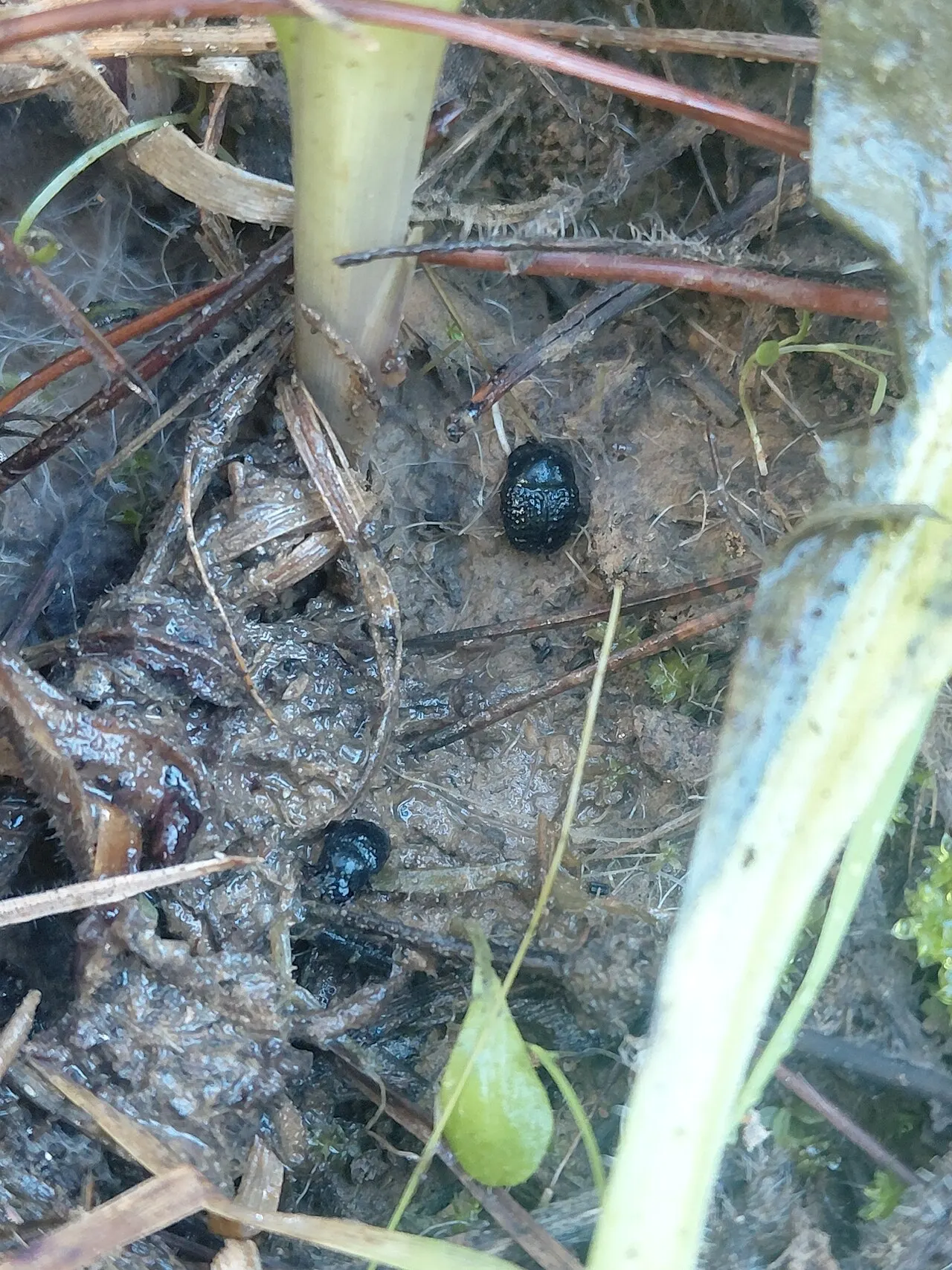
Critically Endangered
Frankenbergerius opacus
Frankenbergerius opacus
Frankenbergerius opacus is a small black scarab beetle recorded from the Western Cape of South Africa and found nowhere else. It was described in 2005 from museum specimens collected at Stellenbosch in 1922. The IUCN Red List published it as Critically Endangered in 2025 because it is known from a single tiny site.
How to recognise it
This is a beetle of about 6 to 7.5 mm. The male holotype is black and shiny, 7.0 mm long and 4.1 mm wide, with tiny setae (hairs) on its back. Other males measure 5.8 to 7.1 mm and females 6.1 to 7.5 mm.
It belongs to a genus of small dark scarabs and resembles two relatives, F. nanus and F. nitidus. The original description separates it by the slightly concave base of the pronotum (the shield behind the head), a small ridge on the pygidium (the exposed tip of the abdomen) and the shape of the male genitalia. The wing cases have matt intervals studded with shiny tubercles, and the front legs have three outer teeth. As in the rest of the genus, the male's front tibial spur is forked, while the female's is simple.
Where it lives
The 2005 revision named Stellenbosch, in the Western Cape, as the only recorded locality. The type series was collected there on 24 May 1922 by a collector labelled Ch. K. Brain and is held at the Natural History Museum in London. One more male, from an unknown locality, sits in the South African national insect collection.
The Red List assessment counts a single location at 228 m elevation and estimates the area of occupancy at 4 to 8 square km. It records the habitat as Mediterranean-type shrubland. GBIF lists five research-grade iNaturalist observations from the Stellenbosch and Drakenstein areas, all dated 2026. The coordinates are blurred, but the records suggest the beetle is still being seen.
Pins are Wikidata “endemic to” fields. Orange dots, when present, are GBIF occurrence tiles — survey bias included.
How it lives
Little is known about this species itself, and its immature stages are undescribed. The genus gives some clues. Frankenbergerius beetles have mostly been collected in dense vegetation among leaf litter and rotting plant matter, and several records link them to mushrooms. Although they belong to the dung beetle subfamily, there is little evidence that they feed on dung or carrion. Nesting has not been studied in any member of the genus.
Why it is in trouble
The assessment lists housing and urban areas, agro-industry farming, and invasive Acacia and Pinus trees as ongoing pressures. It says the effect of the invasive trees is unclear, and it marks the scale and severity of all three as unknown. It does record a continuing decline in habitat area. The species is not known from any protected area, and its population trend is listed as unknown.
What is being done
No conservation actions are listed. The assessment identifies research on population size, distribution and trends, and on life history and ecology, as the priorities.
Sources
Written for this catalog in our own words from the sources below, checked against them on 12 November 2026. Population figures are estimates and carry the year they were made. Status and assessment year: IUCN. 2026. The IUCN Red List of Threatened Species. Version 2026-1. iucnredlist.org.




