Endangered
Fleay's barred frog
Mixophyes fleayi
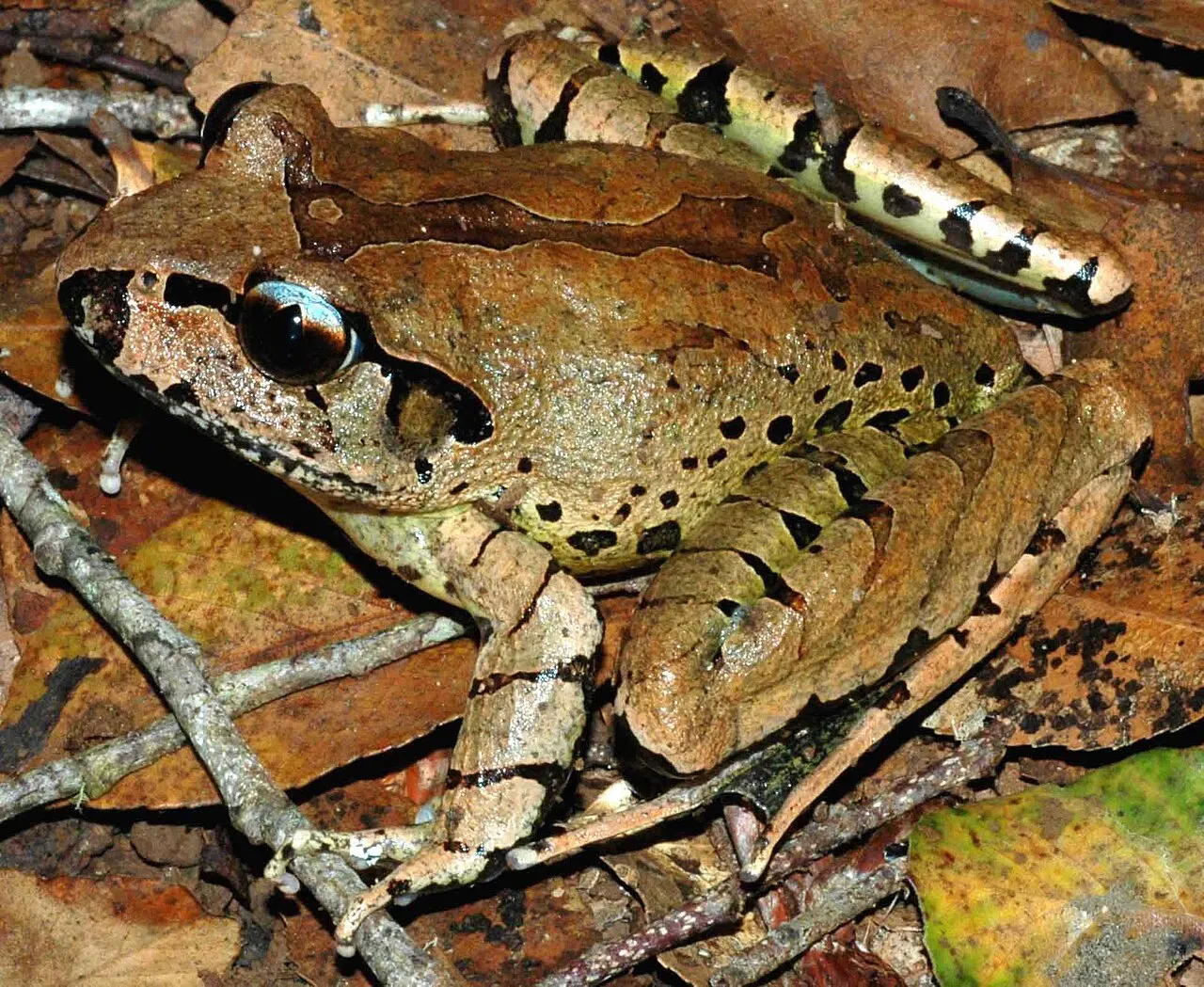
Fleay's barred frog (Mixophyes fleayi) is a big, brown stream frog of the rainforests of northern New South Wales and south-eastern Queensland, Australia. The IUCN Red List assessed it as Endangered in 2023. Chytrid fungus hit it hard, yet some populations have rebuilt, and its eyes are half silvery blue.
How to recognise it
It's a moderately large frog, reaching about 90 mm. The back is light brown with darker blotches and a finely granular texture, and an irregular dark band runs down the back from behind the eyes. The limbs carry seven or eight narrow dark bars, the toes are about three-quarters webbed, and the belly is smooth and pale yellow or white.
The eye is the best clue. The top third of the iris is silvery to pale blue and the lower two-thirds is brown, which is why it is sometimes called the silverblue-eyed barred frog. Three similar barred frogs (the stuttering, great barred and giant barred frogs) overlap with it in places, and eye colour is the most reliable way to separate them.
Where it lives
Its range is a broken chain of wet forest patches from the Conondale Range in Queensland south to Yabbra Scrub in New South Wales. Known sites include the Main Range, Springbrook and Lamington plateaus and Mount Barney in Queensland, and the Border Ranges, Mount Warning (Wollumbin), Nightcap Range, Tooloom Scrub and Yabbra in New South Wales. Most frogs live in rainforest above 400 m, although a few lowland sites are known, and the Red List gives a lower limit of 90 m.
The IUCN estimated its extent of occurrence at about 16,565 square kilometres and its area of occupancy at about 112 square kilometres, with a severely fragmented population. It has vanished from the Bunya Mountains and Mount Tamborine.
Pins are Wikidata “endemic to” fields. Orange dots, when present, are GBIF occurrence tiles — survey bias included.
How it lives
This is a frog of flowing water. It lives beside rainforest creeks and streams, and in neighbouring wet eucalypt forest and Antarctic beech forest. After rain in spring and summer, males call from the leaf litter beside the stream. The female's eggs go into a nest dug in gravel and leaf litter in shallow, flowing water.
Tadpoles grow up to 65 mm and take about 200 days to metamorphose. The young frogs are about 20 mm long and look like small adults, except that their irises are copper red.
Why it is in trouble
Fleay's barred frog began disappearing from Queensland sites in the 1970s, with declines in the north of its Queensland range through the 1980s, and it went extinct locally in at least three places. Chytrid fungus, a disease of amphibians, is the main suspect, and the Red List rates that threat as affecting the whole population. Weed invasion, grazing, recreation and past housing development add smaller pressures. The IUCN lists the population trend as decreasing.
Targeted surveys in the mid to late 1990s found the frog extremely rare, and absent from some known sites.
What is being done
Some of the news is good. A seven-year study published in PLOS ONE in 2013 followed two streams, one in Border Ranges National Park and one in Nightcap National Park, and found numbers had risen by up to tenfold from a very low point, even with chytrid present. Some frogs lived more than six years. A later survey at Brindle Creek in the Border Ranges put adult male numbers at roughly 38 to 46 in 2013 and 2014, against about 53 in 2008, and the survey concluded the population had been relatively stable for about ten years.
In 2022, Matthijs Hollanders and David Newell of Southern Cross University reported on four years of work with 686 microchipped frogs. Frogs were more likely to clear an infection than to catch one, about one in five carried chytrid at any time, and counts of close to 100 frogs compared with up to 15 in the late 1990s. The team hopes to use resistant frogs to reintroduce the species to Wollumbin, where it disappeared in the 1990s. The IUCN notes that the species occurs in protected areas, is monitored systematically and is subject to ex situ conservation.
Sources
Written for this catalog in our own words from the sources below, checked against them on 12 November 2026. Population figures are estimates and carry the year they were made. Status and assessment year: IUCN. 2026. The IUCN Red List of Threatened Species. Version 2026-1. iucnredlist.org.




