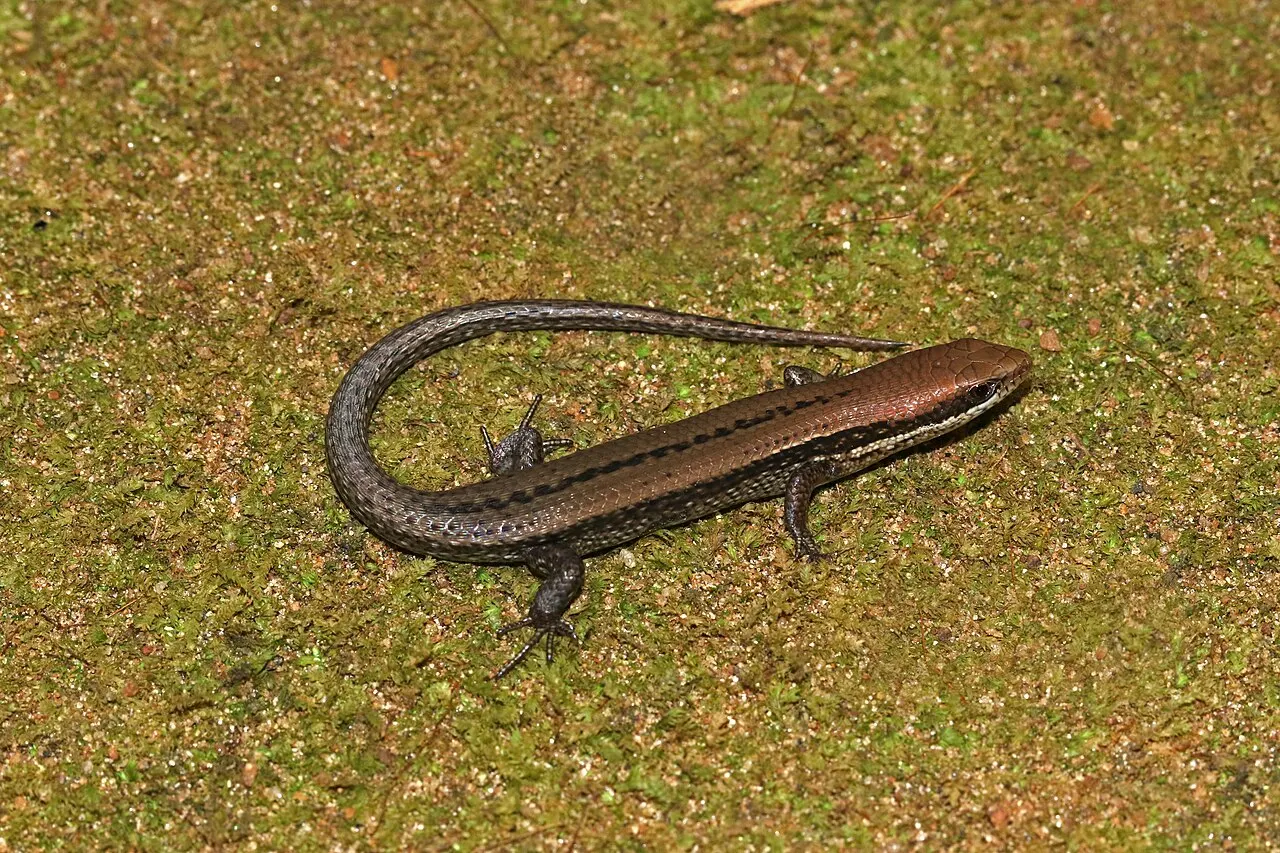
Endangered
Inger's Mabuya
Eutropis clivicola
Eutropis clivicola, the Ponmudi skink or Inger's mabuya, is a small forest skink from the Western Ghats of southern India. It was described in 1984 from Kerala and was first recorded in Karnataka in 2024. The IUCN Red List assessed it as Endangered in 2013.
How to recognise it
The Ponmudi skink grows to about 55 mm from snout to vent. Its scales have five weak keels, the prefrontal scales on the head touch one another narrowly, and it has 17 to 19 broad scales (lamellae) under the fourth toe. A narrow dark stripe runs along the middle of the back, and it is most distinct in larger animals.
Where it lives
The skink was first described in 1984 as Mabuya clivicola, from Ponmudi in Thiruvananthapuram district, Kerala, at about 260 m. It has since been found in many Kerala districts, including most of the north, and at sites such as the Peechi-Vazhani Wildlife Sanctuary (148 to 250 m).
In December 2024 a team from the Zoological Survey of India and Mangalore University found it in the university's botanical garden, on a laterite hillock about 120 m high. In a 2025 paper in Reptiles & Amphibians, Palot and colleagues called these the first confirmed Karnataka records. The nearest earlier records were about 115 km away in Kerala.
The IUCN gives an elevation range of 250 to 800 m, four locations and an extent of about 1,900 km2, and lists moist lowland forest, moist montane forest and plantations as habitat.
Pins are Wikidata “endemic to” fields. Orange dots, when present, are GBIF occurrence tiles — survey bias included.
How it lives
At Mangalore the skinks searched through thick leaf litter for insects by day and vanished into the litter at the slightest disturbance. They were most active in sunny hours, and none was seen active after 4 pm. They were found only in densely wooded parts of the 143 ha campus. The Reptile Database lists the species as egg-laying, though it notes this is inferred rather than observed.
Why it is in trouble
It was rated Endangered because of its limited distribution and few sightings. The IUCN lists roads and railways, mining and quarrying, tourism and recreation areas, industrial-scale farming, and unintended effects of small-scale harvesting as threats. No population estimate exists and the trend is unknown.
What is being done
The assessment lists site and area protection as the conservation action, though it recorded the species as not known from any protected area in 2013. Later records come from protected areas such as Peechi-Vazhani Wildlife Sanctuary and the Aralam Wildlife Sanctuary area, but no species-specific programme turned up in published sources.
Sources
Written for this catalog in our own words from the sources below, checked against them on 12 November 2026. Population figures are estimates and carry the year they were made. Status and assessment year: IUCN. 2026. The IUCN Red List of Threatened Species. Version 2026-1. iucnredlist.org.




