Endangered
Eupsophus migueli
Eupsophus migueli
Eupsophus migueli is a small brown frog of the Chilean coastal forests, known only from the Mahuidanche Range in the south of the country. The IUCN Red List rated it Endangered in 2023 because its forest home keeps shrinking. Males call from stream banks in spring, and the young probably skip the free-swimming tadpole stage.
How to recognise it
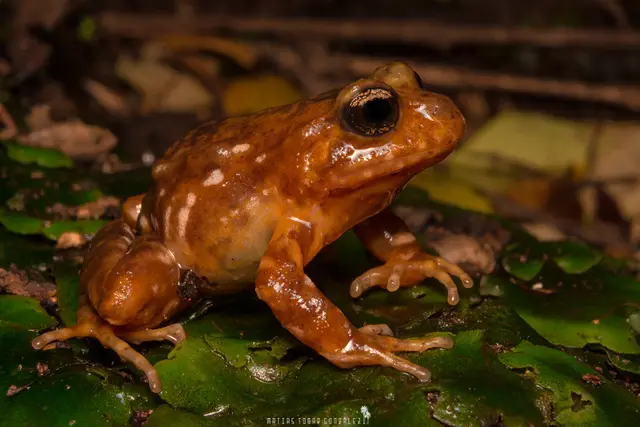
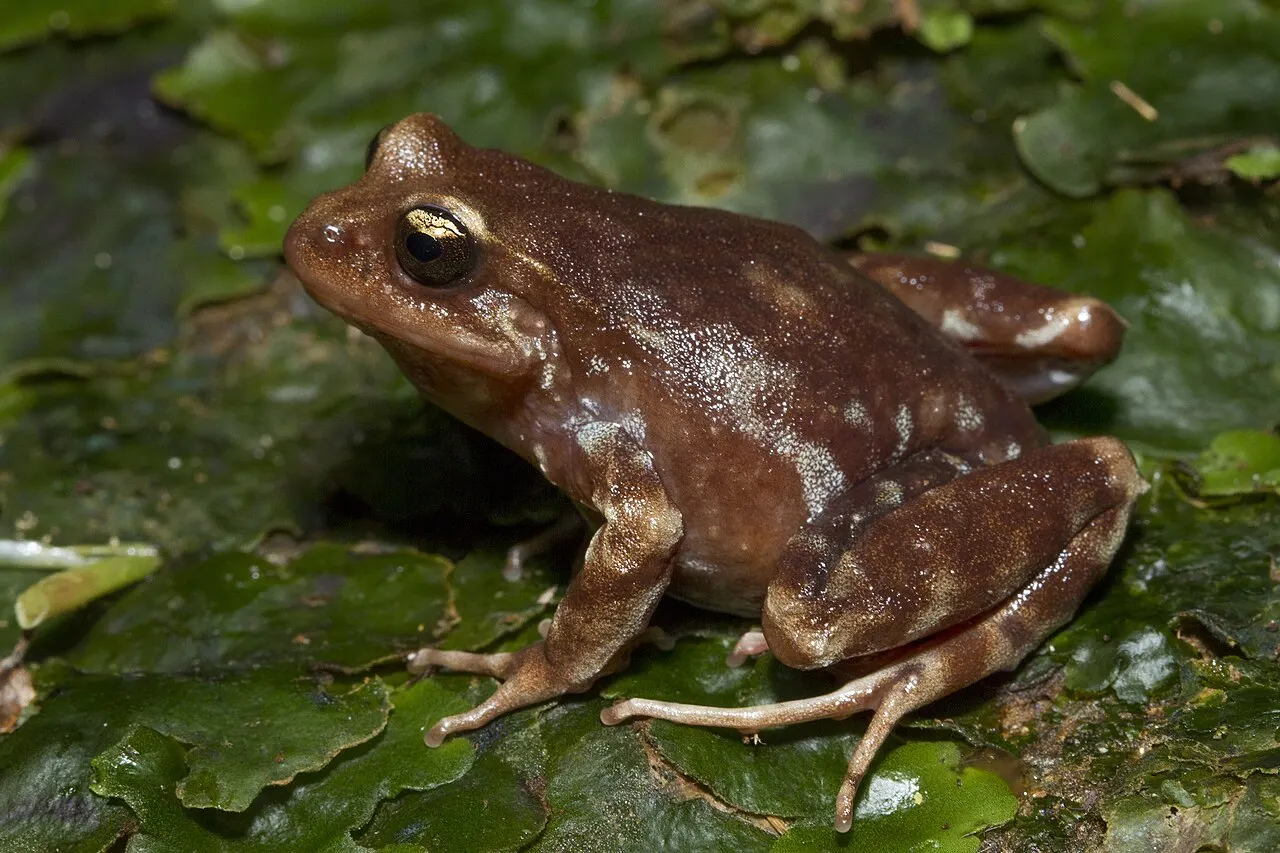
Adults are small, roughly 3.5 to 5 cm long (measurements differ between sources). The back varies a lot between sites, from dark brown to almost entirely yellowish, and animals with reddish or pink backs are also reported. The iris is yellow.
The belly is the better clue. It shows whitish netting over a wine-coloured base, never the plain flesh tone of the related Eupsophus roseus. Two other look-alikes, E. altor and E. calcaratus, also have yellow eyes but a translucent belly instead.
Where it lives
This frog is endemic to Chile. It was described from Quebrada Casanova near Mehuín, and for decades it was known from only a few sites close by, covering no more than about 2.4 square kilometres. Field surveys between 2011 and 2016 found it across a much wider patch of the Mahuidanche Range, adding about 200 square kilometres to its known range to the north, northeast and east. The IUCN's 2023 assessment puts its extent of occurrence at about 260 square kilometres, with records from 30 to 650 m above sea level.
Where its range ends depends on taxonomy. A 2017 study treated the neighbouring E. altor as a synonym of E. migueli, which would have stretched E. migueli south to the Lingue River. Later work, including a 2019 review of the genus, restored both as separate species. The 2020 surveys follow that view and place E. migueli from the Lingue River northward.
Pins are Wikidata “endemic to” fields. Orange dots, when present, are GBIF occurrence tiles — survey bias included.
How it lives
Males call from late winter to the end of October, hidden in moss or among roots on the banks of small streams, usually in swampy ground. Newly metamorphosed froglets of 5 to 10 mm turn up in the same places from early spring. Other frogs in the group, such as E. altor, lay at least 45 to 50 eggs in a ground cavity guarded by the male, and several of them have larvae that develop inside the egg without swimming free. For E. migueli this is inferred from the calling sites and the froglets, not watched directly.
After breeding, the frogs spread away from the streams into the forest. They shelter in leaf litter and under fallen logs and rocks. Surveyors found them in remnant native forest, in regrowing forest, and even in pine plantations that still had a dense native understory. They share the area with other frogs, including Darwin's frog (Rhinoderma darwinii) and E. vertebralis.
Why it is in trouble
The Nothofagus and Valdivian forests of the coastal range have been cleared for farms, pine and eucalyptus plantations, towns and tourist developments. The IUCN also lists livestock grazing and more frequent fire among the pressures. Its habitat is severely fragmented, and the IUCN considers the population to be decreasing.
Chile's own classification also rates it Endangered, and used to add the label 'Rare'. Surveys from 2011 to 2016 found it common at many of its sites, which suggests 'Rare' may have been misapplied. The Endangered rating still holds because the forest it depends on keeps shrinking.
What is being done
The IUCN assessment records that the species does not occur in any protected area, and it lists site protection and habitat protection as the needed actions. The 2020 paper argued that the way pine and eucalyptus are harvested, and how streamside vegetation is managed, could decide whether the frogs persist in working forest.
Sources
Written for this catalog in our own words from the sources below, checked against them on 12 November 2026. Population figures are estimates and carry the year they were made. Status and assessment year: IUCN. 2026. The IUCN Red List of Threatened Species. Version 2026-1. iucnredlist.org.