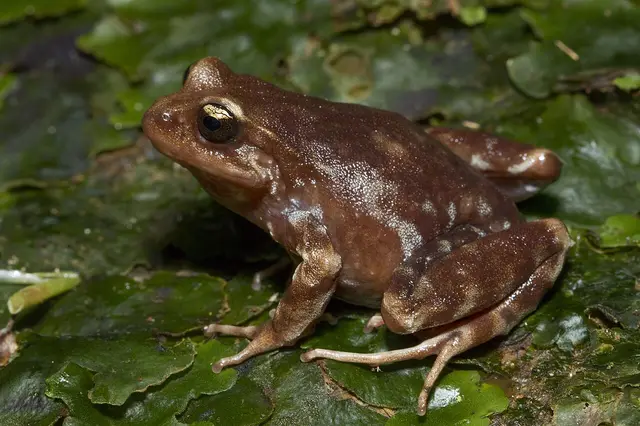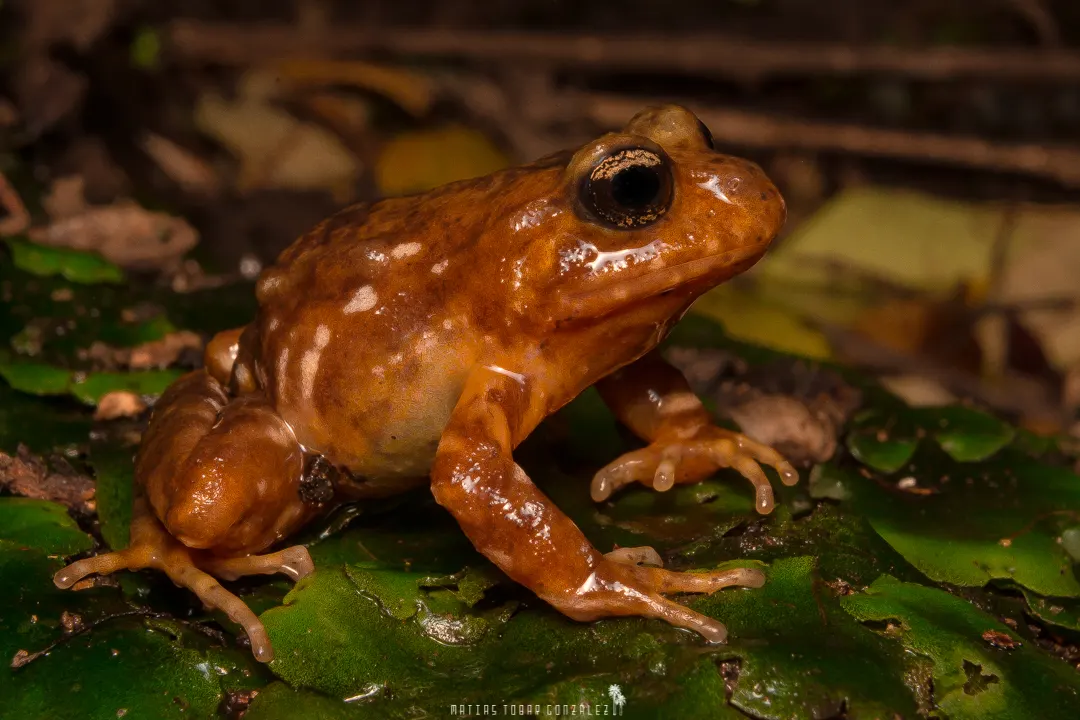
Critically Endangered
Eupsophus insularis
Eupsophus insularis
The Mocha Island ground frog (Eupsophus insularis) is a small forest frog endemic to Chile, centred on Mocha Island off the Biobío coast. The IUCN Red List rates it Critically Endangered (assessed 2019) because its known range is tiny and its forest habitat is shrinking under grazing, farming and introduced predators.
Where it lives
This frog belongs to the family Alsodidae and was first described by Philippi in 1902. The IUCN assessment lists it for the Biobío region of Chile and gives an extent of occurrence of just 25.28 square kilometres, treated as a single location. One reference work reportedly extends its range to the nearby mainland, but the Red List assessment is centred on the island.
It lives in humid temperate forest, and the assessment also lists small seasonal pools and marshes as habitat. A 2021 natural history study in the South American Journal of Herpetology found the frogs in a narrow band between 24 and 205 m above sea level, in pristine forest on gently sloping ground. The IUCN gives a slightly wider elevation range of 20 to 250 m. The frogs have also been reported sheltering under logs, and the IUCN records the species as not migratory.
Pins are Wikidata “endemic to” fields. Orange dots, when present, are GBIF occurrence tiles — survey bias included.
How it lives
The same 2021 study estimated 15 to 66 frogs per hectare of the best habitat, using capture and recapture. Its diet is mostly small invertebrates picked from the forest floor.
Females reportedly lay eggs in small water-filled hollows on hillsides, and the tadpoles are reportedly endotrophic, meaning they live off yolk rather than feeding.
Why it is in trouble
The IUCN lists a decreasing population, with continuing loss of habitat. The threats it names include small-holder grazing and farming, which cause slow but significant declines, along with a second, unspecified human use of the forest. Firewood cutting is reportedly the other main driver, allowed at only a few places on the island and hard to police.
Introduced animals add to the pressure. The assessment names black rats (linked to ongoing slow declines) and domestic dogs, plus a feral cat whose effect is unknown. The 2021 study also reported a high prevalence of chytrid fungus, the disease that has hit frogs around the world, alongside habitat loss as the main concerns.
What is being done
The Red List says the frog occurs in at least one protected area, and much of the island population reportedly falls inside the Isla Mocha Reserve. Site management and action at sub-national level are the conservation actions it lists. The 2021 study aims to help guide management on the island and support stronger responses to current and future threats.
Sources
Written for this catalog in our own words from the sources below, checked against them on 12 November 2026. Population figures are estimates and carry the year they were made. Status and assessment year: IUCN. 2026. The IUCN Red List of Threatened Species. Version 2026-1. iucnredlist.org.