Critically Endangered
Euparkerella robusta
Euparkerella robusta
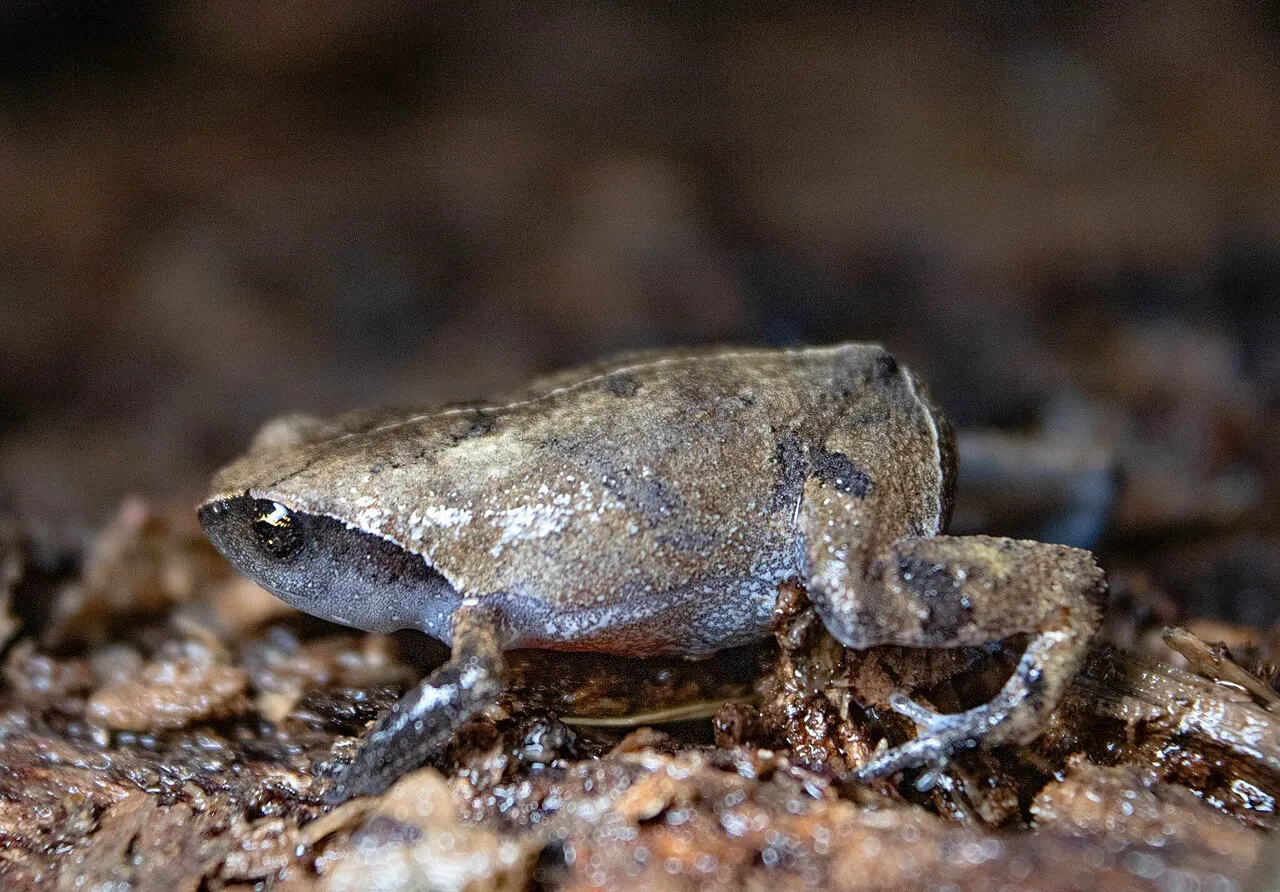
Euparkerella robusta, sometimes called Izecksohn's Guanabara frog, is a small leaf-litter frog of the Atlantic Forest in Espirito Santo, southeastern Brazil. The IUCN Red List rated it Critically Endangered in 2023, with a decreasing population and an extent of occurrence of about 10 square kilometres.
How to recognise it
This is a small, stocky rainfrog. Adult males measure about 17 to 21.5 mm from snout to vent, which makes it one of the larger members of its genus. It looks most like Euparkerella tridactyla, another big species, but has longer fingers. Izecksohn described it in 1988, and a 2015 paper in Zootaxa by Hepp and colleagues treated it as the fifth species in the genus and supplied a key for telling them apart.
The call is a better giveaway than the look. It is a single note made of five to eight long, whistle-like pulses, lasting 1.3 to 2.2 seconds, repeated from time to time. Other Euparkerella give short, snap-like pulses.
Where it lives
It is endemic to Espirito Santo state. The first specimens came from Fazenda Joaquim in Mimoso do Sul, the type locality. The IUCN assessment says a 2011 survey found the frog on a neighbouring farm, Fazenda Fernando, about 5 km to the southwest, and that it no longer occurs at the type locality. The records it cites are from 20 to 70 m above sea level, in moist lowland forest, and it counts one location.
Another source places it in a protected area. A 2018 amphibian survey of the Serra das Torres Natural Monument, published in Biota Neotropica, lists the frog among the reserve's species and describes a population in the Atilio Vivacqua part of the reserve. The reserve covers about 10,450 hectares and the survey sites lay at roughly 600 to 1,000 m. The IUCN assessment, by contrast, records no known protected-area populations and says there are no records inside the park. These accounts conflict and have not been reconciled.
Pins are Wikidata “endemic to” fields. Orange dots, when present, are GBIF occurrence tiles — survey bias included.
How it lives
It lives in leaf litter in both primary and secondary forest and does not occur in degraded or open habitats. Development is thought to be direct, as in related frogs, so eggs hatch as tiny frogs with no tadpole stage and no need for a pond. That ties the frog closely to damp forest floor. Little else is recorded of its biology.
Why it is in trouble
The IUCN assessment rates droughts as the most serious threat, with a high impact and rapid declines, and temperature extremes as a medium one. Small-holder farming and grazing and the unintended effects of small-scale harvesting are listed at lower levels, while large-scale harvesting effects are recorded as past. Like many leaf-litter amphibians, the frog is vulnerable to drying out.
Forest around the type locality has been converted to pasture since the 1960s, which the assessment suspects caused the frog's disappearance there between 1988 and 2011. The Fazenda Fernando population lives in a small forest fragment that could meet the same fate.
What is being done
Listings have changed. An assessment from 2004 rated the frog Vulnerable, and the 2023 assessment moved it to Critically Endangered. The 2018 reserve survey still gave it as Vulnerable under the IUCN and Critically Endangered on the Espirito Santo state list.
The IUCN assessment calls for urgent consideration of a captive assurance population, suggests the type locality as a candidate private reserve, and asks for inclusion in the national action plan for threatened herpetofauna. It also asks for close monitoring of population and habitat trends. The reserve survey recommends limiting pesticide use near the reserve, banning new trails and expanding spring protection.
Sources
Written for this catalog in our own words from the sources below, checked against them on 12 November 2026. Population figures are estimates and carry the year they were made. Status and assessment year: IUCN. 2026. The IUCN Red List of Threatened Species. Version 2026-1. iucnredlist.org.




