Endangered
Eungella torrent frog
Taudactylus eungellensis
The Eungella torrent frog (Taudactylus eungellensis) is a small stream frog found only in the Eungella ranges west of Mackay, Queensland. The IUCN Red List assessed it as Endangered in 2022. It vanished from most streams in the mid-1980s, and the survivors now live with chytrid fungus.
How to recognise it
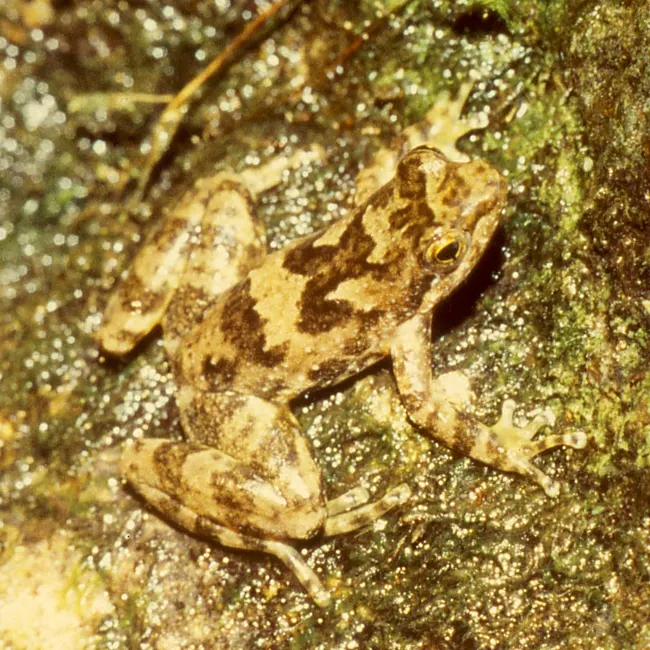
This is a slender frog of up to about 35 mm, with long lean limbs. The back ranges from yellowish tan to dark brown with darker mottling and an X-shaped mark, the belly is yellow, and the irises are golden. The toes end in small pads and have no webbing.
Males make a soft tinkling call that is barely audible over running water, so the frog also signals visually. It waves and flicks its legs, bobs its head and hops, possibly because fast water drowns out calls. Tadpoles are gold-brown with a darker V-shaped mark behind the eyes, and often hide under rocks.
Where it lives
The species occurs only in the mid-eastern Queensland ranges around Eungella. The IUCN counts a single location, with an extent of occurrence and area of occupancy both estimated at 130 square kilometres, down from roughly 550 square kilometres before the decline. It lives at about 190 to 1,050 m, in and beside rocky rainforest streams and wet forest, and is scarce above about 600 m. When alarmed, it jumps into the creek and hides beneath rocks. At least one protected area lies within its range.
Pins are Wikidata “endemic to” fields. Orange dots, when present, are GBIF occurrence tiles — survey bias included.
How it lives
Eggs are laid in small clusters under rocks in creeks or creek pools, and the IUCN gives clutches of about 30 to 50 eggs. FrogID describes breeding as running from spring to autumn, while other accounts say it can happen all year with a peak in November and December.
Why it is in trouble
The frog disappeared from rainforest streams in Eungella National Park in 1985 and 1986, and none were found from 1987 to 1992 despite surveys. Remnant colonies were later estimated at about 5 percent of the original population. The chytrid fungus Batrachochytrium dendrobatidis is believed to be the cause, although the die-off itself was not observed directly.
A 2004 study in PLoS Biology by Retallick, McCallum and Speare followed frogs at six creeks. It found the fungus in 58 of 316 toe clips (18.4 percent) collected between 1994 and 1998, with infection highest in winter (37.8 percent) and lowest in summer (11.3 percent). Infected frogs lived as long as 1,089 days, and survival did not differ consistently between infected and uninfected frogs. The study concluded that the remnants persist with stable infections, not because the fungus went away.
Recovery is limited. After the rediscovery in 1992 the frog turned up at nine sites. Surveys of 114 sites between 2000 and 2015, reported by Meyer and colleagues, found it in many more places, but numbers were typically low and had not clearly risen since the mid-1990s. The IUCN records a decreasing trend and a continuing decline in the population.
What is being done
A recovery plan is in place and conservation sites have been identified over part of the range. The species is listed as Endangered under Australia's national environment law and, reportedly, Queensland's Nature Conservation (Animals) Regulation 2020. The IUCN lists habitat protection, invasive species control, training, captive breeding and reintroduction among the conservation actions needed.
Sources
Written for this catalog in our own words from the sources below, checked against them on 12 November 2026. Population figures are estimates and carry the year they were made. Status and assessment year: IUCN. 2026. The IUCN Red List of Threatened Species. Version 2026-1. iucnredlist.org.




