Endangered
Spanish Greenish Black-tip
Euchloe bazae
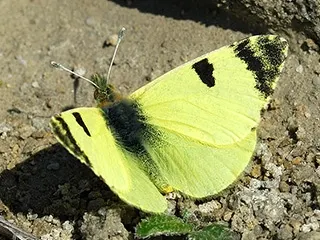
The Spanish greenish black-tip (Euchloe bazae) is a butterfly of the whites and yellows family (Pieridae), found only in Spain, in a few dry, gypsum-rich pockets of Granada and Aragon. The IUCN Red List moved it from Least Concern in 2015 to Endangered in 2025. Adults fly from late winter.
Where it lives
This butterfly is endemic to the Iberian Peninsula, and within Spain it is known from very few places. Two subspecies are recognised, living far apart. Euchloe bazae bazae occurs around the Hoya de Baza in Granada province, in the south. Euchloe bazae iberae lives in the Monegros region and nearby areas of Huesca and Zaragoza, in Aragon, in the north-east.
Both populations favour semi-arid, open ground with a lot of bare earth. Around Baza the vegetation is steppe-like, with esparto grass, retama and rosemary on gypsum-rich soils at roughly 800 to 960 m. In Aragon it is scrub of kermes oak, lentisc and rosemary at around 110 to 330 m. The IUCN lists a total elevation span of 100 to 1,000 m.
Pins are Wikidata “endemic to” fields. Orange dots, when present, are GBIF occurrence tiles — survey bias included.
How it lives
The caterpillars feed on crucifers, and the plant differs by region. Around Baza they use wild rocket (Eruca vesicaria), while in Aragon they feed on Vella aspera, once called Boleum asperum. In 2024 researchers described a third host, Vella pseudocytisus, at a newly found site near Orce in Granada. Females there laid eggs only on that plant (more than 50 observations), even with wild rocket nearby. The larvae are green with whitish hairs that match the plant's own fuzz.
It has one main flight each year, with adults on the wing from about late February to May, depending on the weather. A partial second generation has been recorded only in the south, and a very dry spring in 2023 prevented it. The pupae overwinter and can wait two to three years if conditions are poor. Adults visit rosemary for nectar, and males gather on hilltops, which makes them easy to find at those spots and scarce elsewhere.
Counts are low and variable. Transect surveys in 2013 and 2014 averaged 1.9 adults per kilometre at Baza and 8.3 in Monegros, against 20 to 33 for other butterflies counted the same way in the same areas. A later study in Huesca recorded about 30 per kilometre in 2018.
Why it is in trouble
With so few sites, almost any loss of habitat matters. The IUCN lists conversion of land to farming and plantations, grazing, housing, more frequent fires and dumped rubbish, and it judges the population to be decreasing and severely fragmented. On the ground, researchers have recorded overgrazing by goats and sheep, pine planting, fields converted to irrigation, and scrub taking over abandoned land in Aragon, which crowds out the host plant.
Wind and solar schemes and power lines are now considered the biggest pressures in Granada, where the habitat sits outside Andalusia's protected-area network and much of it is privately owned. One population has already gone. The only known Catalan site, at La Granja d'Escarp near Lleida, has not been relocated since a wildfire in 2003, and Catalonia lists the butterfly as regionally extinct, although a single sighting was reported there in 2017.
What is being done
Spain added the species to its national catalogue of threatened species as Endangered in 2019, after a 2015 request from the ZERYNTHIA butterfly association and the Aragon government. Aragon also lists it regionally, and nearly all its Aragonese habitat lies inside the Natura 2000 network. A Butterfly Conservation Europe recovery plan was drawn up in 2015.
Fieldwork has helped as well as worried. Between 2021 and 2024 surveys raised the known range from 58 to 141 one-kilometre grid squares, and 198 adults were counted in 54 squares in Granada in 2024. A proposed 400 kV power line across the Baza area has been the subject of an impact study and objections, backed by more than 6,000 signatures.
Sources
Written for this catalog in our own words from the sources below, checked against them on 12 November 2026. Population figures are estimates and carry the year they were made. Status and assessment year: IUCN. 2026. The IUCN Red List of Threatened Species. Version 2026-1. iucnredlist.org.




