Endangered
Enyalioides altotambo
Enyalioides altotambo
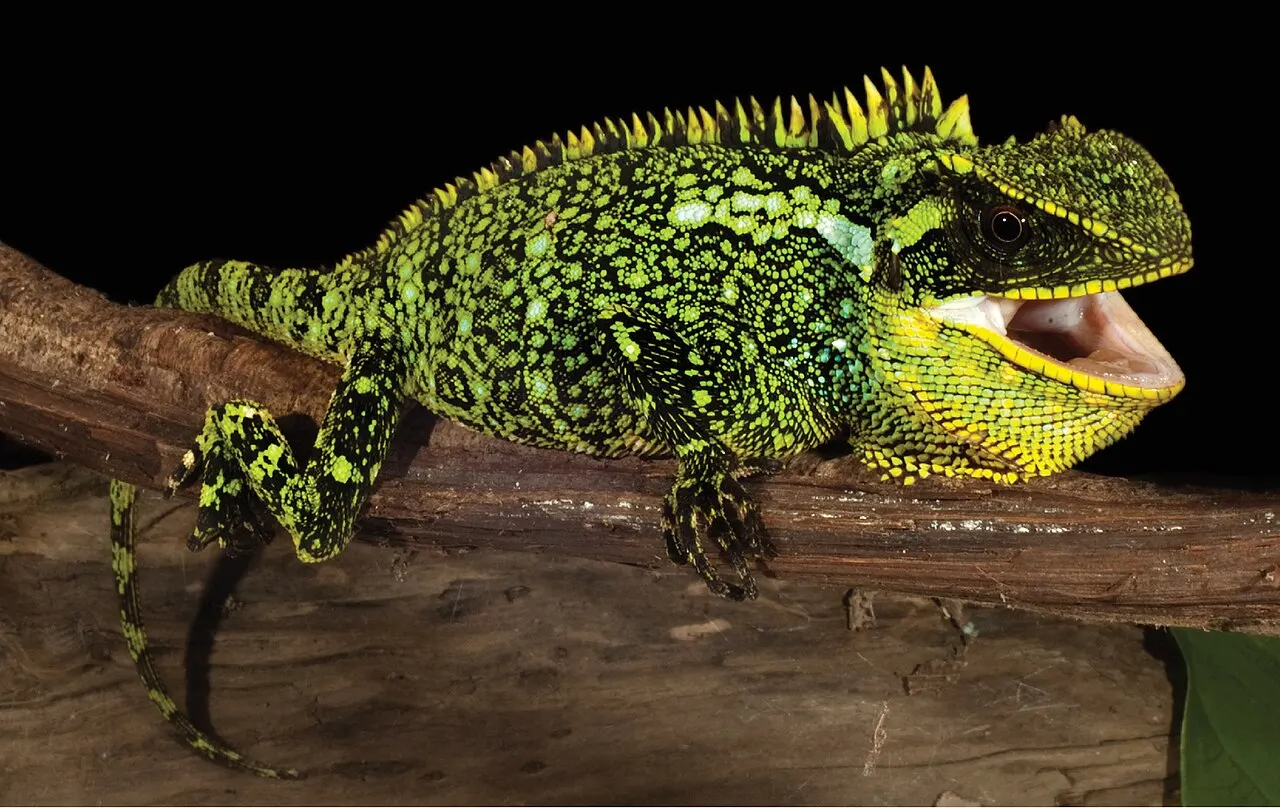
Enyalioides altotambo, the Alto Tambo woodlizard, is a green forest lizard of the family Hoplocercidae, known from just two neighbouring sites in the lowland Chocoan rainforest of northwestern Ecuador. The IUCN Red List assessed it as Endangered in 2021. Only two specimens have been described, and almost nothing is known of its life.
How to recognise it
The first specimen, an adult male, was a striking green animal. Its head was light green with a few black and dark brown scales and yellow scales along the brow and lips. Its back was light green with a fine dark brown net pattern, its tail green with incomplete dark rings, and its chin white. The iris was brown with a golden ring around the pupil.
The only known female looked similar but was larger, with a yellow chin and no black patch on the throat. The male measured 119 mm from snout to vent and the female about 132 to 134 mm (the paper gives both figures). Among woodlizards of the genus Enyalioides, smooth dorsal scales of even size are shared only with E. oshaughnessyi. From that species it differs in having a brown iris, not bright red, and flank scales of nearly even size, without a few enlarged, circular, keeled ones.
A species hiding under another name
Lizards from Alto Tambo were long filed under Enyalioides oshaughnessyi. A 2009 genetic study found that group did not hold together, and a 2011 paper noted that the Alto Tambo animals had a brown iris rather than the bright red seen elsewhere. In 2015 Omar Torres-Carvajal, Pablo Venegas and Kevin de Queiroz described it as a species in ZooKeys, along with two other woodlizards from the Andean slopes of Ecuador and Peru. It is named for Alto Tambo, a village on the Ibarra to San Lorenzo road in Esmeraldas Province.
Where it lives
It is known from two adjacent localities at 620 to 645 m in Chocoan rainforest. The male was collected on 2 May 2010 about 5 km along the road to Placer from Alto Tambo, and the female on 5 November 2005 near the Balthazar River. The IUCN gives a wider elevation band of 260 to 645 m, an estimated extent of occurrence of about 300 square kilometres and four locations. It lists tropical moist lowland forest as the habitat.
Natural history is nearly blank. The female was seen at 5:30 pm with her head pointing up on a tree trunk. Diet and breeding have not been recorded.
Pins are Wikidata “endemic to” fields. Orange dots, when present, are GBIF occurrence tiles — survey bias included.
Why it is in trouble
The 2021 assessment, under criterion B1ab(iii), records a continuing decline in the area of forest it depends on. The threat listed is large-scale harvest with unintended effects, and the stress listed is conversion of the ecosystem. The population trend is listed as unknown, and no population size has been estimated.
What is being done
The IUCN reports that the lizard occurs in at least one protected area. Site and area protection is listed as an action needed. No captive population or targeted programme is on record.
Sources
Written for this catalog in our own words from the sources below, checked against them on 12 November 2026. Population figures are estimates and carry the year they were made. Status and assessment year: IUCN. 2026. The IUCN Red List of Threatened Species. Version 2026-1. iucnredlist.org.




