Endangered
Engystomops coloradorum
Engystomops coloradorum
The Colorado dwarf frog, Engystomops coloradorum, is a tiny frog found only in western Ecuador, on the Pacific lowlands and Andean foothills around Santo Domingo. The IUCN Red List classed it as Endangered in 2023, after earlier Data Deficient listings, because farmland keeps replacing its forest and pools.
How to recognise it
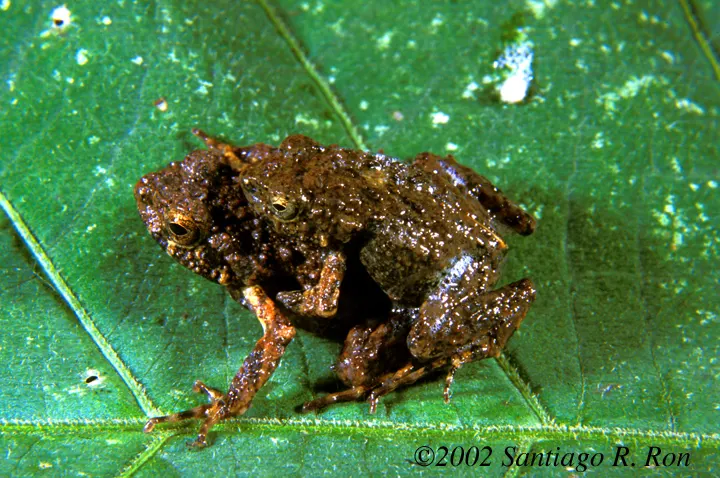
It is a very small frog. Adult males measure 18 to 24 millimetres from snout to vent, and females 22 to 26 millimetres. The back is brown with small tubercles, and larger ones on the head and body. Some frogs have an orange-brown stripe down the rear half of the back.
The belly is black, heavily mottled with white or bluish white. The eye is pale greyish brown or dull bronze with fine black netting. The fingers have no webbing, and the toes are webbed only at the base.
Where it lives
The species is endemic to Ecuador. It occurs in the Pacific lowlands and foothills of the Andes in Pichincha and Santo Domingo de los Tsáchilas provinces. The type locality is Santo Domingo de los Colorados, at about 580 metres above sea level.
The Red List assessment gives an elevation range of 400 to 1,000 metres, an extent of occurrence of about 3,143 square kilometres and five locations. It does not occur in a protected area.
Pins are Wikidata “endemic to” fields. Orange dots, when present, are GBIF occurrence tiles — survey bias included.
How it lives
It lives in moist lowland forest, but it also turns up in rural gardens, pastureland and small seasonal pools and marshes, so it copes with some disturbance. It breeds in small, still bodies of water and builds foam nests. In places it can be abundant, though its overall range is small.
Why it is in trouble
The frog's range sits in a heavily farmed part of Ecuador. The assessment lists farming and grazing, both large-scale and small-holder, among the threats, along with unintentional losses from harvesting. These convert forest into open ground and degrade what is left.
The population trend is decreasing. The frog persists in altered habitat, but assessors in 2023 projected a future reduction of 50 to 70 percent, based on declining habitat area, extent and quality, and gave a generation length of three years. That projection, with its small range, places it in the Endangered category under criteria A3c and B1ab(iii,v). It was listed as Data Deficient in 2004 and 2010.
What is being done
The Red List entry lists site and area protection and management as the conservation actions relevant to the frog, but no protected area is known to hold it. Older literature uses the former name Physalaemus coloradorum.
Sources
Written for this catalog in our own words from the sources below, checked against them on 12 November 2026. Population figures are estimates and carry the year they were made. Status and assessment year: IUCN. 2026. The IUCN Red List of Threatened Species. Version 2026-1. iucnredlist.org.




