Endangered
Elacatinus atronasus
Elacatinus atronasus
The Exuma goby, Elacatinus atronasus, is a small reef fish known only from the Bahamas, where it hovers in groups by coral ledges in Exuma Sound. The IUCN assessed it as Endangered in 2015 because of its very small range and its possible exposure to invasive lionfish.
How to recognise it
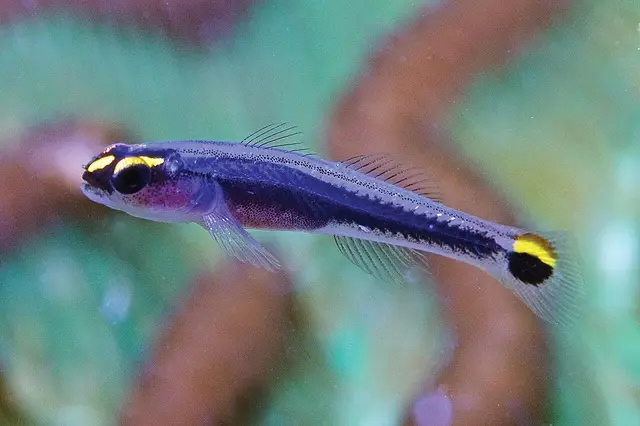
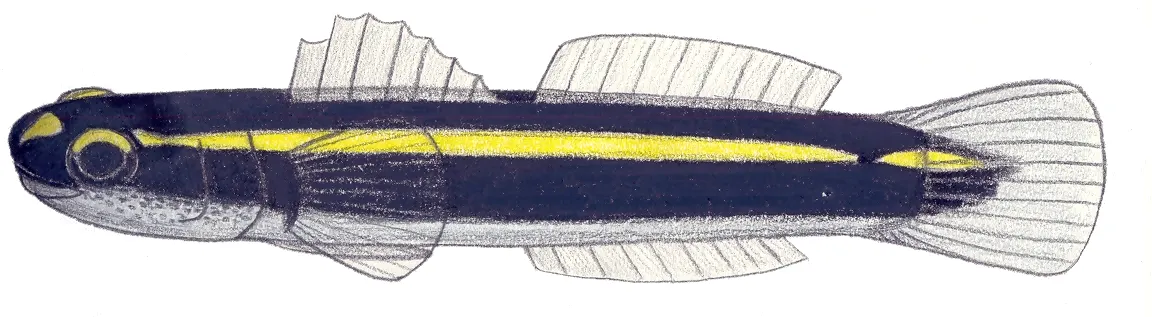
This is a very small goby; the two reference sites that give a size say about 1 cm, which looks low for its genus, so the exact size is uncertain. The front of the head and the snout are black, and a yellow oval spot runs from just ahead of the eye toward the mouth. A yellow stripe extends from above the eye to the base of the tail, and a wide dark band along the side ends in a distinct black oval spot. The back is dusky and every fin except the tail is clear, according to a reef-fish reference.
James Böhlke and C. Richard Robins described it in 1968 as Gobiosoma (Elacatinus) atronasum, from a specimen collected off Long Island, on the Great Bahama Bank, at a depth of about 105 feet. It has since been placed in the genus Elacatinus.
Where it lives
It is found only in the Bahamas, and the IUCN records a single location. Its estimated area of occupancy is 145 square kilometres and its extent of occurrence 17,205 square kilometres (2015). Fish have been recorded at depths of 25 to 35 m on coral reef. Encyclopedic accounts place the population on one reef in Exuma Sound.
It favours vertical reef faces riddled with holes, and undercut ledges.
Pins are Wikidata “endemic to” fields. Orange dots, when present, are GBIF occurrence tiles — survey bias included.
How it lives
Many gobies in this genus are cleaners that pick parasites off larger fish. This one is not. It feeds mainly on drifting zooplankton and lives in large mixed groups, forming schools above the seabed. By day it hovers over the corals, and at night it rests on them. Nothing is known about how it breeds.
Why it is in trouble
Its range is tiny, which alone puts it at risk. The IUCN names an invasive species, the red lionfish (Pterois volitans), as the threat and records the population as decreasing. Lionfish are reported to have spread quickly through the Bahamas, and the IUCN's concern about the goby's exposure to them rests on its small range rather than on measured losses.
A 2012 study in PLoS ONE at nine reefs off New Providence found that lionfish, first sighted there in 2004, cut the combined biomass of 42 small prey fish species by 65 percent between 2008 and 2010. Elacatinus gobies at those reefs, which were never found in lionfish diets, showed no significant change. That study did not cover this species, so how hard lionfish actually hit the Exuma goby is unclear.
What is being done
No conservation actions are recorded for the species. The IUCN notes that no conservation sites have been identified for it and that it is unknown whether it occurs in a protected area. A reef-fish reference states there are no reports of it being kept successfully in captivity.
Sources
Written for this catalog in our own words from the sources below, checked against them on 12 November 2026. Population figures are estimates and carry the year they were made. Status and assessment year: IUCN. 2026. The IUCN Red List of Threatened Species. Version 2026-1. iucnredlist.org.
- IUCN Red List assessment, Elacatinus atronasus (2015)
- FishBase, Elacatinus atronasus
- Reeflex, Elacatinus atronasus
- Catalog of Fishes, California Academy of Sciences
- Green and colleagues 2012, Invasive lionfish drive Atlantic coral reef fish declines, PLoS ONE 7(3)
- Elacatinus atronasus (encyclopedia article)