Endangered
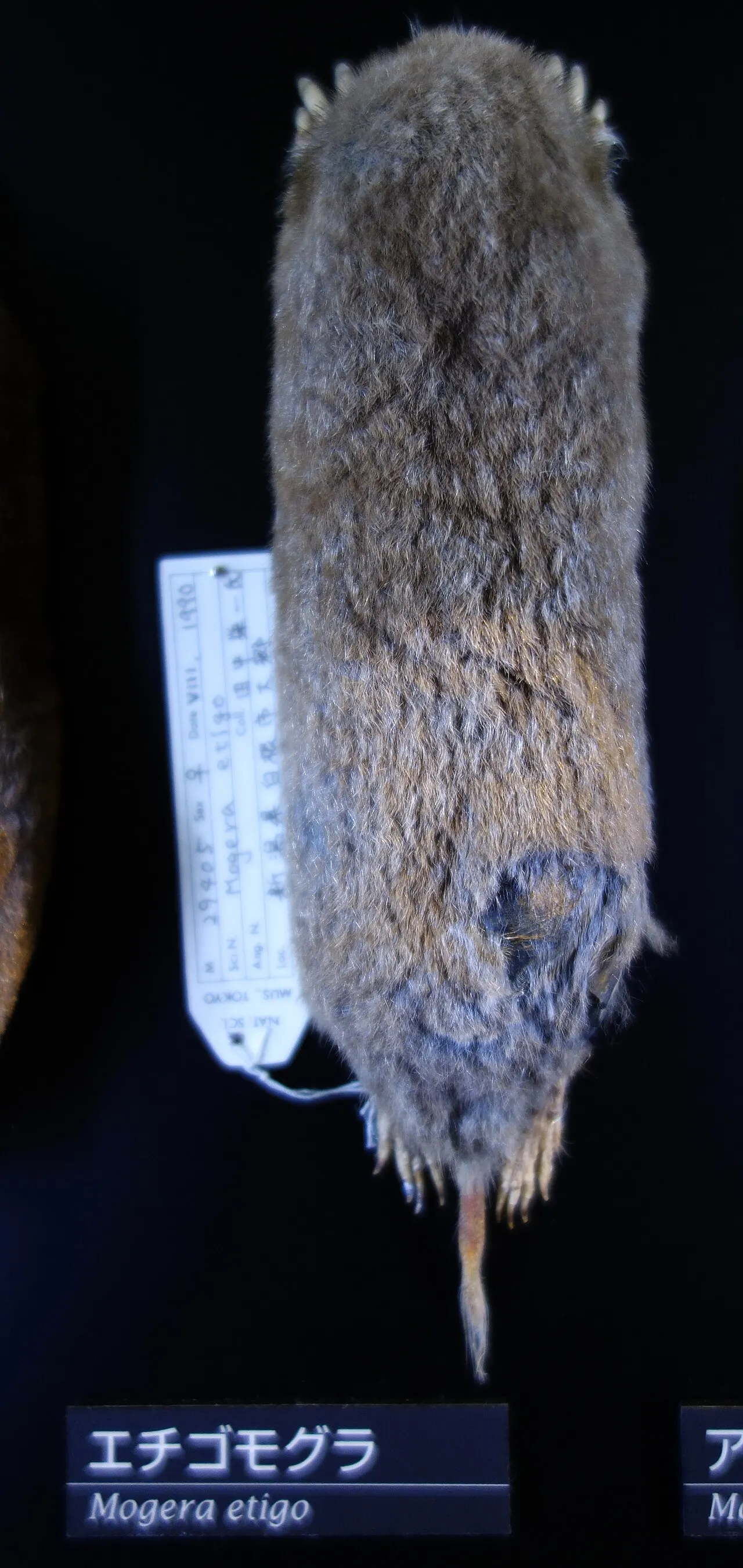
Echigo mole
Mogera etigo
The Echigo mole (Mogera etigo) is a small burrowing mammal found nowhere outside the Echigo Plain of Niigata Prefecture, on Japan's main island of Honshu. It lives mostly in rice paddies. The IUCN Red List rated it Endangered in 2025, as its range shrinks.
Where it lives
The Echigo mole is endemic to Japan, and within Japan it's confined to the flat, low-lying Echigo Plain. The IUCN gives its extent of occurrence as about 1,954 square kilometres, at elevations from sea level to 30 m, in one to five locations. It was described to science only in 1991 by Yoshiyuki and Imaizumi, from a specimen collected at Inugaeshi-shinden in Shirone.
Its range overlaps with that of a close relative, the small Japanese mole (Mogera imaizumii), which is part of the story of its decline.
Pins are Wikidata “endemic to” fields. Orange dots, when present, are GBIF occurrence tiles — survey bias included.
How it lives
This is a mole of farmland. The IUCN lists temperate grassland and arable land as its habitat, and field surveys describe it living mainly in paddy fields. A generation is around two years.
Researchers track it mostly by mapping burrows in paddies and along their edges. Little else has been published about its diet or behaviour.
Why it is in trouble
A burrow survey in three areas of the Echigo Plain in 2011, reported by Abe in Mammalian Science, compared results with surveys from 1995 to 1996 and 2003 to 2005. Near Mitsuke and Tochio the range had held with a small reduction. Around Gosen and Niitsu, parts of the range had vanished or been taken over by the small Japanese mole, and in one paddy field in Niigata City the range had contracted. Abe attributed the first two losses to competition between the two species and to changes in the fields, including deep concrete or iron-plate ditch walls, grassy ditch banks lost to frequent herbicide spraying, and hard gravel farm roads. The Niigata City contraction was put down to habitat change alone.
A 2019 survey of paddy fields by Sato and colleagues, published in 2021, found a similar pattern. In the southern Kounan area of Niigata City the Echigo mole appeared to have vanished from part of its former range, or been displaced, and burrows of the small Japanese mole were recorded there for the first time. In western Gosen, Echigo mole burrows were isolated from one another, and the team warned they could disappear if the habitat changes or the competitor moves in.
The IUCN assessment also lists farming intensification, housing development, herbicides and pesticides, and problem native species among the ongoing threats, though their scale is unknown.
What is being done
The 2025 assessment records that the species doesn't occur in any protected area. The conservation actions it lists are site protection and site management. Because most of the habitat is working farmland, the realistic options involve how paddies, ditches and farm tracks are built and maintained.
Sources
Written for this catalog in our own words from the sources below, checked against them on 12 November 2026. Population figures are estimates and carry the year they were made. Status and assessment year: IUCN. 2026. The IUCN Red List of Threatened Species. Version 2026-1. iucnredlist.org.




