Endangered
Grey skate
Dipturus canutus
The grey skate (Dipturus canutus) is a medium-sized deepwater skate found only off southern and eastern Australia, on the continental slope. The IUCN Red List lists it as Endangered (assessed 2016) because trawl and longline fisheries have probably cut its numbers sharply in the southeast, where it dominated skate catches in surveys.
How to recognise it
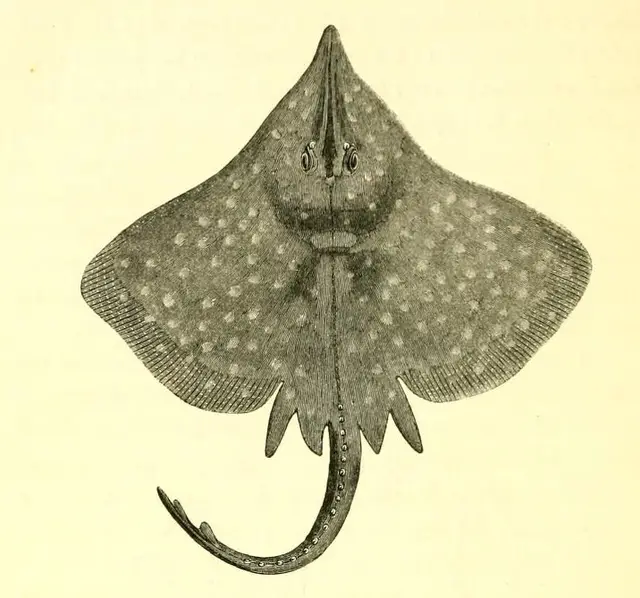
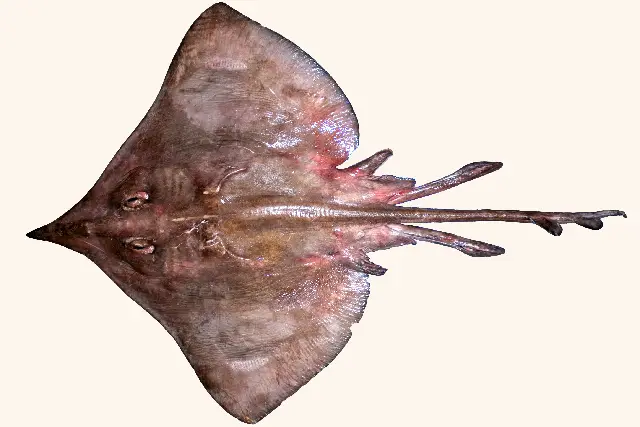
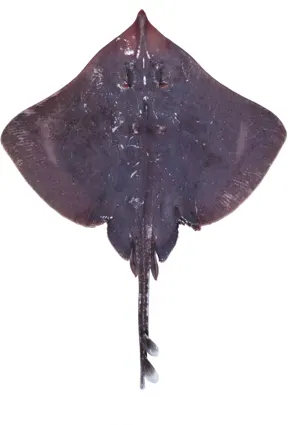
The grey skate is a flat, kite-shaped ray, grey on top and paler grey to whitish underneath, with dark markings around the cloaca, the internasal flap and the chin. The Latin name canutus means grey. It grows to about 90 to 94 cm in total length, depending on the source, which is medium-sized for its genus.
Males reach maturity at roughly 72 cm and females at roughly 77 cm. Peter Last reportedly described the species in 2008 from a specimen collected off Maria Island, Tasmania.
Where it lives
It is endemic to Australia. Its range runs from Crowdy Head in New South Wales, round the south coast, to at least Eucla in Western Australia. The Red List records it in New South Wales, Victoria, Tasmania, South Australia and Western Australia. In Tasmania it occurs from Strahan around to Maria Island but is absent from Bass Strait.
It lives on the bottom of the continental slope at depths of 155 to 1,050 m, most often between 330 and 730 m, over both soft and hard seabed.
Pins are Wikidata “endemic to” fields. Orange dots, when present, are GBIF occurrence tiles — survey bias included.
How it lives
Very little is known. How long it lives is unknown, and no survey has estimated the total population. The Red List gives a generation length of about 12 years, which it uses to measure decline over three generations (36 years).
Why it is in trouble
The grey skate is caught incidentally in trawl and longline fisheries, including Australia's Southern and Eastern Scalefish and Shark Fishery. Surveys on south-east trawl grounds found mean catch rates of deepwater skates fell by 75 to 88 percent over the 20 years from 1977 to 1997, and the grey skate dominated skate catches at depths of 330 to 605 m.
On that evidence, the national report card cites an estimated decline of more than 90 percent over three generations (36 years) in the southeast, about a quarter of its range. The Red List itself records a past reduction in the 50 to 79 percent range.
Pressure elsewhere is lighter. Total catch in the fishery for 2003 to 2019 was estimated at 261 tonnes, and most skates are released, though how many survive release is unknown. A 2021 report reportedly named it as one of four species threatened with extinction by trawling.
What is being done
Fishing deeper than 700 m has been prohibited in the fishery since 2007, giving the skate a refuge at depth. An area south of Coffin Bay in the Great Australian Bight, where grey skates were abundant, was closed to fishing, and Commonwealth marine parks add some further protection. A 2021 risk assessment rated the species at medium risk in the Commonwealth Trawl Sector and low risk in the Great Australian Bight sectors.
The Red List records no species recovery plan and no systematic monitoring scheme. A national report card rates its Australian status as Depleted.
Sources
Written for this catalog in our own words from the sources below, checked against them on 12 November 2026. Population figures are estimates and carry the year they were made. Status and assessment year: IUCN. 2026. The IUCN Red List of Threatened Species. Version 2026-1. iucnredlist.org.