Endangered
Diplomystes nahuelbutaensis
Diplomystes nahuelbutaensis
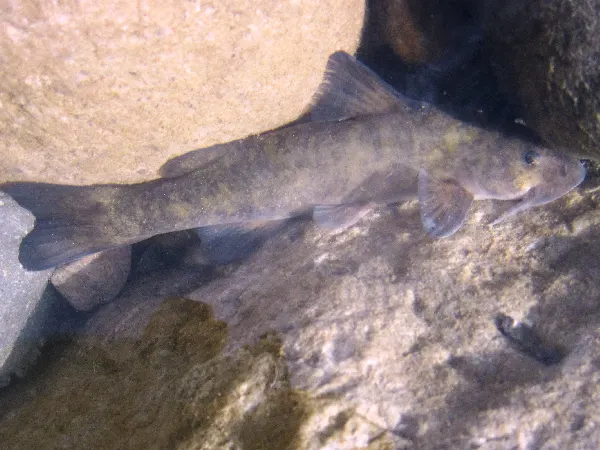
Diplomystes nahuelbutaensis is a velvet catfish, a family some analyses place as the sister group of all other catfishes, found only in rivers of south-central Chile. It grows to about 26 cm and lives on the bottom. The IUCN rated it Endangered in 2023, with a decreasing population.
How to recognise it
Velvet catfishes differ from other living catfish families in having teeth on the upper jaw bone (the maxilla). They also have maxillary barbels and spines in the dorsal and pectoral fins. This species reaches about 26 cm in total length. Its genus name comes from Greek words meaning twice and lip, and Arratia described the species in 1987.
Where it lives
It is endemic to Chile. Its core range is the Biobío River basin, including the Loncomilla River, plus the Imperial River basin and some coastal basins in the Biobío Region. It lives on the bottom of rivers and streams.
A 2020 study in Neotropical Ichthyology (Muñoz-Ramírez and colleagues) reported four juvenile Diplomystes, 3.9 to 7.5 cm long, from two small coastal basins, Laraquete and Carampangue, after surveys between 2014 and 2019. The only earlier coastal record dated from 1919. Mitochondrial DNA placed the fish close to D. nahuelbutaensis of the Biobío basin but showed gene variants not found there.
Pins are Wikidata “endemic to” fields. Orange dots, when present, are GBIF occurrence tiles — survey bias included.
How it lives
Little is known of this species specifically. Velvet catfishes in Chile live mostly on the bottom of fast-flowing streams and eat worms, molluscs and arthropods. Fish of this species have been found with aquatic insect larvae and a freshwater crab-like crustacean (Aegla) in their guts. Breeding occurs at least in the austral summer in the family. FishBase puts its trophic level at about 3.3, which fits a bottom-feeding predator.
The IUCN gives a generation length of about three years.
Why it is in trouble
The 2023 assessment (criteria A2bc+3c+4c) records a decreasing population, a past reduction of about 54 percent and a continuing decline in the area it occupies. Listed threats include soil erosion and sedimentation, nutrient pollution and sewage, plantations and farming, drought, extraction of river water, and both small and large dams.
The 2020 study named the replacement of native forest by exotic tree plantations and farming, and introduced salmonids that compete with and prey on native fish. It also noted that the coastal populations are small and isolated, with a low occupied area.
What is being done
The assessment lists site protection and management, resource and habitat protection, control of problem species, and education among its actions, but records no recovery plan and no systematic monitoring scheme. The 2020 study recommended that the Laraquete and Carampangue populations be classed as Critically Endangered.
Sources
Written for this catalog in our own words from the sources below, checked against them on 12 November 2026. Population figures are estimates and carry the year they were made. Status and assessment year: IUCN. 2026. The IUCN Red List of Threatened Species. Version 2026-1. iucnredlist.org.




