Endangered
Striped Gekko
Dierogekko nehoueensis
The striped gecko, Dierogekko nehoueensis, is a small lizard found only on Grande Terre, the main island of New Caledonia. It lives in forest and shrubland in the north of the island. The IUCN Red List assessed it as Endangered in 2021, with a decreasing population, and nickel mining is among the threats listed.
How to recognise it
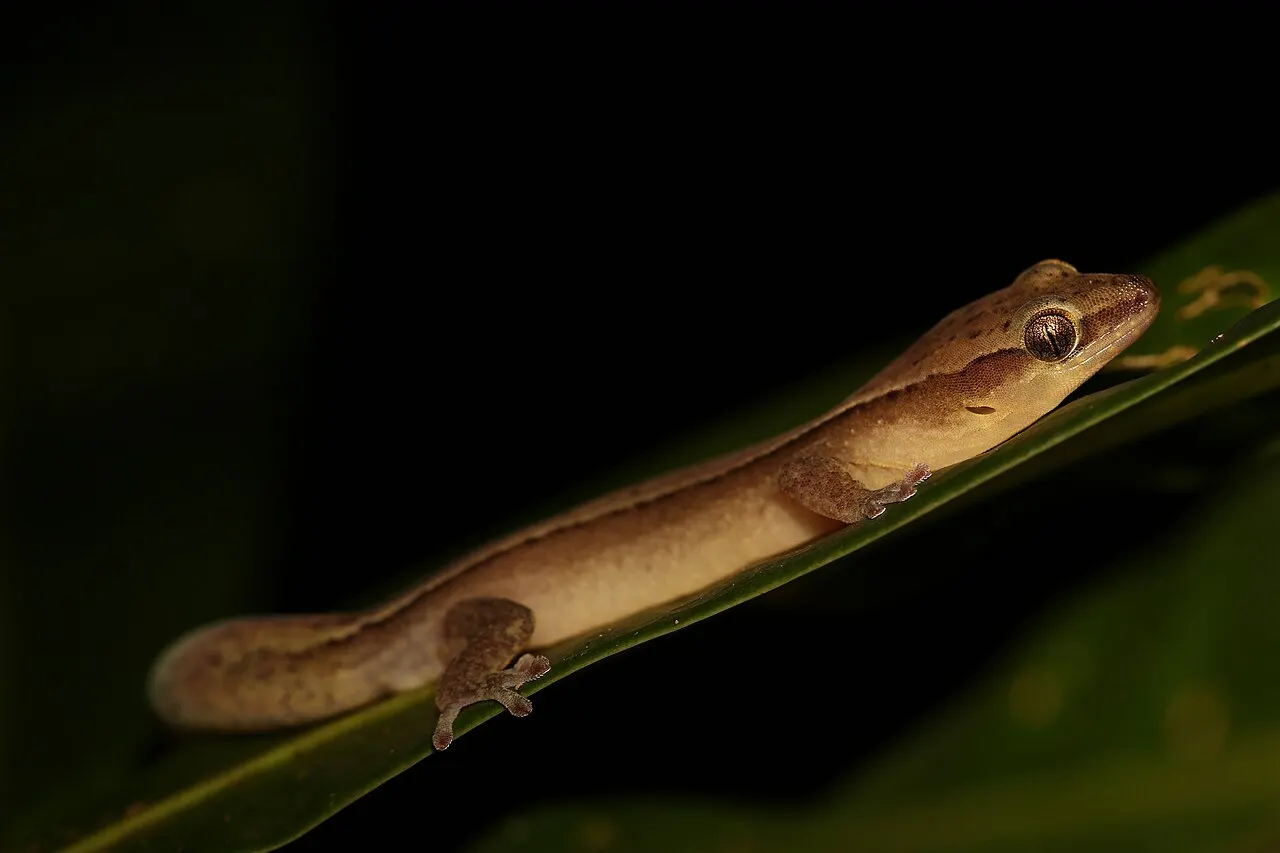
This is a small gecko, reaching about 40 mm from snout to vent. Narrow beige and dark brown lines border a paler back, and a dark brown line runs beside the beige stripe from the lower back onto the base of the tail. Males have pores in front of the vent arranged in two rows.
Where it lives
Dierogekko nehoueensis was described in 2006 by Aaron Bauer and colleagues, who set up the genus Dierogekko in the same paper. The type specimen, an adult male, was collected in January 2003 beside the Néhoué river in Province Nord, at about 5 m above sea level. The name comes from that river.
The Reptile Database lists three localities, and the IUCN assessment counts two locations with an occupied area of about 32 km2. At the type locality the gecko lives in gallery forest, the strip of forest along a river. The IUCN lists moist lowland forest and moist shrubland as its habitat, with an upper elevation of 580 m.
Pins are Wikidata “endemic to” fields. Orange dots, when present, are GBIF occurrence tiles — survey bias included.
How it lives
Where it has been found it appears fairly common, but the range is small and the land is heavily used by people. The species lays eggs, according to the Reptile Database. Diet and breeding have not been well documented in the sources available.
Why it is in trouble
The IUCN assessment records a decreasing population, with the extent and occupied area both still shrinking. Listed threats include mining and quarrying, increased fire frequency and intensity, harvesting of the animal itself, and several problem species.
Habitat loss to operating and planned nickel mines is a major threat across the whole genus Dierogekko, one of the most threatened groups of lizards. Introduced animals such as rats, cats, deer and pigs also damage the humid forest and shrubland the geckos need. An earlier IUCN assessment, in 2011, rated this species Critically Endangered.
What is being done
The assessment lists site and area protection as the conservation action, and notes that the species occurs in at least one protected area. No breeding programme or species-specific project turned up in published sources.
Sources
Written for this catalog in our own words from the sources below, checked against them on 12 November 2026. Population figures are estimates and carry the year they were made. Status and assessment year: IUCN. 2026. The IUCN Red List of Threatened Species. Version 2026-1. iucnredlist.org.




