Critically Endangered
Australian longnose skate
Dentiraja confusa
The Australian longnose skate (Dentiraja confusa) is a flat, egg-laying ray that lives on the seabed off southeastern Australia, from Sydney round to Portland and Tasmania. The IUCN's 2016 assessment rates it Critically Endangered, after trawl fishing cut its numbers by more than 90 percent over three generations.
How to recognise it
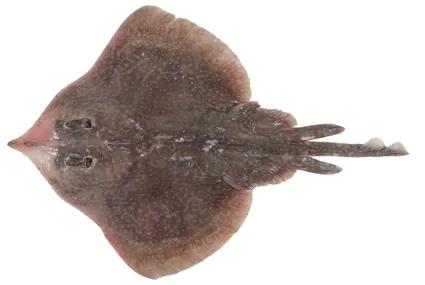
This is a modest-sized skate, growing to about 70 cm in total length. Its back is brownish or yellowish with paler spots, blotches and net-like markings, while the underside is mostly whitish with grey patches and black-edged pores. The disc is weakly four-cornered, the snout moderately long, and the tail short, broad and flattened, with 6 to 14 prominent thorns around the eyes.
A rough patch of small tooth-like scales along the front edge of the underside helps separate it from the whitespotted skate, which lives deeper, has clearer white spots and lacks those scales. Its scientific name was once Dipturus confusus, and the species name reflects earlier mix-ups with other skates. Peter Last described it in 2008.
Where it lives
It is endemic to the temperate waters of southeastern Australia, recorded in New South Wales, Victoria and Tasmania. Reports give its main range as Sydney to Portland. It lives on soft, muddy or sandy bottoms of the continental shelf and slope, and the IUCN also lists hard ground among its habitats.
Depth ranges differ between sources. A fisheries assessment gives 20 to 390 m, and the IUCN and Fishes of Australia reach down to 600 m. Most animals are found shallower than about 120 m, and more than 90 percent of recorded catches come from water shallower than 199 m.
Pins are Wikidata “endemic to” fields. Orange dots, when present, are GBIF occurrence tiles — survey bias included.
How it lives
It feeds on animals on the seabed, particularly crabs and shrimp. It lays eggs, and the young hatch at about 10 cm after 96 to 180 days. Males mature at around 6 years and 47 to 48 cm, females at about 7 years and 52 to 53 cm, and the oldest age estimated is 12 years.
The IUCN uses a generation length of 9.5 years.
Why it is in trouble
The cause is fishing. The skate is caught incidentally, mainly by trawl and less often by longline, gillnet and Danish seine, in the Commonwealth Southern and Eastern Scalefish and Shark Fishery. Surveys from 1977 to 1997 found an 83 percent fall in mean catch rates of deepwater skates there, including this species, and from 1998 to 2004 its standardised catch rate fell by 96 percent.
Over three generations (29 years) the decline works out to more than 90 percent. The species was historically common, and the catch from 2000 to 2006 averaged an estimated 25 tonnes a year, most of it retained.
What is being done
The 2016 assessment lists harvest management and site protection among the actions needed, and records that the skate occurs in at least one protected area. It also records no harvest management plan, recovery plan or monitoring scheme in place.
Fishing pressure in the main fishery has since fallen significantly, and the skate is no longer retained there, although its survival after release is unknown. Part of its range is covered by the South-east Marine Parks Network, which has zoning and gear restrictions, and by Bass Strait, where fishing effort is limited. Australia's fish stocks report card calls the species Depleted. The IUCN still records the population trend as decreasing.
Sources
Written for this catalog in our own words from the sources below, checked against them on 12 November 2026. Population figures are estimates and carry the year they were made. Status and assessment year: IUCN. 2026. The IUCN Red List of Threatened Species. Version 2026-1. iucnredlist.org.




