Critically Endangered
De Winton's golden mole
Cryptochloris wintoni
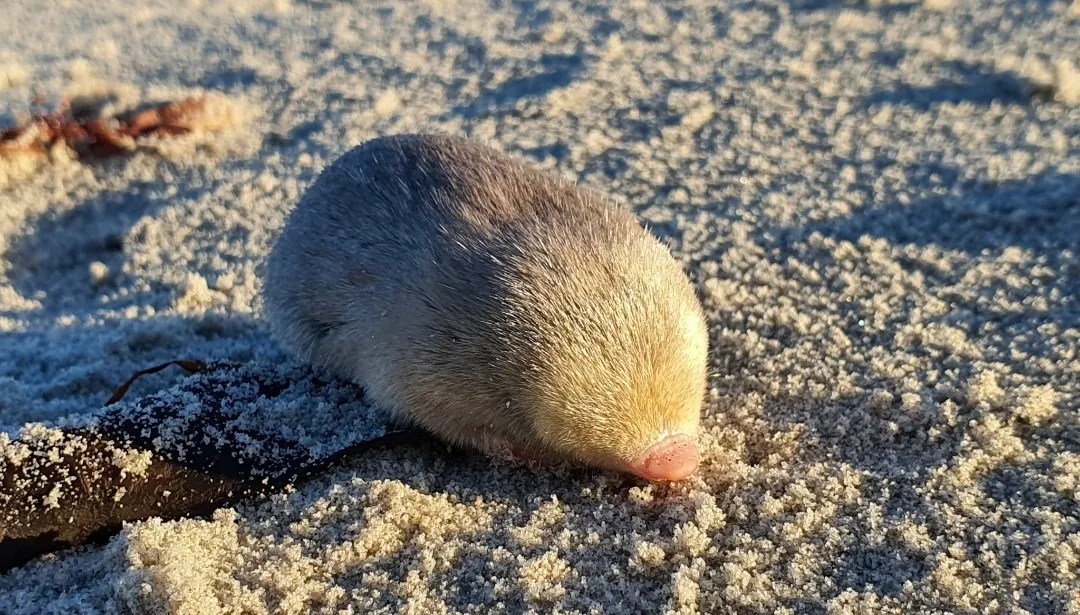
De Winton's golden mole (Cryptochloris wintoni) is a small, blind, sand-swimming mammal from the northwest coast of South Africa. The IUCN Red List rated it Critically Endangered, and possibly extinct, in 2015. In 2023 researchers reported it alive, after more than 80 years without a confirmed record.
How to recognise it
Golden moles aren't true moles. They belong to their own family, Chrysochloridae, and this one is blind. De Winton's has slate-grey fur with a yellowish tinge, strongest on the face, cheeks and lips. The belly is paler. Its coat has an iridescent sheen.
Its forefeet are built for digging. The claw on the third toe is about 10.5 mm long, with shorter claws beside it. It looks a lot like Grant's golden mole, which shares part of its range, and the two may have been confused. Skull shape, an ear bone and vertebra counts show they are separate species.
Where it lives
It is found only in South Africa, in coastal dunes and nearby sandy ground with dry shrubland. Port Nolloth, in the Northern Cape, was the only place it had ever been recorded. The species was described in 1907 and named for the British zoologist William Edward de Winton.
Environmental DNA has since turned up as far south as Lambert's Bay, which suggests a wider range than the old single record implied. Re:wild reported four more populations identified since the 2021 expedition. The IUCN assessment, written before the rediscovery, gives a tiny range of about 8 square kilometres and counts a single location.
Pins are Wikidata “endemic to” fields. Orange dots, when present, are GBIF occurrence tiles — survey bias included.
How it lives
Golden moles spend nearly all of their lives underground, and their only surface sign is usually a ridge over a shallow tunnel. In loose sand those tunnels collapse, so the signs are faint and easy to miss. The animal also eluded trapping, which helps explain why it stayed hidden.
Beyond that, little is known. Nobody has estimated its population size.
The long search
The last confirmed record came from Port Nolloth in 1936 or 1937, depending on the source. Re:wild reportedly named it one of its 25 most wanted lost species in 2017.
In July 2021 a team of five from the Endangered Wildlife Trust spent a week surveying about 300 km of coast, from the Groen River mouth north to Alexander Bay. They collected over 100 soil samples from tunnels and had a border collie trained on other golden moles, whose lack of interest in certain tunnels hinted at something unfamiliar. Matching the DNA took time, because the comparison sequence was not conclusive until a second reference sequence became public in January 2022.
The team then captured one live animal at Port Nolloth and confirmed it by DNA from swabs. Their paper appeared in Biodiversity and Conservation on 24 November 2023, and the rediscovery was announced on 29 November. Mole activity was especially abundant at McDougal's Bay beach.
Why it is in trouble
The IUCN assessment lists housing, commercial and industrial development, mining, tourism and industrial aquaculture as threats, and records that its habitat is still shrinking. Diamond and mineral mining along the west coast has likely caused a substantial decline over the past century, though how large is not measured. The population trend was recorded as unknown in 2015.
At the time of that assessment the animal did not occur in any protected area.
What is being done
The researchers' next steps are more surveys to map where it lives, better protection and management at McDougal's Bay and nearby sites, and finding more sites worth protecting. The Red List entry still carries the 2015 status, written before the rediscovery.
Sources
Written for this catalog in our own words from the sources below, checked against them on 12 November 2026. Population figures are estimates and carry the year they were made. Status and assessment year: IUCN. 2026. The IUCN Red List of Threatened Species. Version 2026-1. iucnredlist.org.




