Endangered
Ctenophila caldwelli
Ctenophila caldwelli
Ctenophila caldwelli is a land snail found only on the island of Mauritius, in the Indian Ocean. William Henry Benson described it in 1859. The IUCN Red List lists it as Endangered, on an assessment from 1996. Little has been published about its biology, and no population count exists.
How to recognise it
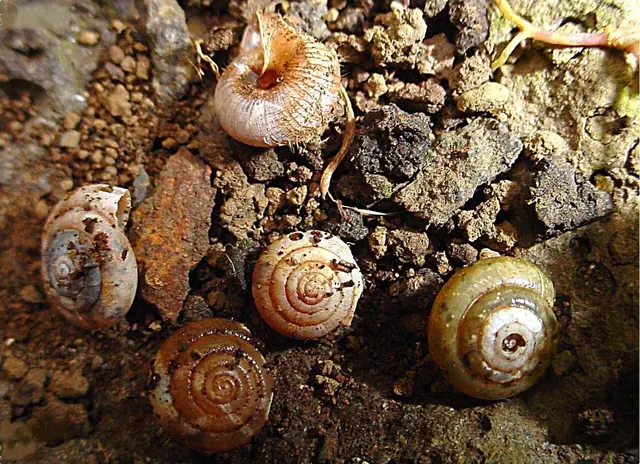
The shell has about 5.7 whorls and is orange-brown and dull rather than glossy. The spire and apex sit slightly raised. The embryonic whorls carry very fine spiral ribs, while the later whorls have strong radial ribs. The rounded whorls form an evenly curved edge, and the umbilicus (the hollow under the shell) is open and moderately wide.
The living animal is dark grey with a white sole on the foot. Most of what is known about its body comes from a single dissected specimen described in a 2010 revision of the family by Hyman and Ponder.
Names and relatives
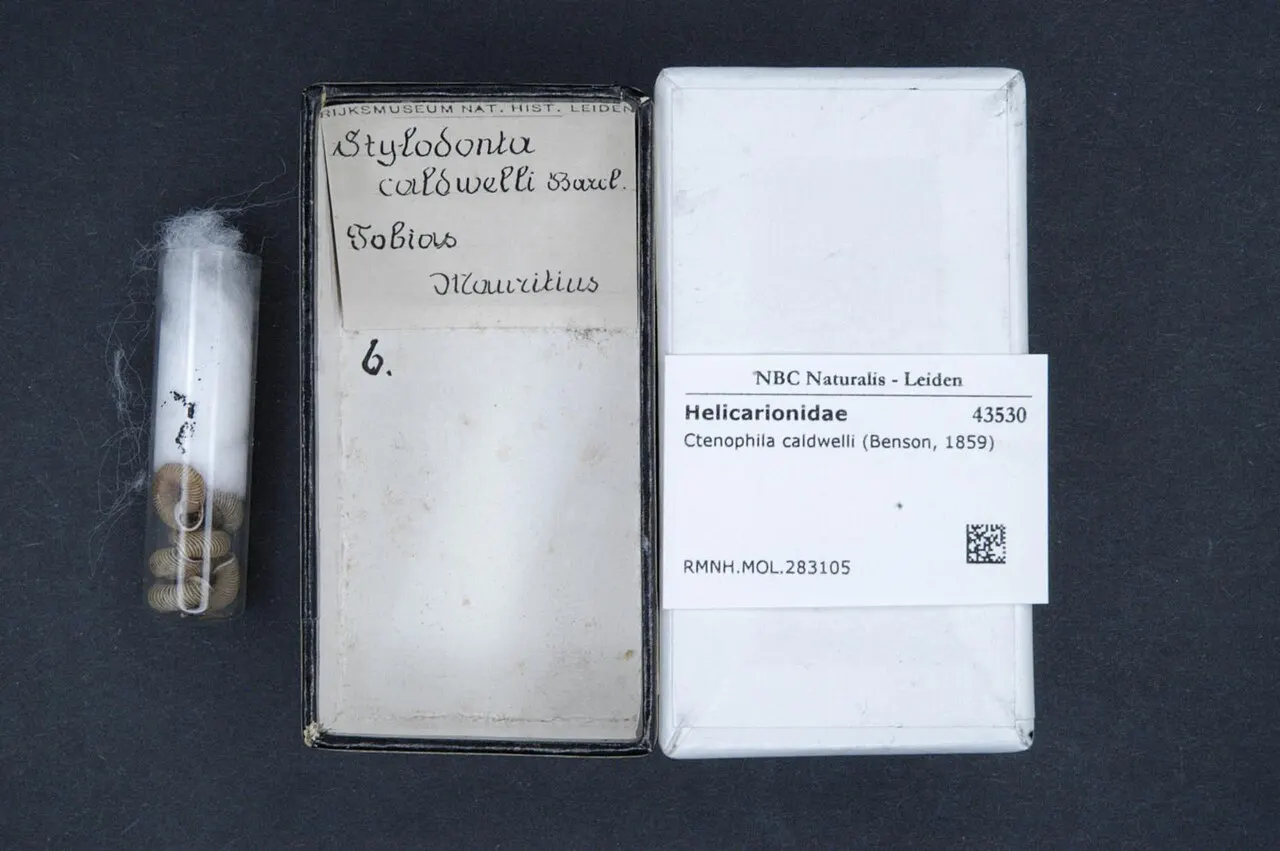
William Henry Benson named it Helix caldwelli in 1859, in a paper on new land shells from Mauritius. It was later moved to Ctenophila, a genus that is endemic to Mauritius and holds two to four species, according to a source cited by Isabel Hyman and Winston Ponder. A later name, Ctenophila planorbina (Germain, 1918), is now treated as the same animal.
It sits in the family Helicarionidae. Hyman and Ponder noted strong similarities with another Mauritian snail, Erepta odontina, and said the two genera might one day be merged, pending further study.
Where it lives
The IUCN records it as native to Mauritius and found nowhere else. The one specimen examined in the 2010 revision came from leaf litter in rainforest at the summit of Le Pouce, collected in 1990 by O. L. Griffiths and K. Emberton.
Pins are Wikidata “endemic to” fields. Orange dots, when present, are GBIF occurrence tiles — survey bias included.
Why it is in trouble
The 1996 assessment placed it in the Endangered category under criteria B1+2a, which concern a small range. It lists no threats, population numbers or trend.
The wider picture on Mauritius is clearer. A captive-breeding protocol from La Vanille Nature Park counts 125 native land snail species on the island, 81 of them endemic. It says 36 of those 81 (44 percent) have gone extinct since people arrived. It names habitat destruction and invasive animals as the main causes, including the rosy wolf snail, toads, rats, tenrecs and pigs. These are general pressures on Mauritian snails, not findings about this species alone.
What is being done
The La Vanille protocol lists C. caldwelli among seven focal snails for captive breeding. It sets a target of 250 adults per species, kept in outdoor enclosures with leaf litter, palm fronds and rocks. Local experts Owen Griffiths and Vincent Florens rated the snail Critically Endangered in 2006, though that rating is informal and not an IUCN listing. The protocol is a plan, and it reports no breeding results.
Sources
Written for this catalog in our own words from the sources below, checked against them on 12 November 2026. Population figures are estimates and carry the year they were made. Status and assessment year: IUCN. 2026. The IUCN Red List of Threatened Species. Version 2026-1. iucnredlist.org.