Critically Endangered
Crossodactylus dantei
Crossodactylus dantei
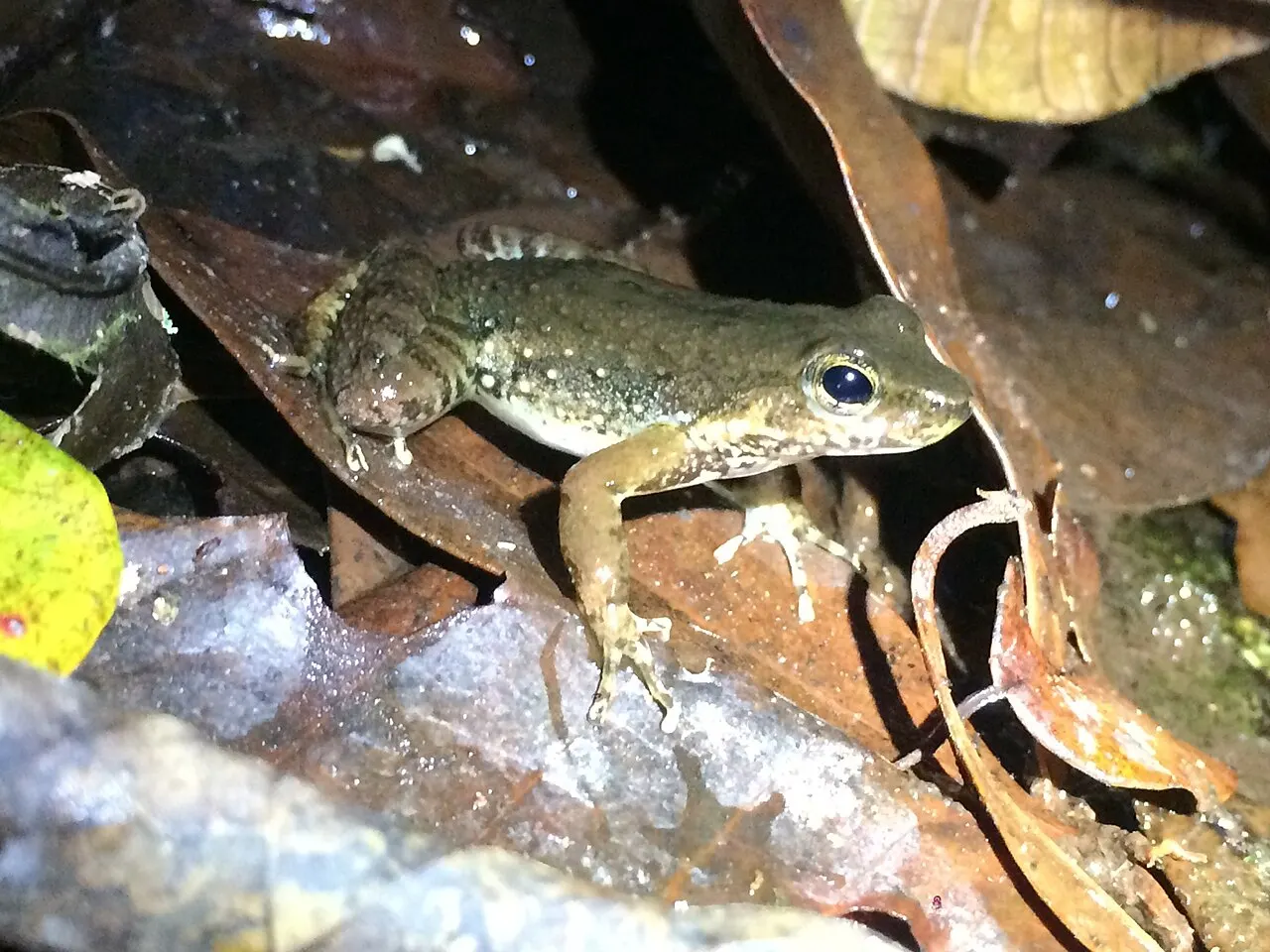
The Murici spinythumb frog (Crossodactylus dantei) is a small stream frog from one forest patch in Alagoas, north-east Brazil. It is the only member of its family known from the northern Atlantic Forest. The IUCN Red List rated it Critically Endangered in 2023, based on a range of just a few square kilometres.
Where it lives
Carcerelli and Caramaschi described the frog in 1993. It is known only from the municipality of Murici in Alagoas, and its type locality lies in the Murici Ecological Station, at about 551 m above sea level. The Red List gives an elevation range of 400 to 600 m, with Alagoas as its confirmed state and nearby Bahia listed as uncertain.
A 2024 paper in the Herpetological Journal puts its range at only 8 square kilometres and says it has been recorded from two streams. The Red List estimates its extent of occurrence and area of occupancy at 4 square kilometres each, in a single location.
Pins are Wikidata “endemic to” fields. Orange dots, when present, are GBIF occurrence tiles — survey bias included.
How it lives
Its relatives in the family Hylodidae are daytime frogs that live along streams in the Atlantic Forest, and this one fits the pattern. The Red List lists lowland moist forest and permanent streams, including waterfalls, as its habitat.
For years almost nothing was known about its biology beyond the adult description. The species went unrecorded from 1988 to 2012. Fieldwork between December 2012 and December 2013 at the type locality produced the first descriptions of its tadpoles and calls. On 31 May 2013 a male was seen calling above half-submerged leaves at the edge of a small permanent stream.
The advertisement call is a series of about 23 pulsed notes lasting around 2.5 seconds, at a dominant pitch near 3,356 Hz. Males also give a longer territorial call of roughly 23 seconds. The tadpoles measured about 43 mm in total length on average. DNA work placed the frog as a sister to a pair of related species, Crossodactylus gaudichaudii and Crossodactylus timbuhy.
Why it is in trouble
With so small a range, one bad event could do serious harm. The Red List records continuing decline in the habitat area and lists small-holder and industrial farming, housing, grazing, more frequent fires, and some small-scale harvest-related disturbance as threats. Its listing rests on criteria B1ab(iii)+2ab(iii).
Population size has not been estimated. The Red List calls the population trend stable. An older 2004 assessment had listed the frog as Data Deficient, so the picture has changed as more has been learned.
What is being done
The frog's known home lies inside a protected area, the Murici Ecological Station, and the Red List lists site protection and site management among its conservation actions. Researchers at the Federal University of Alagoas published the 2024 work on its calls and larvae, which gives later surveys a baseline to compare against.
Sources
Written for this catalog in our own words from the sources below, checked against them on 12 November 2026. Population figures are estimates and carry the year they were made. Status and assessment year: IUCN. 2026. The IUCN Red List of Threatened Species. Version 2026-1. iucnredlist.org.




