Endangered
Crenicichla hu
Crenicichla hu
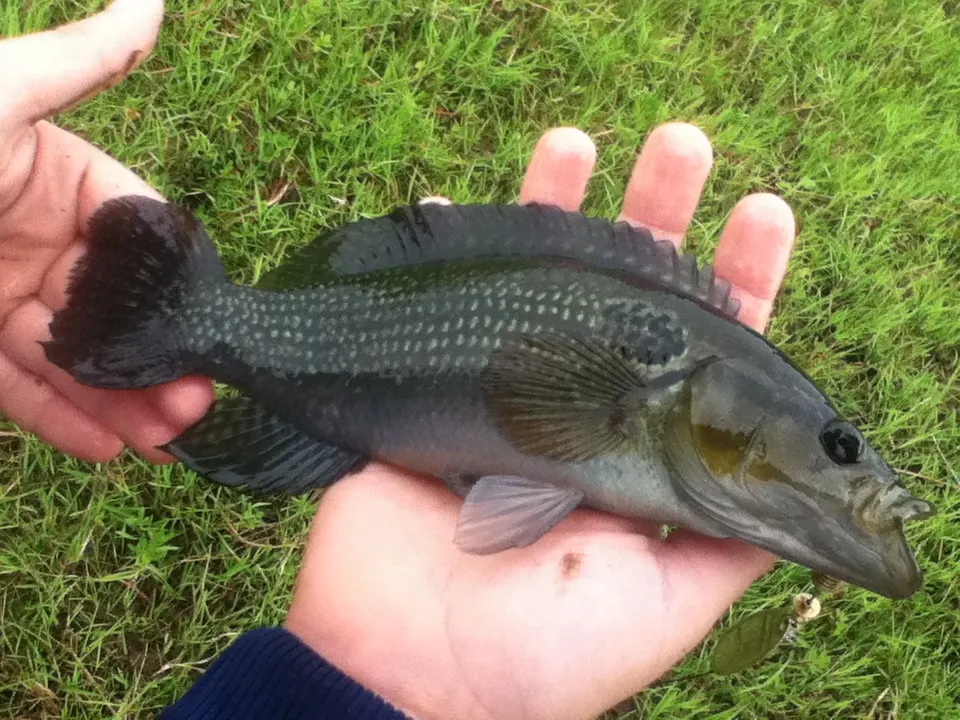
Crenicichla hu is a dark pike cichlid known from a single stream, the arroyo Piray-Miní in Misiones province, northeastern Argentina. The IUCN Red List assessed it as Endangered in 2022. The largest known fish was a 15.3 cm male, and the species was only described to science in 2010.
How to recognise it
This is a slim, elongate cichlid with a short, bluntly pointed snout and a slightly protruding lower jaw. Its colour is the giveaway. The body and fins are dark grey or dark brown, sometimes nearly black, and live fish lack almost all the bright colours many cichlids have. Seven to nine irregular black blotches run along each flank, and a black spot sits on the tail fin above its midline.
Adult females have a dorsal fin patterned with wide black and white stripes or blotches, and some show a faint orange patch behind the pectoral fin. The type specimens ranged from 7.7 to 15.3 cm in standard length, the largest being a male.
Where it lives
The only known home of the species is the arroyo Piray-Miní, a left-bank tributary of the río Paraná in Misiones. The type specimens were collected there in November 2007 at about 26 degrees 20 minutes south. The stream has clear, fast-flowing water 0.2 to 1.4 m deep, a bed of mud, sand and mostly stones, and only patches of submerged plants.
The Red List treats the fish as occurring at a single location, at about 475 m above sea level, with an estimated extent of occurrence of roughly 1,989 square kilometres. A 2002 study cited in the original description found Misiones has the highest rate of endemism among Argentina's freshwater fish regions. Crenicichla hu, C. tesay and C. yaha are the Crenicichla known only from there.
Pins are Wikidata “endemic to” fields. Orange dots, when present, are GBIF occurrence tiles — survey bias included.
How it lives
Very little has been published on its diet, breeding or behaviour. Genetic work in the original description placed it at the base of a group of Crenicichla endemic to the Misiones part of the Paraná basin, alongside C. tesay, C. yaha and C. mandelburgeri.
Its closest DNA match, C. mandelburgeri, differed by at least 3.3 per cent in the ND2 gene. That is more than the 0.6 to 1.0 per cent gaps found between some other species pairs in the study.
Why it is in trouble
The 2022 assessment (criterion B1ab(iii)) rests on a tiny range and continuing decline in the area of its habitat. Listed threats include small-holder and industrial farming, pesticides and herbicides, mining and quarrying, roads and railways, dams, sewage, and housing and commercial development. Subsistence or small-scale harvest is also recorded. The population trend is unknown, and no population estimate has been made.
What is being done
The assessment lists site protection and site management as needed actions, and records no conservation measures currently in place. With one stream holding the whole species, keeping that catchment clean and intact is the central need.
Sources
Written for this catalog in our own words from the sources below, checked against them on 12 November 2026. Population figures are estimates and carry the year they were made. Status and assessment year: IUCN. 2026. The IUCN Red List of Threatened Species. Version 2026-1. iucnredlist.org.




