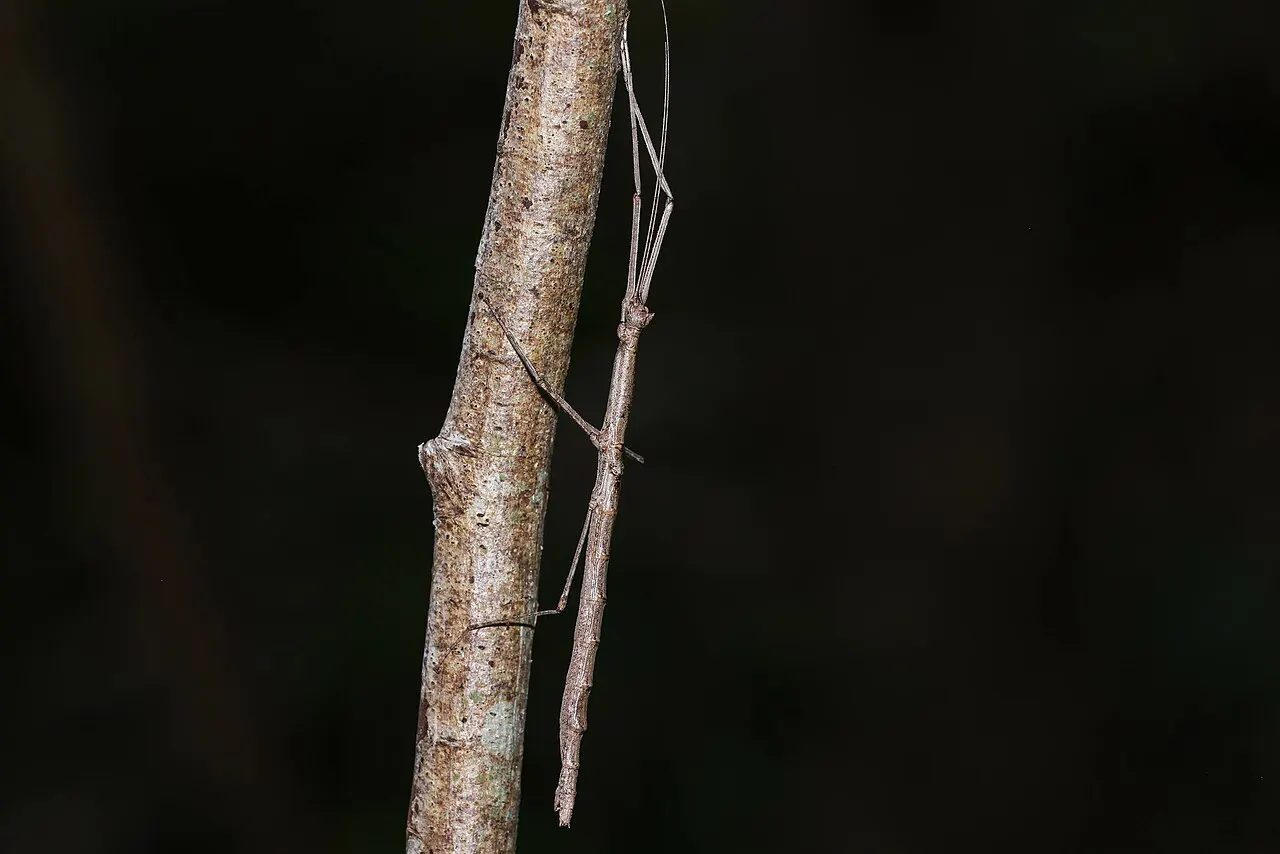
Critically Endangered
Lord Howe Horn-headed Stick-insect
Cornicandovia australica
The Lord Howe horn-headed stick-insect (Cornicandovia australica) is a stick insect known only from Lord Howe Island, in the Tasman Sea off eastern Australia. The IUCN Red List lists it as Critically Endangered (2018) and tags it as possibly extinct, because its last record dates from about 1900.
What is known about it
The entomologist Josef Redtenbacher described this insect in 1908, in a work on stick insects co-authored with Brunner von Wattenwyl, under the name Parasosibia australica. It is now accepted as Cornicandovia australica, in the family Lonchodidae.
Beyond its naming, almost nothing is on record. The Atlas of Living Australia shows no description for it, no images and no occurrence records. No published account of its habits, diet or habitat exists in the sources consulted.
Where it lived
The only locality on record is Lord Howe Island, New South Wales, and the last record is dated to about 1900. A database of recently extinct species lists it as missing.
Pins are Wikidata “endemic to” fields. Orange dots, when present, are GBIF occurrence tiles — survey bias included.
About the island, and why the cause is unclear
Lord Howe Island is small, about 14.5 square km, roughly 10 km long and 0.3 to 2 km wide, and lies around 600 km east of Port Macquarie. It became a World Heritage Site in 1982.
Black rats reached the island in 1918, when the supply ship SS Makambo ran aground. They wiped out several endemic birds and may have harmed the island's other stick insect, the much better-known Lord Howe Island stick insect (Dryococelus australis), which was not found after 1920.
The horn-headed species was last recorded roughly two decades before the shipwreck, so rats cannot be shown to explain its disappearance, and no cause is documented. Its habitat and population trend are likewise undocumented in the available sources.
What is being done
No conservation action aimed at this insect is recorded. Rat eradication on the island is relevant to any insect that might survive there: the island was considered rat-free as of October 2023, and birds, insects and plants have reportedly recovered to levels not seen in decades.
The Lord Howe Island stick insect survived on Ball's Pyramid, a sea stack about 23 km southeast, where 24 living insects were found in 2001. No equivalent survivor has been found for the horn-headed species.
Sources
Written for this catalog in our own words from the sources below, checked against them on 12 November 2026. Population figures are estimates and carry the year they were made. Status and assessment year: IUCN. 2026. The IUCN Red List of Threatened Species. Version 2026-1. iucnredlist.org.




