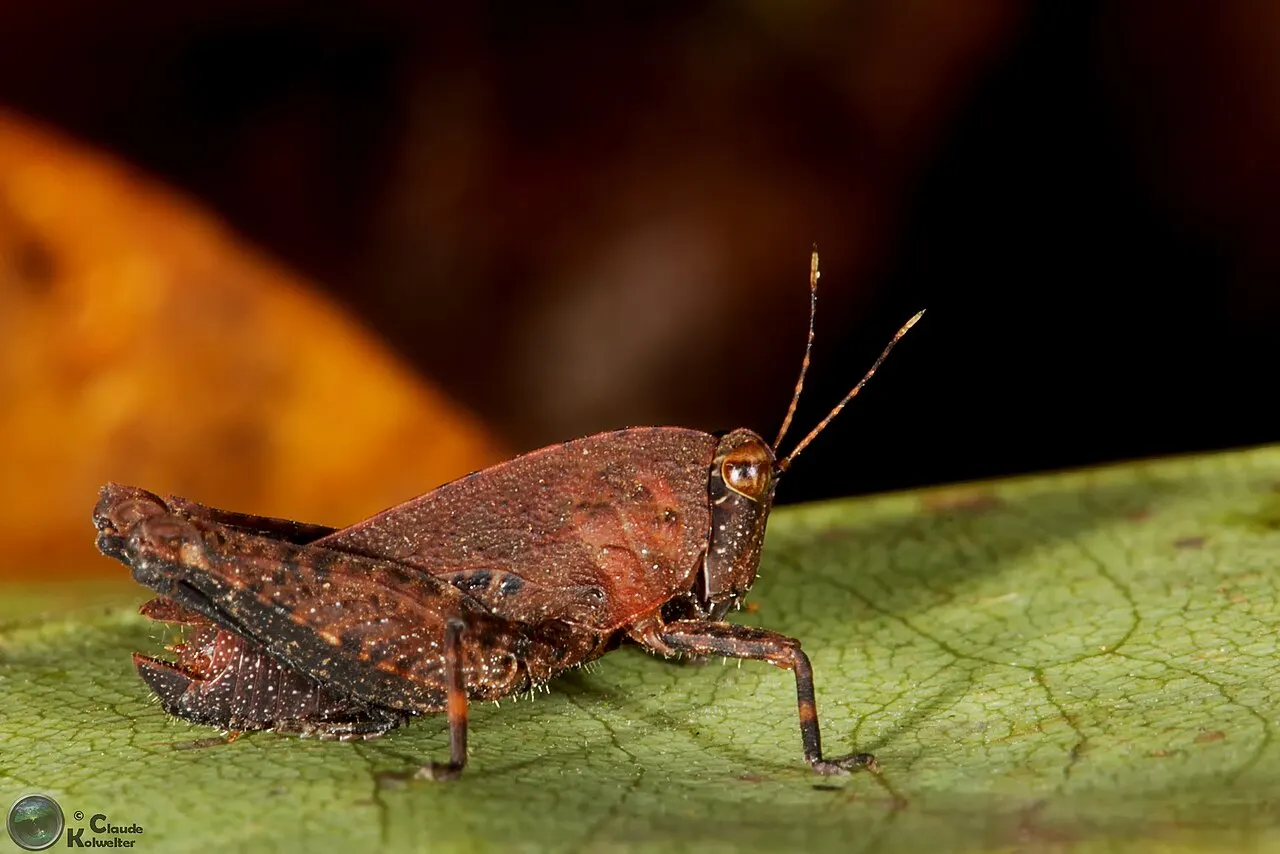
Critically Endangered
Seychelles Crested Groundhopper
Coptottigia cristata
The Seychelles crested groundhopper (Coptottigia cristata) is a small groundhopper known from a single location in the Seychelles. The IUCN Red List rated it Critically Endangered in 2012, because its range is tiny and still shrinking. Almost nothing has been published about how it lives.
What it is
Groundhoppers, also called pygmy grasshoppers, belong to the family Tetrigidae, small insects with cryptic colouring and a long plate behind the head. This species was described by the Spanish entomologist Ignacio Bolívar in 1912 in the Transactions of the Linnean Society of London.
The original specimens came from Mahé and Silhouette islands in the Seychelles. Four of these type specimens are held in museums in London, Madrid and Cambridge.
Where it lives
The IUCN treats the species as living in a single location. It estimates both the area it occupies and its overall range at just 10 square kilometres, and records it in moist lowland forest between 500 and 900 m above sea level. The assessment gives its population trend as unknown, but notes that both its range and its habitat quality are continuing to decline.
The species occurs in at least one protected area. No population size has been estimated.
Pins are Wikidata “endemic to” fields. Orange dots, when present, are GBIF occurrence tiles — survey bias included.
Why it is in trouble
The IUCN lists drought, habitat shifting and alteration, and unspecified problem species among the threats. Invasive plants, particularly cinnamon, were among the factors examined in a 2013 project on the endemic insects of Mahé.
The project was led by Axel Hochkirch of Trier University in Germany and funded by a Mohamed bin Zayed Species Conservation Fund grant of $4,160. Two students began fieldwork in July 2013, studying habitat preferences of endemic crickets and searching the cloud forests for the groundhopper. The team did not manage to rediscover it.
What is being done
No species-specific conservation action is recorded. The 2013 project planned to map where endemic Seychelles grasshoppers and crickets live and to start a habitat restoration project for the benefit of the crickets. The IUCN lists research on the species' population trend, ecology and threats as a priority.
Sources
Written for this catalog in our own words from the sources below, checked against them on 12 November 2026. Population figures are estimates and carry the year they were made. Status and assessment year: IUCN. 2026. The IUCN Red List of Threatened Species. Version 2026-1. iucnredlist.org.




