Endangered
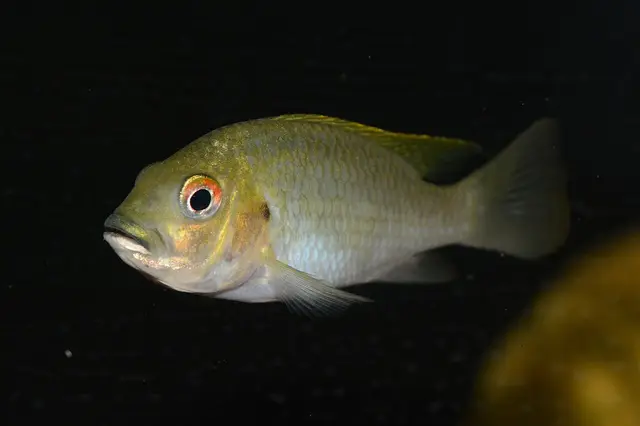
Coptodon kottae
Coptodon kottae
Coptodon kottae is a small cichlid found in just two lakes in Cameroon's Southwest Region, Barombi Koto and the much smaller Mboandong. It feeds mostly on plant material and guards its eggs in hidden crevices. The IUCN Red List assessed it as Endangered in 2017 because of its tiny range and degrading lakes.
How to recognise it
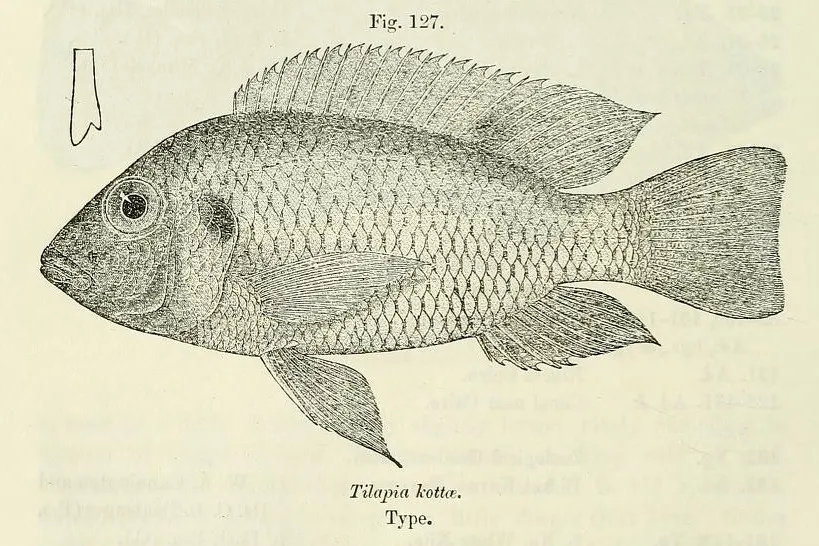
This is a modest-sized fish, reaching about 15 cm in length. It belongs to the tilapia group of cichlids and was described by Lönnberg in 1904 as Tilapia kottae, before being moved to the genus Coptodon. Fish identification keys count 14 to 16 spines and 10 to 13 soft rays in the dorsal fin, and 3 spines and 8 to 9 soft rays in the anal fin.
Where it lives
The species is restricted to Lake Barombi Koto and the smaller Lake Mboandong, about a kilometre to the south. Barombi Koto is a volcanic crater lake about 110 m above sea level. It covers roughly 330 hectares, but it's shallow, averaging only 3.8 m deep and reaching 6.2 m at most. A small island in the middle is home to the Barombi, a community of fishers.
Only seven fish species are known from Barombi Koto: five cichlids, a barb and a Clarias catfish. Mboandong is a smaller, shallow crater lake whose fish are all shared with its neighbour. The IUCN classes the habitat as permanent freshwater marshes and pools, and FishBase gives a water temperature of 24 to 26 degrees Celsius.
Pins are Wikidata “endemic to” fields. Orange dots, when present, are GBIF occurrence tiles — survey bias included.
How it lives
It lives near the bottom and in open water, feeding mainly on plants and small particles such as detritus and the algae-rich film that grows on surfaces. Breeding pairs bond, and prefer to spawn in hidden spots like crevices in sunken wood. Both parents guard the eggs and fry.
Why it is in trouble
A fish confined to two small lakes has nowhere else to go when conditions worsen. The lakes are reported to receive sediment and pollution, linked to slash-and-burn farming and nearby oil plantations. Deforestation may also let wind mix the water more strongly, which can disturb the lake's layering and leave deep water short of oxygen.
The IUCN assessment uses the criteria B1ab(iii)+2ab(iii), which cover a small range and ongoing decline in habitat quality. It records the population trend as unknown, and no population size has been published. The same assessment lists soil erosion and sedimentation among the threats.
What is being done
The assessment lists no conservation actions in place for the species. Any recovery would depend on reducing runoff into the two lakes, which is where the reported pressures come from.
Sources
Written for this catalog in our own words from the sources below, checked against them on 12 November 2026. Population figures are estimates and carry the year they were made. Status and assessment year: IUCN. 2026. The IUCN Red List of Threatened Species. Version 2026-1. iucnredlist.org.