Endangered
Seychelles magpie-robin
Copsychus sechellarum
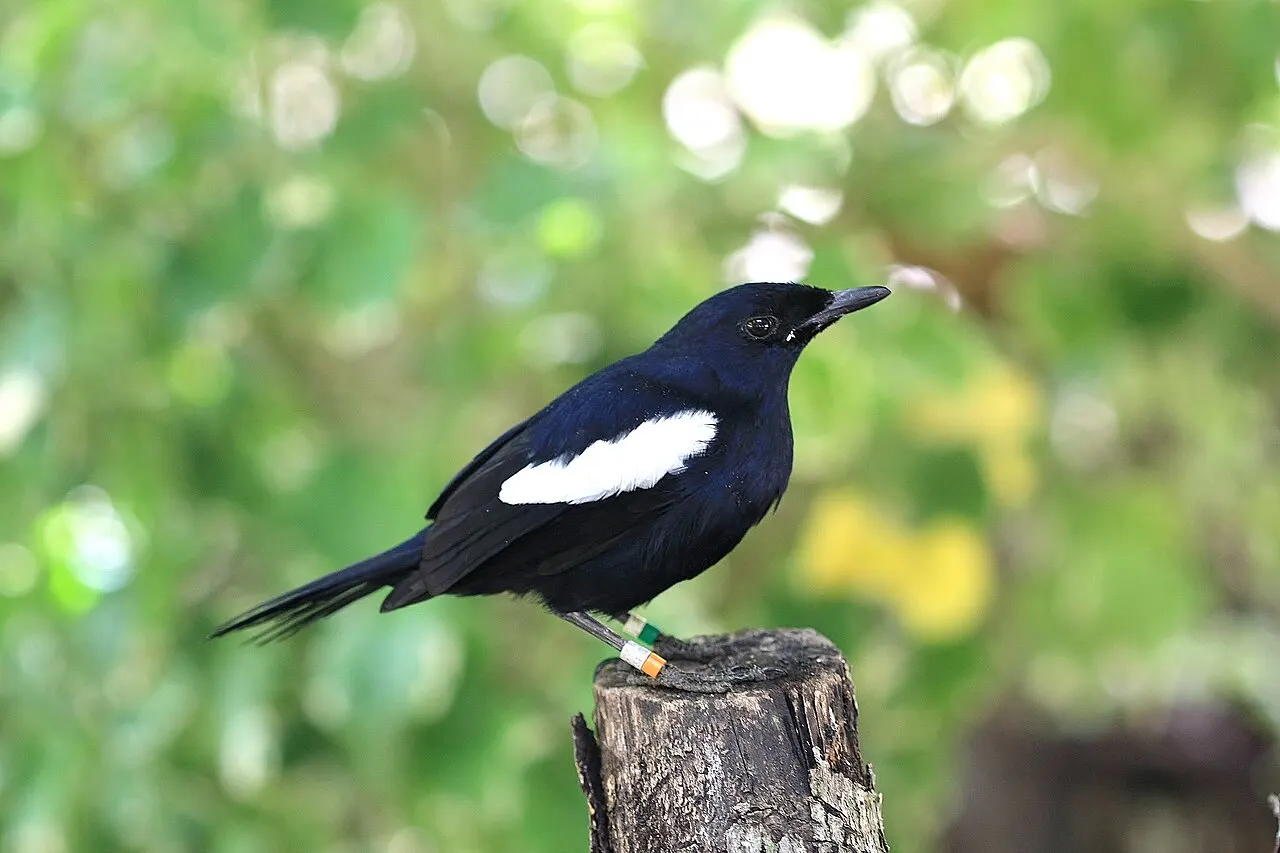
The Seychelles magpie-robin (Copsychus sechellarum) is a glossy black songbird with a white wing bar, found on five small granitic islands in the Seychelles. It was down to a few birds on one island in the 1960s. The Red List rated it Endangered in 2021, with a rising population.
How to recognise it
Adults are glossy, coal-black birds with a bold white bar on each wing. Length is given as roughly 25 cm in one source and 18 to 21 cm in the Red List. Males weigh about 76 g and females about 65 g.
Young birds are duller, with grey edges to the white wing bar. It is a long-lived bird, with individuals known to live over 15 years.
Where it lives
It once lived on most of the granitic Seychelles. It vanished from Praslin by 1878, Mahé by 1883 and Marianne by 1948. Today it is found on five islands, Frégate, Cousin, Cousine, Aride and Denis, in woodland, plantations and the edges of gardens. On Frégate, birds favoured open ground with leaf litter.
The Red List counts about 190 mature individuals in five locations, with an occupied area of about 60 square kilometres.
Pins are Wikidata “endemic to” fields. Orange dots, when present, are GBIF occurrence tiles — survey bias included.
Why it is in trouble
Clearance of land for farming and introduced predators such as rats and cats wiped it out island by island, and over-collecting may have played a part. The last population sat on Frégate. Counts differ by source: 12 birds in 1960, 8 in 1965 and 16 in 1970. The count then reached 38 to 41 in 1977 and 1978, and was 17 to 21 by 1988 to 1990.
A 2016 review of the species' history listed the problems that remain: barn owls, common mynas competing for nest sites, parasites and eye worms, and fighting over territories as islands fill up. On Aride the population fell from a peak of 32 in 2013 to 10 in September 2015. A genome study of 141 birds, summarised by the British Ornithologists' Union in 2023, found the lowest average heterozygosity reported for any bird species, pointing to inbreeding after the bottleneck.
What is being done
A recovery programme began in 1990 under what is now BirdLife International, and was later run by Nature Seychelles. It used predator control, supplementary feeding, nest boxes, habitat restoration and a ban on some pesticides. Birds were moved from Frégate to Cousin in 1994, Cousine in 1995, Aride in 2002 and Denis in 2008.
A 2012 count gave 244 to 248 birds, and by September 2015 there were about 280. The British Ornithologists' Union later reported almost 400. The Red List moved the bird from Critically Endangered to Endangered in 2005. The genome study recommends continued genetic monitoring and choosing unrelated birds for future moves.
Sources
Written for this catalog in our own words from the sources below, checked against them on 12 November 2026. Population figures are estimates and carry the year they were made. Status and assessment year: IUCN. 2026. The IUCN Red List of Threatened Species. Version 2026-1. iucnredlist.org.




