Critically Endangered
Cophotis dumbara
Cophotis dumbara
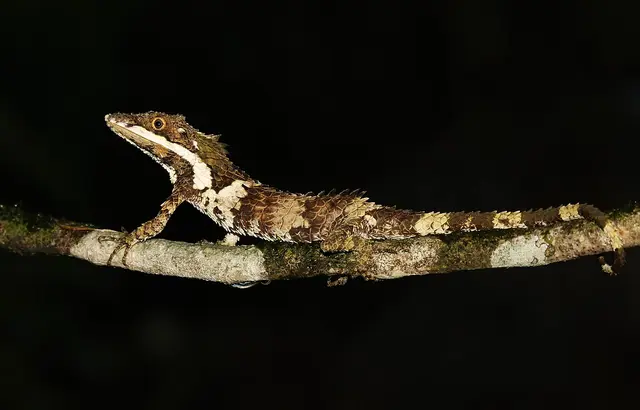
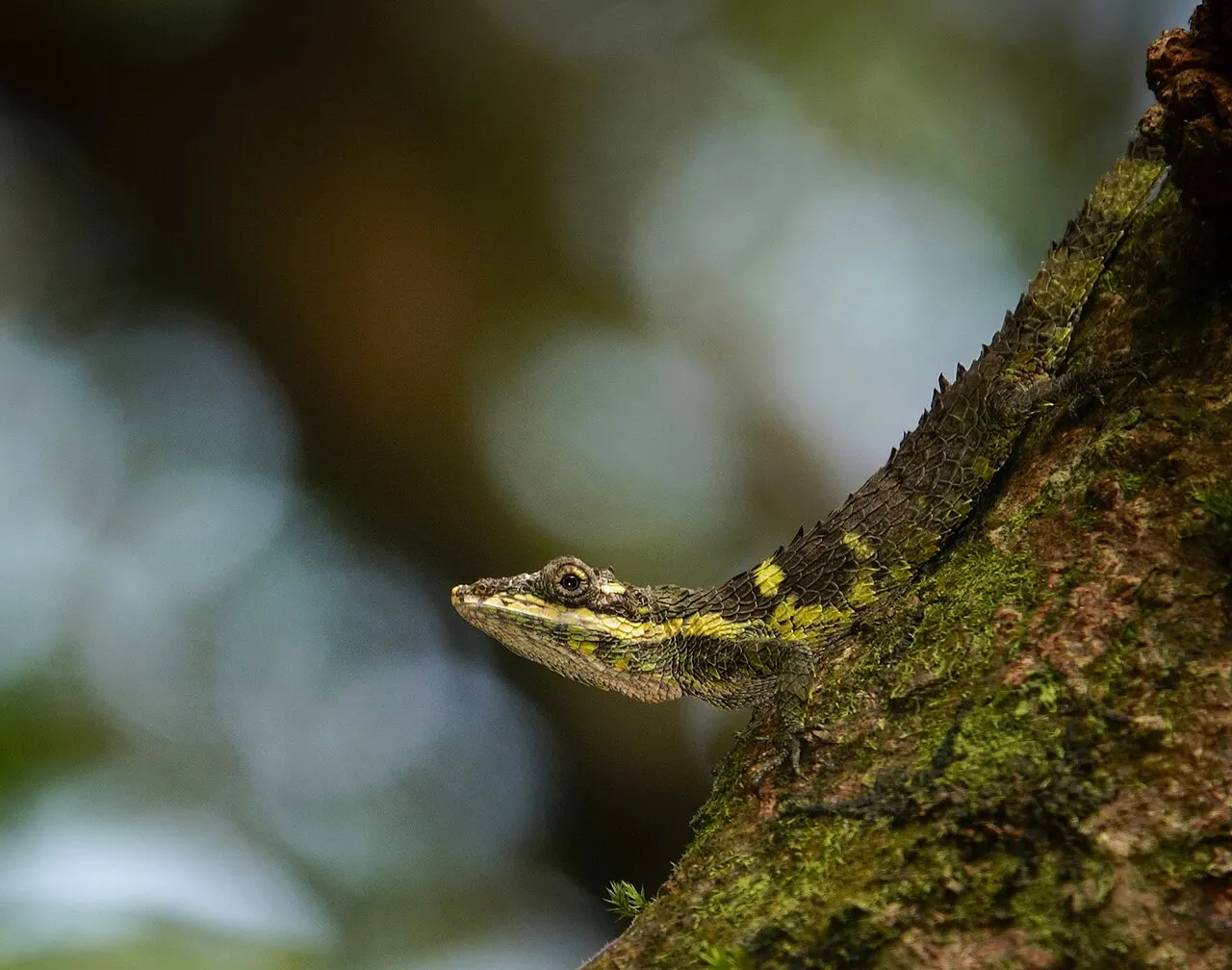
The Dumbara agama, or Knuckles pygmy lizard (Cophotis dumbara), is a small tree-dwelling lizard found only in the Knuckles Mountain Range of Sri Lanka. It is listed as Critically Endangered on the Red List (2021 assessment), with one known location, and its popularity among exotic-pet buyers abroad adds to the worry.
How to recognise it
It is a pygmy lizard, with a head-and-body length of roughly 50 to 60 mm. A mature female recorded in the field in 2020 measured about 150 mm in total, tail included. It was described as a species in 2006 by Samarawickrama and colleagues.
Males are more strikingly marked. They have a pale greenish-yellow upper lip, a dark greenish-black lower lip, a black crest with pale green patches and a reddish-orange throat that shows when they display. The tail carries alternating greenish-yellow and black bands. Females are plainer, with a buff, brown-streaked throat and brown tail bands. Colour varies, and a 2020 field observation described both sexes as pale green with white and dark bands.
Where it lives
Cophotis dumbara is endemic to Sri Lanka and known only from the Knuckles range in the central hills. The IUCN gives its elevation as 1,200 to 1,550 m and counts one location. It lives in tropical moist montane forest, the cool cloud forest that clothes the upper slopes.
It is arboreal and is regularly seen in cloud forest vegetation above 1,200 m, though a 2021 note in Taprobanica said virtually nothing was known of its natural history and ecology.
Pins are Wikidata “endemic to” fields. Orange dots, when present, are GBIF occurrence tiles — survey bias included.
How it lives
Almost all that is known of its behaviour comes from a short note by Soysa and colleagues in Taprobanica, based on one morning of watching at Riverstone, beside the Matale to Illukkumbura road, on 2 July 2020. A mature female, who looked gravid, spent about half an hour climbing from a shrub into a nearby tree, reaching about 5 m up. A male of similar size then approached and displayed to her, bobbing his head, flashing his red-orange throat sac and nuchal spines, arching his back and whipping his tail from side to side. He bit her nuchal spines and they mated for 2 minutes. Over the next quarter hour they mated twice more, for 2 and 3 minutes.
Diet, clutch size and lifespan have not been documented in the sources available.
Why it is in trouble
The IUCN rated it Critically Endangered under criterion B1ab(iii), meaning a very small range with continuing habitat decline. Its population trend is recorded as unknown. Pressures listed include small-scale farming, more frequent fires, drought, tourism and recreation areas, native problem species or diseases, and collection of animals. Each is scored as low impact in the assessment.
Pet-trade demand is a concern. A January 2026 Mongabay report says Knuckles pygmy lizards and the other Sri Lankan pygmy lizard have been popular on global trading websites since 2015, with captive-bred lizards and juveniles listed at roughly 500 to 1,000 US dollars. Sri Lankan experts quoted there disagree about breeding: one says the lizards are slow breeders that could vanish from the wild if taken, while another says they breed well, which he gives as a reason for the demand.
What is being done
Both Cophotis species are protected under Sri Lanka's Flora and Fauna Protection Ordinance, which bars collecting from the wild, hunting and export without special permits. Sri Lanka also proposed both Cophotis species for CITES Appendix I, the strictest level of trade control, and they were added at the 2019 meeting of the parties, with the change taking effect on 26 November 2019.
The IUCN notes that the species occurs in at least one protected area and lists habitat protection and management, restoration, awareness work and international and national legal measures among the actions identified. A 2025 study in Integrative Conservation found that more than 40 percent of the most critical habitat of Sri Lanka's agamid lizards lies outside protected areas, and named the Knuckles range among the hotspots.
Sources
Written for this catalog in our own words from the sources below, checked against them on 12 November 2026. Population figures are estimates and carry the year they were made. Status and assessment year: IUCN. 2026. The IUCN Red List of Threatened Species. Version 2026-1. iucnredlist.org.
- IUCN Red List assessment, Cophotis dumbara (2021)
- Wikipedia, Cophotis dumbara
- Soysa et al. 2021, Copulatory behavior of Knuckles pygmy lizard, Taprobanica 10(2): 128-130 (PDF)
- Mongabay, Jan 2026, habitat destruction and illegal trade threaten Sri Lanka's agamids
- US Fish and Wildlife Service, Changes to CITES species listings (9 Sept 2019)