Endangered
Glittering starfrontlet
Coeligena orina
The dusky starfrontlet (Coeligena orina), also called the glittering starfrontlet, is a dark hummingbird of a few high cloud-forest and páramo edges in Colombia's Western Andes. The IUCN Red List rated it Endangered in 2020, with 250 to 2,499 mature individuals estimated and a declining trend.
How to recognise it
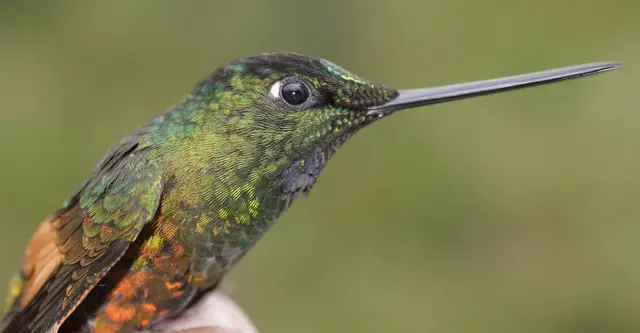
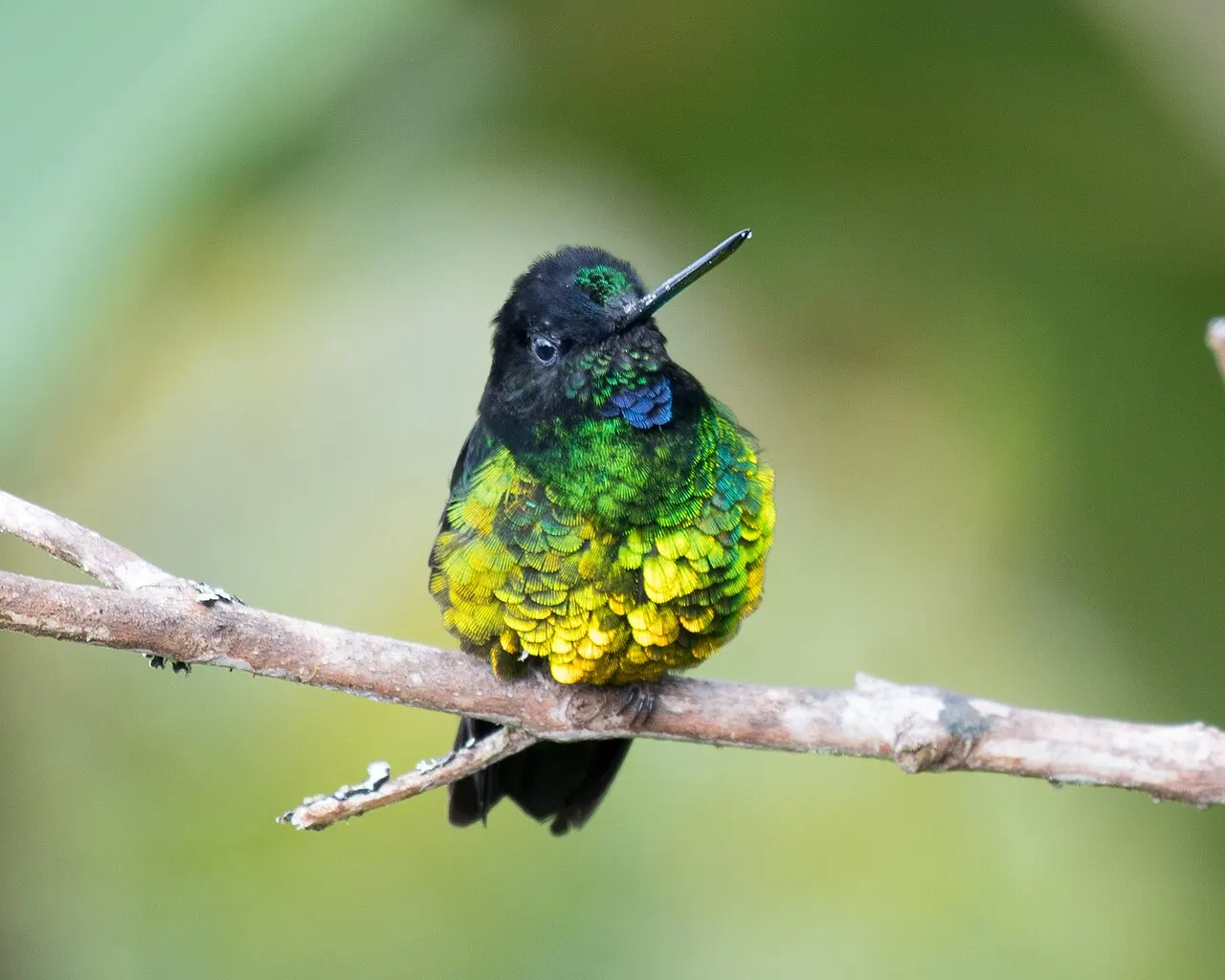
It is a mid-sized hummingbird, about 14 cm long and roughly 6.7 to 7.2 g. Males have a glittering blue-green to golden-green forehead, a velvety black crown, face and back, and a large cobalt-blue patch on the lower throat.
Females are greener, with dark-tipped feathers that give a scaly look, a cinnamon-buff throat and a golden-green belly with dusky marks.
Where it lives
The species is endemic to Colombia, known from about a dozen sites in a few small areas of the Western Andes, in Antioquia, Chocó and Risaralda. Places include Páramo de Frontino, Las Orquídeas National Natural Park, Tatamá National Natural Park and the Jardín area.
It lives in tall humid forest, stunted elfin forest and the edge where forest meets páramo. Most records fall between about 3,100 and 3,500 m, with a single record at 2,500 m. The IUCN gives 2,950 to 3,400 m and counts six to ten locations, with a severely fragmented population.
Pins are Wikidata “endemic to” fields. Orange dots, when present, are GBIF occurrence tiles — survey bias included.
How it lives
It feeds on nectar from several kinds of plant, and stomach contents have also held spiders, wasps and flies. Breeding is poorly known. Two nests have been found, both in Tatamá, built on rock faces about 3 m up, each holding two eggs.
The IUCN does not treat it as a migrant, and counts a generation as about 2.4 years.
A species found, doubted and found again
It was described in 1953 from a single specimen collected in 1951. In 1988 it was reassessed as a subspecies of the golden-bellied starfrontlet. It was rediscovered in 2004 during an expedition to the Páramo de Frontino, and additional specimens confirmed it as a full species. It has no recognised subspecies.
Why it is in trouble
Forest and páramo are being cleared for timber, farming and settlement, even inside national parks. The IUCN also lists grazing, housing, mining, drought and more frequent fires, and a decline in the area of habitat. Gold, zinc and copper mining at Páramo de Frontino is a possible future threat.
The Red List has changed its verdict several times: Least Concern in 2004, Critically Endangered from 2007 to 2018, and Endangered in 2020.
What is being done
The conservation group ProAves created a reserve on 6 October 2005, now called the Dusky Starfrontlet Bird Reserve (also Colibri del Sol), in the Cordillera Occidental about 17 km north of Urrao in Antioquia, to protect the species and its moorland. A fire in February 2010 burned 253 hectares in the Páramo del Sol, in Urrao municipality, a reminder of the risk to this habitat.
The IUCN reports that conservation sites are identified across the whole range, but that no recovery plan or systematic monitoring scheme was in place at the time of the assessment. The reserve offers lodging for ten people, and hummingbird feeders are listed as an attraction.
Sources
Written for this catalog in our own words from the sources below, checked against them on 12 November 2026. Population figures are estimates and carry the year they were made. Status and assessment year: IUCN. 2026. The IUCN Red List of Threatened Species. Version 2026-1. iucnredlist.org.