Endangered
Perija starfrontlet
Coeligena consita
The Perija starfrontlet (Coeligena consita) is a mid-sized mountain hummingbird that lives only in the Serranía del Perijá, on the Colombia and Venezuela border. The IUCN Red List assessed it as Endangered in 2020, with a small, shrinking population. Its breeding and song are still undocumented.
How to recognise it
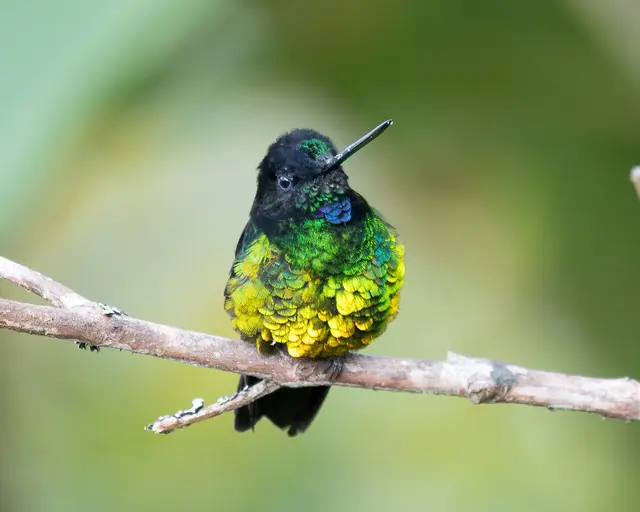
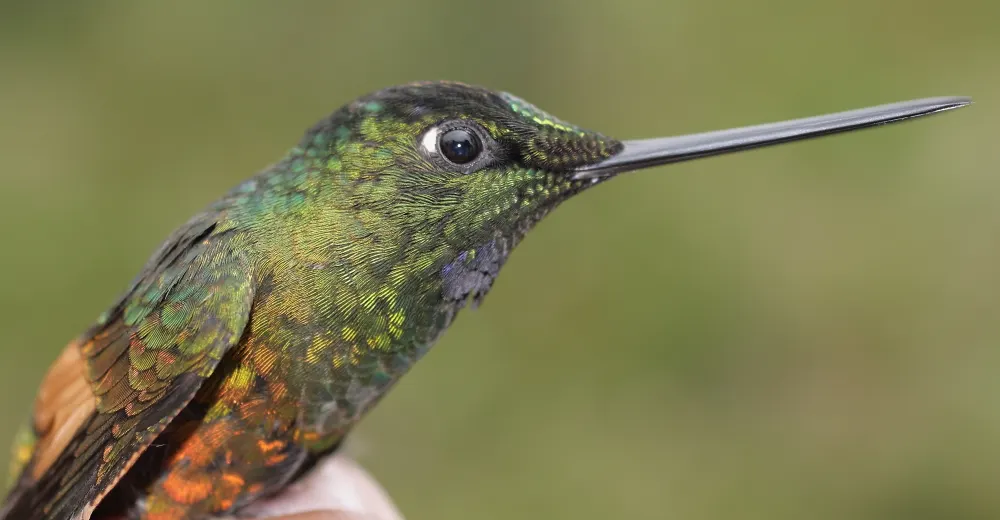
It's about 11 cm long, and roughly 3 cm of that is bill. The male has a blackish crown, a shiny green forehead, a small white spot behind the eye and a small deep blue patch on a glittering green throat. The back is dark green and turns golden orange toward the rump, and the underparts run from copper to reddish gold.
Females are plainer. They have a buff throat with green spots at the sides, a mottled breast and cinnamon underparts with a golden belly. Young birds look like adult females.
Where it lives
The species is found only in the Serranía del Perijá, the range on the border of north-eastern Colombia and north-western Venezuela. It lives in humid montane forest, including the stunted elfin forest near the treeline, and along forest edges and some higher open areas.
Published elevation ranges differ. Some accounts give 1,400 to 3,200 m, while the IUCN assessment gives a narrower band of 2,550 to 3,000 m. The same assessment counts 2 to 5 locations. The bird was described in 1952 by Alexander Wetmore and William Phelps from a specimen collected on the Venezuelan side of the range, near Cerro Tetarí in Zulia.
Pins are Wikidata “endemic to” fields. Orange dots, when present, are GBIF occurrence tiles — survey bias included.
How it lives
It stays in the mountains year round and isn't a migrant. Like its relatives it feeds mainly on nectar from tubular flowers, including Bomarea, Cavendishia, Fuchsia, Macleonia, Mutisia and Palicourea. It also catches small arthropods, picking them off leaves, hovering to take them or snapping them from the air.
Almost nothing else is known. Its nest, eggs and breeding season haven't been described, and as of early 2023 there were no recordings of its voice in the two big public sound archives, xeno-canto and the Macaulay Library.
Why it is in trouble
The IUCN estimates 250 to 999 mature individuals and a population that is still declining. The listed threats are small-holder farming and grazing, housing, mining, roads and an increase in fire. Forest has been cleared in the range for settlement, ranching and mining, and illegal poppy growing has also been reported.
Taxonomy adds a wrinkle. Several major checklists treat it as its own species, but the South American Classification Committee still lumps it with the golden-bellied starfrontlet (Coeligena bonapartei) as a subspecies, and a proposal to split it is pending. Its standing differs by authority.
What is being done
The IUCN records that the bird occurs in at least one protected area and that conservation sites have been identified across its whole range. The assessment lists no recovery plan and no systematic monitoring scheme, and it calls for effective protection of Sierra de Perijá National Park and for research on population size and ecological needs.
International trade in the species is subject to controls, and it is listed on CITES Appendix II.
Sources
Written for this catalog in our own words from the sources below, checked against them on 12 November 2026. Population figures are estimates and carry the year they were made. Status and assessment year: IUCN. 2026. The IUCN Red List of Threatened Species. Version 2026-1. iucnredlist.org.