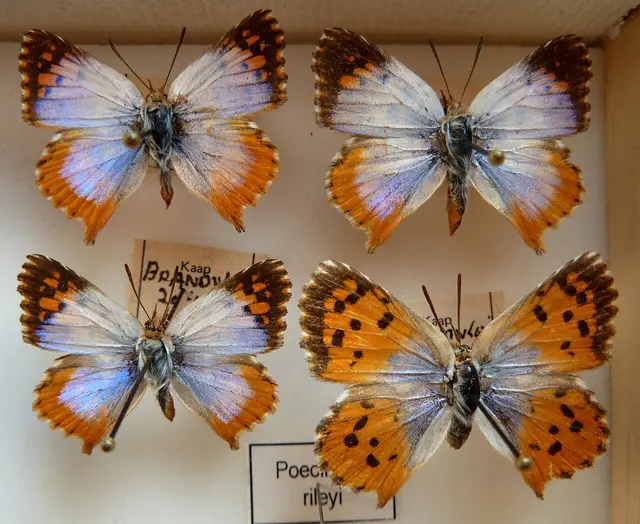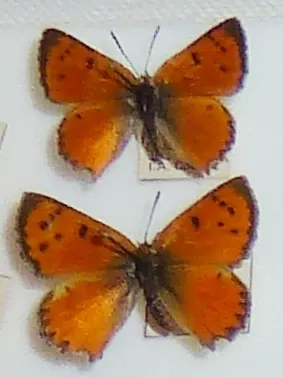
Endangered
Chrysoritis aureus
Chrysoritis aureus
The Heidelberg copper, also called the golden opal (Chrysoritis aureus), is a small butterfly found only in montane grassland and rocky ground in Gauteng and Mpumalanga, South Africa. The IUCN Red List rated it Endangered in 2020, with about 1,000 individuals estimated and a declining population.
How to recognise it
This is a small copper butterfly, with a wingspan of 24 to 28 mm in males and 28 to 32 mm in females. It was described by Van Son in 1966. Adults can be seen all year, with peaks of activity in December and March.
Where it lives
It is endemic to South Africa, living in montane grassland in Gauteng and Mpumalanga. The IUCN lists dry savanna and rocky habitat at 1,600 to 1,800 m. The 2020 assessment counts six locations, an extent of occurrence of about 297 square kilometres and an area of occupancy of only 36 square kilometres.
A 2017 study in the journal Bothalia surveyed 11 known habitats on the Witwatersrand and Ventersdorp geological systems, so counts of sites differ with how they are defined.
Pins are Wikidata “endemic to” fields. Orange dots, when present, are GBIF occurrence tiles — survey bias included.
How it lives
The caterpillars feed on varieties of Clutia pulchella. The 2017 Bothalia survey found the plant in every habitat and dominant on both geological systems, and called its presence essential to the butterfly's survival at these sites. The larvae are reportedly tended by a Crematogaster ant, Crematogaster liengmei.
Generations are short, with an estimated generation length of 3 to 9 months. The largest of the six subpopulations holds an estimated 51 to 250 individuals.
Why it is in trouble
The assessment reports a continuing decline in population, area occupied and number of locations. Listed threats are reduced fire frequency and intensity, smog, acid rain and unspecified species. The 2017 habitat study also recommended monitoring for, and removing, invasive alien plants.
What is being done
The species occurs in at least one protected area. The assessment lists habitat and natural process restoration and species recovery as conservation actions. The Bothalia study recommended monitoring butterfly numbers and vegetation, regular burning to keep the vegetation suitable, and removing invasive alien plants.
Sources
Written for this catalog in our own words from the sources below, checked against them on 12 November 2026. Population figures are estimates and carry the year they were made. Status and assessment year: IUCN. 2026. The IUCN Red List of Threatened Species. Version 2026-1. iucnredlist.org.