Endangered
Chrysoritis rileyi
Chrysoritis rileyi
Riley's opal is a small South African butterfly in the blue family (Lycaenidae). It is known only from the Western Cape, around the eastern end of Brandvlei Dam and one other area to the east. The IUCN Red List classed it as Endangered in 2020, because its range is tiny and its habitat is declining.
How to recognise it
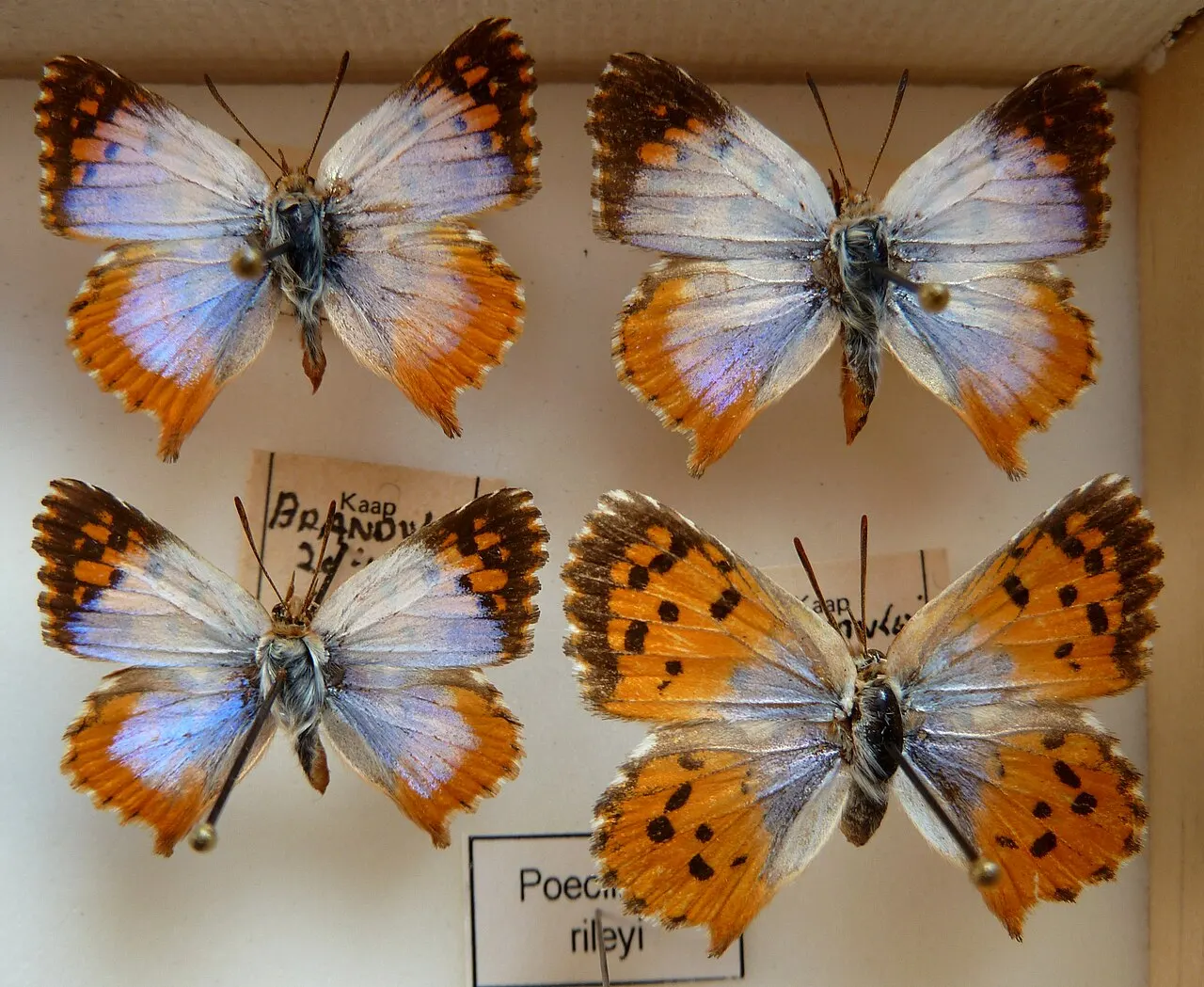
Riley's opal is a small butterfly. Males have a wingspan of 30 to 35 mm and females are slightly larger, at 32 to 38 mm. In a 2023 revision of the genus, Heath compared it with its closest relative, Chrysoritis endymion, and noted more extensive structural blue colour, a greener tinge to the iridescence when lit from the side, and more heavily blackened wing veins.
It flies alongside Brook's opal (Chrysoritis brooksi), so the two can be confused in the field. A possible hybrid between them is mentioned in the same revision.
Where it lives
The butterfly was described in 1966 by Dickson from the area around Brandvlei Dam, near Worcester, and the type specimen is held in the Natural History Museum in London. For decades it was known only from hill slopes and river flats at the eastern end of that dam. Heath's revision adds a second locality about 45 km to the east, near Robertson, a record attributed to the lepidopterist A. Morton.
The IUCN assessment counts two locations, with an estimated extent of 68 km2 and an area actually occupied of about 16 km2. The habitat is low-lying, flat or gently sloping ground in Mediterranean-type shrubland, the dry scrub of the Western Cape lowlands.
Pins are Wikidata “endemic to” fields. Orange dots, when present, are GBIF occurrence tiles — survey bias included.
How it lives
Adults reportedly fly from September to April, with peaks in October and November and again in March. The caterpillars are said to feed on plants in two genera, Thesium and Zygophyllum.
Like many opals, the caterpillars are tended by ants. The host ant is Crematogaster peringueyi. The butterfly therefore depends on its food plants and on that ant living in the same patch.
Why it is in trouble
The IUCN assessment links the Endangered listing to a very small range and continuing decline in habitat. Threats it lists include housing, shifting and industrial-scale farming, herbicides and pesticides, tourism and recreation areas, recreational activities, and large dams. No population size is given and the trend is recorded as unknown.
What is being done
The assessment lists site and area protection, habitat protection and restoration, control of invasive species, site management, and awareness work as conservation actions needed. It records no conservation measures as already in place, and no specific protected area or recovery programme for the butterfly turned up in published sources.
Sources
Written for this catalog in our own words from the sources below, checked against them on 12 November 2026. Population figures are estimates and carry the year they were made. Status and assessment year: IUCN. 2026. The IUCN Red List of Threatened Species. Version 2026-1. iucnredlist.org.




