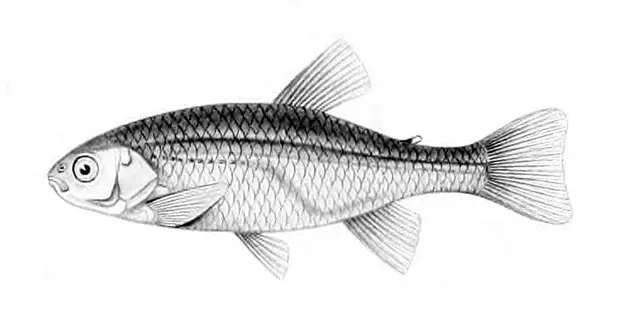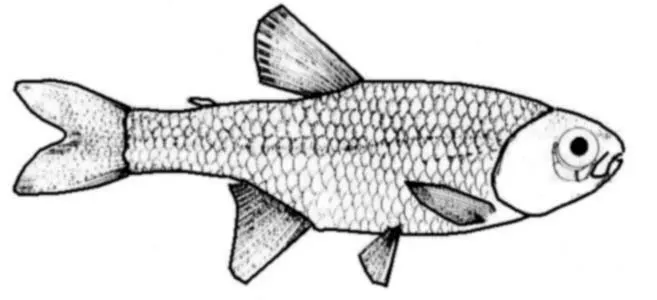
Endangered
Cheirodon kiliani
Cheirodon kiliani
Cheirodon kiliani is a tiny characin, about 3 cm long, that lives only in rivers and lakes of southern Chile. It was described in 1982 and is rated Endangered on the IUCN Red List (2023 assessment), with a decreasing population and threats that include dams.
How to recognise it
This is a very small fish, reaching about 3 cm in standard length at most. It belongs to the characin family and to the genus Cheirodon, whose name comes from Greek words for hand and teeth.
The Chilean biologist Hugo Campos described the species in 1982, and the original description is the reference for identification. He named it for his teacher Ernst Kilian, a German biologist who became founding director of the zoology institute at the Universidad Austral de Chile.
Where it lives
It is endemic to Chile, in rivers that drain to the Pacific. FishBase gives its range as running from the Lake Lanalhue drainage in the north to the Calle Calle River basin in the south. The original specimens came from the Cau Cau River.
The IUCN assessment lists a broad mix of freshwater habitats: permanent and seasonal rivers and streams, permanent and seasonal lakes, marshes and pools, and shrub-dominated wetlands.
Pins are Wikidata “endemic to” fields. Orange dots, when present, are GBIF occurrence tiles — survey bias included.
How it lives
Details of its diet and breeding have not been published for this species. The IUCN assessment describes it as a schooling fish that is not a migrant, with a generation length of about one to two years.
A chromosome study of Chilean Cheirodon sampled this species in the Calle Calle River. All the species studied had 50 chromosomes per cell and karyotypes dominated by acrocentric chromosomes.
Why it is in trouble
The assessment rates it Endangered under criterion A2c, which rests on a decline in the area occupied, the extent of its range or habitat quality. It records a past population reduction of about 50 percent and a continuing decline in the area where it lives. The threats listed are dams of unknown size, an unspecified species threat and one of unrecorded type.
Conservation actions listed in the assessment include site protection and management, habitat restoration, control of problem species, and education and awareness. The fish occurs in at least one protected area and some invasive species control is in place, but there is no recovery plan or systematic monitoring scheme.
Sources
Written for this catalog in our own words from the sources below, checked against them on 12 November 2026. Population figures are estimates and carry the year they were made. Status and assessment year: IUCN. 2026. The IUCN Red List of Threatened Species. Version 2026-1. iucnredlist.org.