
Endangered
Chaunus achalensis
Rhinella achalensis
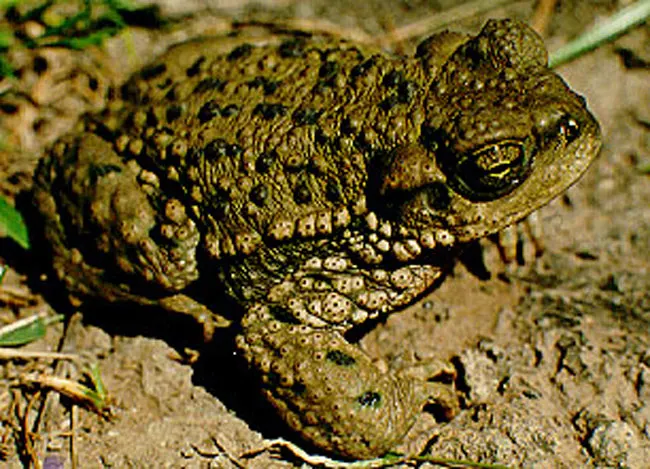
The Achala toad (Rhinella achalensis, formerly Chaunus achalensis) is a mountain toad found only in the highlands of Córdoba and San Luis provinces in central Argentina. It breeds in cold streams. The Red List rated it Endangered in 2019, up from Near Threatened in 2010, because the population is small, fragmented and shrinking.
Where it lives
José Cei described the toad in 1972, originally as Bufo achalensis, and it has also been placed in the genus Chaunus before settling in Rhinella. It belongs to the true toad family, Bufonidae, and is endemic to Argentina. The IUCN lists Córdoba and San Luis provinces, with an extent of occurrence of about 13,155 square kilometres.
It lives at high elevation, roughly 1,600 to 2,700 m according to the 2019 assessment. Its habitat is temperate grassland, rocky outcrops and the permanent streams that run through them, plus seasonally wet grassland. Juveniles and adults seem to avoid heavily grazed ground and use rock outcrops instead, where they have more cover.
Pins are Wikidata “endemic to” fields. Orange dots, when present, are GBIF occurrence tiles — survey bias included.
How it lives
The toad breeds in mountain streams. The assessment describes it as not migratory. Beyond that, little has been published on its diet, lifespan or breeding season, and the sources available give no size for adults.
Why it is in trouble
The 2019 assessment estimates seven to 50 subpopulations, none holding all the animals, and calls the population severely fragmented and decreasing. It records a population size of 2,499 mature individuals, which sits right at the 2,500 limit for Endangered under criterion C2a(i). That looks like a bound rather than a count, so the real total could be lower.
The threats it names are cattle ranching and farming, both small-holder and agro-industrial, and soil erosion and sedimentation. Cattle reportedly also pollute the mountain streams where the toad breeds. The species was rated Near Threatened in 2004 and again in 2010 before the move to Endangered.
Trout were stocked in the Córdoba mountains about 90 years ago for sport fishing. A 2020 study by Miloch and colleagues in Aquatic Conservation surveyed 33 streams in the upper Sierras Grandes. Two other amphibians tracked trout presence, but the Achala toad did not. The researchers suggest its skin toxins make it unpalatable to fish. The toad turned up in much lower proportions than the other amphibians surveyed.
What is being done
The toad occurs in at least one protected area. The assessment lists site and area management, site protection and species recovery as actions to pursue. Because it uses streams and rock outcrops that cattle degrade, grazing near its breeding streams is the pressure that matters most.
Sources
Written for this catalog in our own words from the sources below, checked against them on 12 November 2026. Population figures are estimates and carry the year they were made. Status and assessment year: IUCN. 2026. The IUCN Red List of Threatened Species. Version 2026-1. iucnredlist.org.