Endangered
Chatham Islands oystercatcher
Haematopus chathamensis
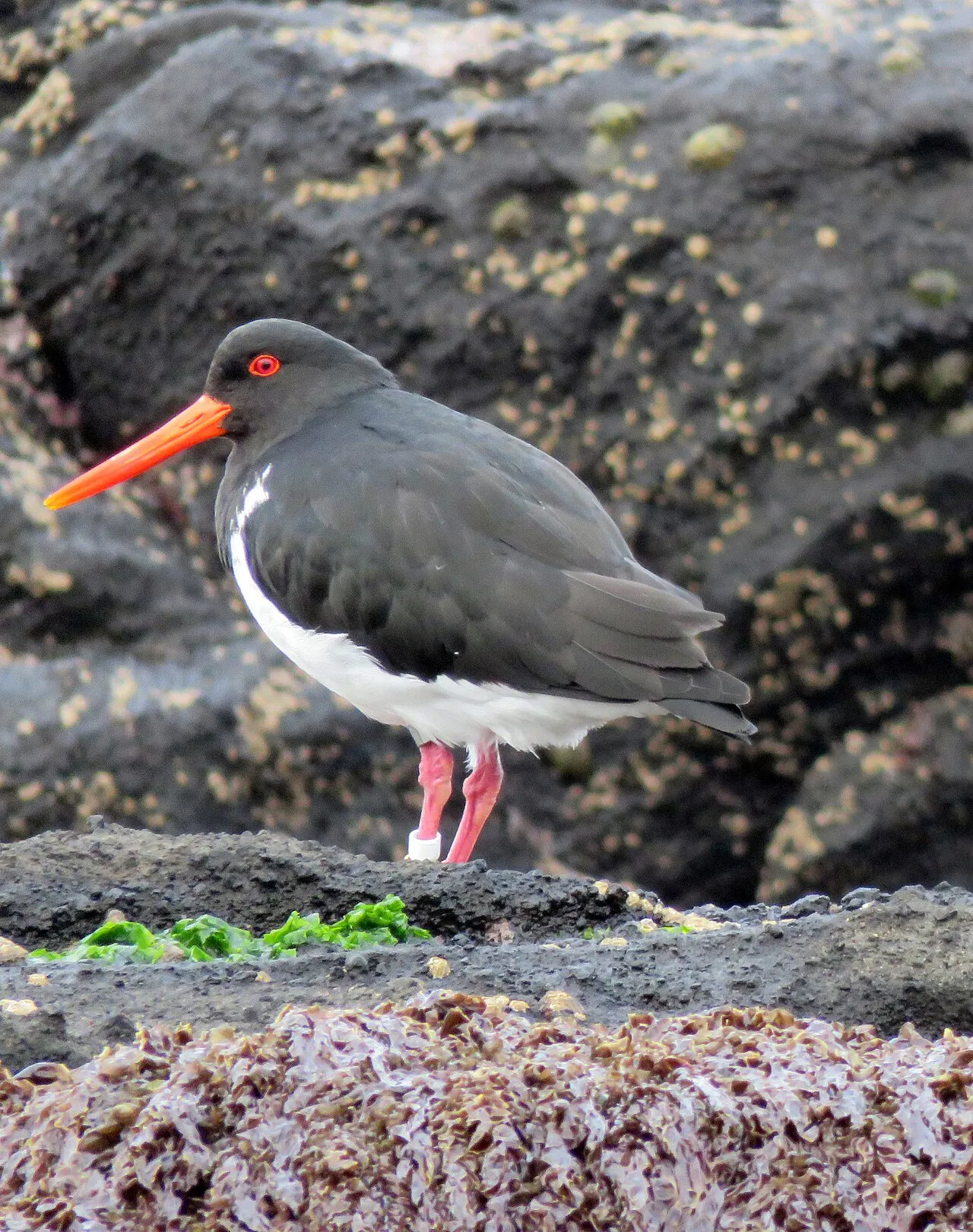
The Chatham Islands oystercatcher (Haematopus chathamensis) is a black-and-white shorebird with an orange bill, found nowhere except the Chatham Islands of New Zealand. The IUCN Red List rated it Endangered in 2022. Predators, farm stock and steepened dunes make nesting hard.
How to recognise it
It's a pied wader about 48 cm long and around 600 g. The head, neck, back and upper breast are black and the underparts white, with a smudgy rather than sharp boundary across the breast. Adults have an orange bill and eye-ring, red eyes and pink legs and feet.
Young birds have paler skin and a dark-tipped bill, and adult features develop gradually from about two years old. The South Island pied oystercatcher is smaller, less sturdy and has a more distinct chest boundary, and a pied variable oystercatcher has not been recorded on the Chathams.
Where it lives
It breeds only on the Chatham Islands of New Zealand: on Chatham, Pitt, Rangatira (South East) and Mangere Islands. It favours sheltered coasts where food is available at every state of the tide, such as rocky wave platforms, kelp debris and stream mouths. Territories run from about 100 m to 1 km of shoreline, and some birds feed on adjacent farmland, especially in winter.
Pins are Wikidata “endemic to” fields. Orange dots, when present, are GBIF occurrence tiles — survey bias included.
How it lives
It feeds on shore invertebrates, including marine worms, molluscs, crustaceans, amphipods, echinoderms and sea squirts. Both parents share the incubation of one to three eggs (average 2.2) for about 29 days. The nest is a simple scrape in sand or gravel, or a lined hollow on rock. Chicks are mobile once dry and rely on hiding in tidal debris. Most birds first breed at three or four years old, and the oldest known lived at least 30 years.
Why it is in trouble
Numbers were tiny in the last century. Estimates give as few as 50 birds in 1970, 110 in 1987 and 142 in 1998. Introduced cats are the main threat on Chatham and Pitt Islands, taking eggs, chicks and some adults. Weka eat eggs, livestock can trample nests, and subantarctic skuas take eggs and chicks on the southern islands. On Rangatira, about 12 pairs in the 1970s had dropped to 2 by 2016, for reasons that aren't understood.
Marram grass planted to hold dunes has also made them steep, which pushes nests close to the high tide line where storms can wash them out. The IUCN lists the trend as stable in 2022, with an estimated 200 to 249 individuals, a number small enough to qualify as Endangered under criterion D (very small population). In New Zealand it is ranked Nationally Critical.
What is being done
Intensive management on northern Chatham Island between 1998 and 2004 combined predator control, keeping stock off nesting beaches and moving nests away from the tideline. Average productivity rose from 0.35 to 1.0 chicks per pair per year, and an influx of birds aged 2 to 6 years more than doubled the breeding population. A December 2004 count found 311 birds including 88 breeding pairs. Minimum counts were 313 birds in 2006 and 309 in both 2010 and 2014.
Since 2005 the work has been less intensive. Productivity has dropped, fewer young birds are joining the population, and cat control on the north coast looks less effective than it was. Trial dune restoration with native plants in place of marram has produced safer nesting conditions. A recovery plan for 2001 to 2011 aimed to keep the population at or above 250 birds with minimal management.
Sources
Written for this catalog in our own words from the sources below, checked against them on 12 November 2026. Population figures are estimates and carry the year they were made. Status and assessment year: IUCN. 2026. The IUCN Red List of Threatened Species. Version 2026-1. iucnredlist.org.




