Endangered
White-naped mangabey
Cercocebus lunulatus
The white-naped mangabey (Cercocebus lunulatus) is a large forest monkey of West Africa, recorded in Ghana and Côte d'Ivoire, and possibly Burkina Faso, and marked by a pale half-moon on its nape. The IUCN Red List rates it Endangered (assessed 2020), estimating a loss of about half the population over roughly 27 years.
How to recognise it
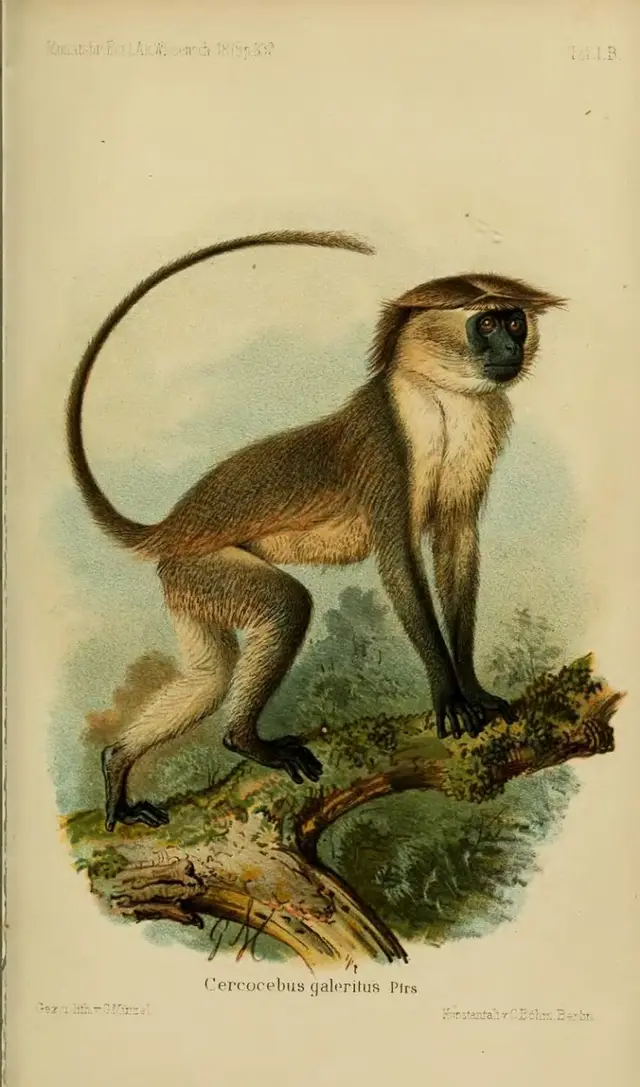
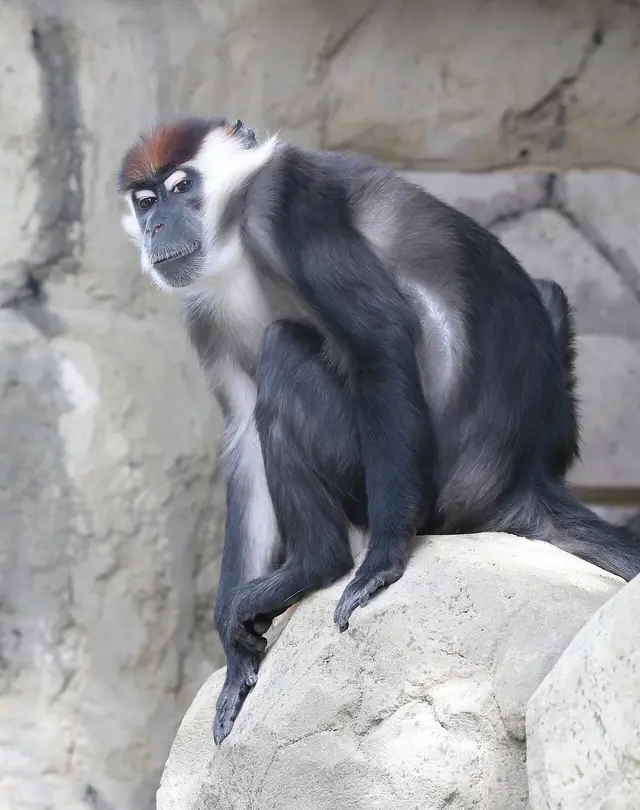
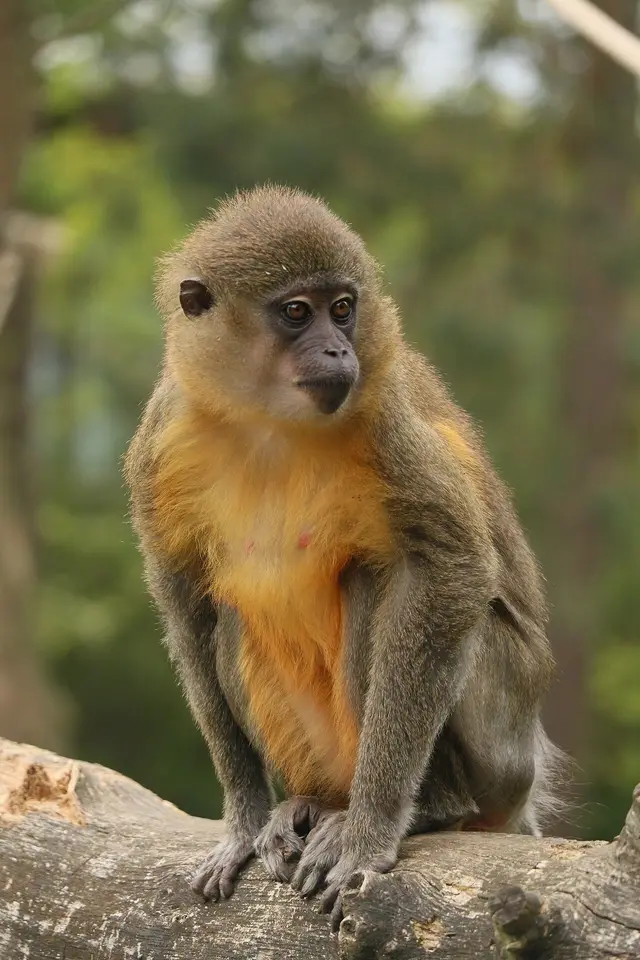
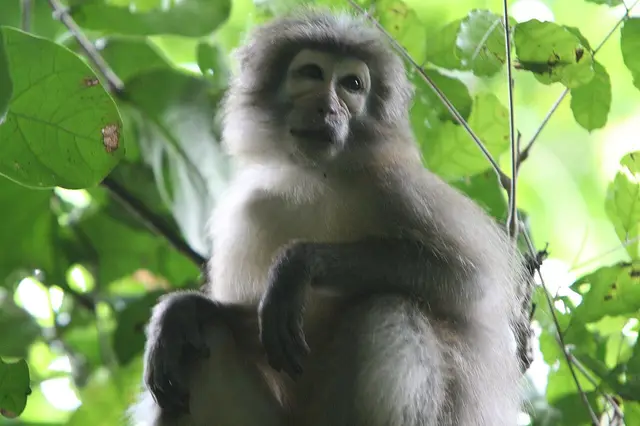
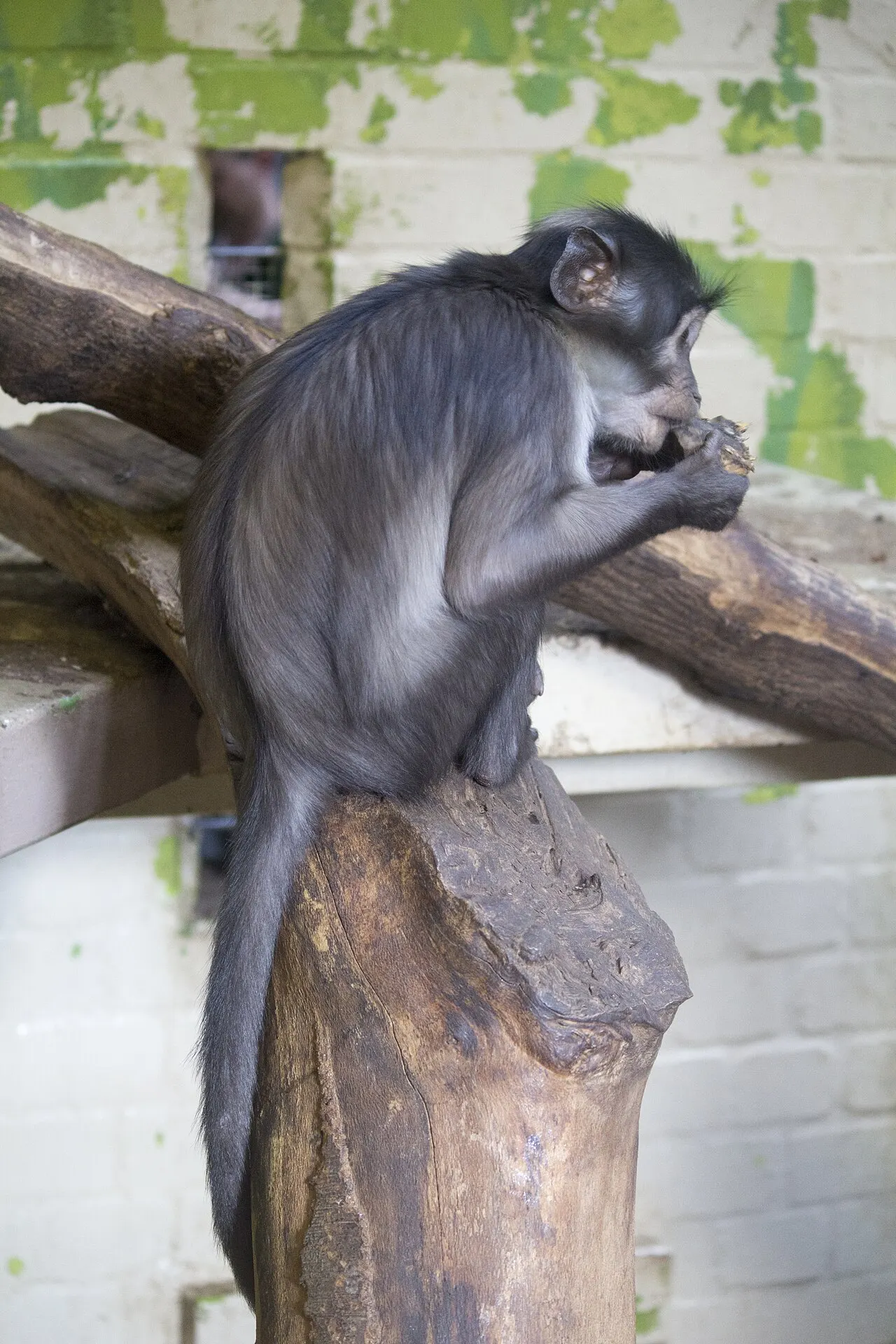
A white half-moon patch on the nape gives the species its name. The fur is soft brown-grey with a creamy belly, neck and inner limbs, long hair flares at the cheeks, and the face is bald and dark with white eyelids. Limbs and tail are long.
Males are clearly larger than females and have longer canine teeth. Males weigh roughly 8.5 to 14 kg and females 5 to 9 kg, though zoo sources give lower adult weights. It was long treated as a subspecies of the sooty mangabey and is now considered a species in its own right.
Where it lives
It occurs in Côte d'Ivoire and Ghana, and possibly in Burkina Faso, where it was first recorded in 2006 and is believed to be locally extinct or nearly so, in swamp forest, mangroves, moist lowland and dry forest, riverside habitats, and degraded former forest. The range is now patchy and much smaller than it once was. In Ghana it is now restricted to two areas, Cape Three Points Forest Reserve and the Ankasa-Tano Community Forest, and it has disappeared from some protected areas in the west of the country. The Tanoé swamp forest in Côte d'Ivoire is one of its most important refuges.
It is still found in protected areas that include Comoé National Park and Atewa Forest Reserve.
Pins are Wikidata “endemic to” fields. Orange dots, when present, are GBIF occurrence tiles — survey bias included.
How it lives
Its diet is mainly fruit and nuts, supplemented with seeds, stems, roots, fungi and small invertebrates. Strong jaws and large incisors let it crack nuts that many other monkeys leave alone, and it forages on the forest floor as well as in the trees. Males eat more of the tough nuts and seeds, while females take more soft fruit.
It lives in groups with several males and females. Reported group sizes vary a great deal, from about 10 to 90 at Dublin Zoo's account, 15 to 100 (with up to 300 reported in the Tanoé swamp forest) from a primate conservancy, and up to 30 at Barcelona Zoo. Females generally remain in the group where they were born, and males leave at about five years old.
A single infant is born after a pregnancy of around five and a half to six months. One source gives an average lifespan of about 18 years in the wild and 27 in captivity.
Why it is in trouble
Hunting is the biggest threat. The monkeys are killed for meat, sold as bushmeat, and shot as crop pests. The IUCN lists the species as used for human food. Forest is also being lost to farming and rubber plantations, to charcoal and firewood cutting, and to fires. Warmer temperatures, longer dry seasons and erratic rain add further pressure. Conflict and civil unrest are also listed as a threat.
The IUCN assessment estimates a decline of about 50 percent over three generations, taking a generation as 9 years.
What is being done
The species is listed on CITES Appendix II and under Class B of the African Convention on the Conservation of Nature and Natural Resources. The IUCN also lists habitat protection and restoration, harvest and trade management, awareness and training, and livelihood alternatives as actions.
In captivity, Barcelona Zoo coordinates the European breeding programme. Dublin Zoo helped found West African Primate Conservation Action in 2001, together with ten other European zoos and two conservation groups.
Sources
Written for this catalog in our own words from the sources below, checked against them on 12 November 2026. Population figures are estimates and carry the year they were made. Status and assessment year: IUCN. 2026. The IUCN Red List of Threatened Species. Version 2026-1. iucnredlist.org.