Critically Endangered
Centrolene buckleyi
Centrolene buckleyi
Centrolene buckleyi is a glass frog of high Andean forest and scrub in Colombia, Ecuador and Peru. The IUCN Red List rated it Critically Endangered in 2022, after a past decline of around 80 percent that is expected to continue. Males carry a prominent spine on the upper arm.
How to recognise it
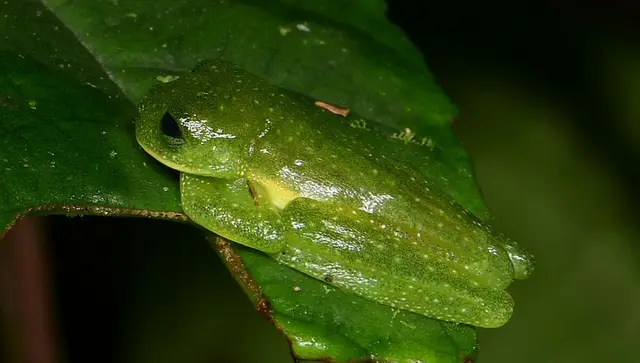
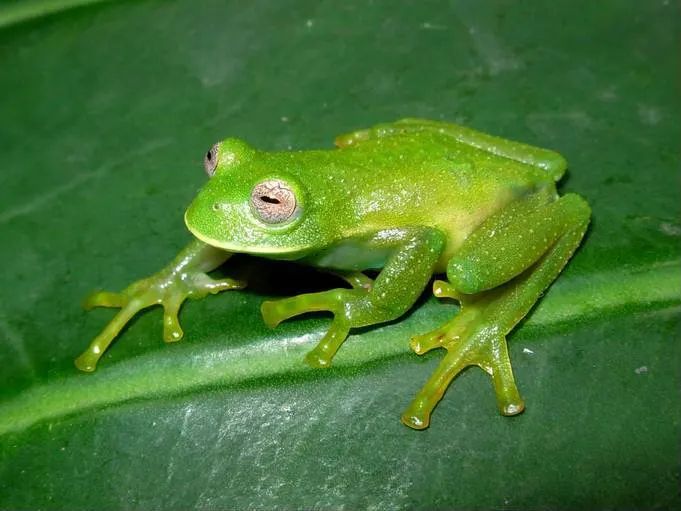
This is a medium-sized glass frog. Males measure about 26.5 to 30.9 mm and females 29.3 to 34.4 mm. The back is a plain green, and a white upper lip usually continues as a white line along the flanks.
Like its relatives, it has a see-through belly, but only partly: the front of the underside is opaque and the rear section is translucent. Adult males have a large spine on the upper arm, called a humeral spine. The frog was described by George Boulenger in 1882 and named after the naturalist Samuel Botsford Buckley.
Where it lives
It is an animal of cool mountain country. The IUCN records it at 2,450 to 3,300 m above sea level, in moist montane forest, high-altitude shrubland and grassland, and along permanent rivers and streams. The assessed range covers records from Colombia and Ecuador, and it is also reported from Peru. The IUCN put the extent of its range at about 36,284 square kilometres and does not treat the population as severely fragmented.
It is not a migrant. Its generation length is estimated at about three years.
Its identity is still being worked out. A 2018 study in PeerJ examined the Centrolene buckleyi species complex and found four genetic lineages, three of them proposed as candidate new species that need testing with further evidence. One of the three comes from Colombia and the others from Ecuador.
Pins are Wikidata “endemic to” fields. Orange dots, when present, are GBIF occurrence tiles — survey bias included.
Why it is in trouble
The IUCN estimates the frog has already lost about 80 percent of its population in the past and projects another 80 percent loss ahead, with the area it occupies still shrinking. The causes it lists are habitat loss and degradation from small-holder and industrial farming, plantations and grazing, roads, dams and drought.
The assessment also points to the effects of introduced species, pathogens or similar pressures as part of the picture. Total population size has not been estimated.
The same PeerJ study cites reports of population crashes. It says the frog has disappeared from, or is rarely found in, places where it was once abundant, and that earlier fieldwork at one Ecuadorian site, Yanayacu, found only three individuals over three years.
What is being done
The only conservation measure recorded as in place is that the frog occurs in at least one protected area. The IUCN lists site and habitat protection as actions needed, along with continued research on its taxonomy, population, ecology and threats.
Sources
Written for this catalog in our own words from the sources below, checked against them on 12 November 2026. Population figures are estimates and carry the year they were made. Status and assessment year: IUCN. 2026. The IUCN Red List of Threatened Species. Version 2026-1. iucnredlist.org.