Endangered
Burrowes' giant glass frog
Burrowes' giant glass frog
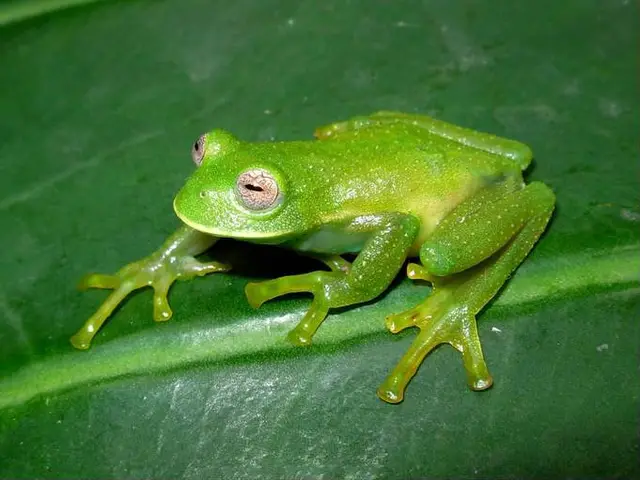
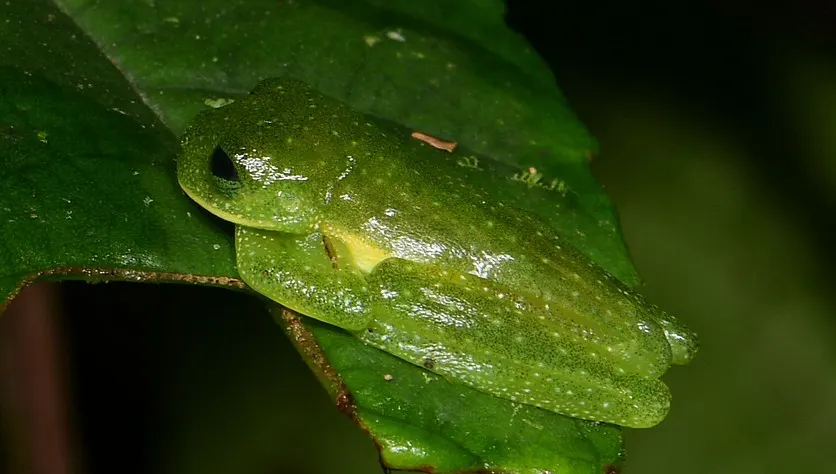
Burrowes' giant glass frog (Burrowes' giant glass frog), also called the golden-flecked glassfrog, is a small green frog of cloud forest streams on the Pacific slope of the northern Andes in Ecuador and southern Colombia. The Red List has rated it Endangered since 2019. Tiny gold flecks speckle its back.
How to recognise it
This is a small glassfrog. Adult males measure about 19 to 22 mm from snout to vent, and females about 21 to 23 mm. The back is dark lime green, scattered with minute pale gold-white flecks that are densest on the hind legs. The scientific name ballux is Latin for gold dust, a nod to those specks.
The snout is rounded, the fingers and toes are webbed, and the eardrum is visible. The belly is translucent, which is the trait that gives glassfrogs their name. The tips of the digits are yellowish green.
Where it lives
The species is known from only a few separate sites on the Pacific slope of the northern Andes. In Colombia it has been recorded in Nariño Department, including the private Reserva La Planada. In Ecuador it occurs in Pichincha and Santo Domingo de los Tsachilas provinces, with Reserva Las Gralarias among its known sites.
The Red List counts four locations and estimates the total range at about 3,100 square kilometres. Elevation figures differ between sources. The 2019 assessment gives 1,500 to 2,010 m, while other accounts give 1,700 to 2,340 m.
Pins are Wikidata “endemic to” fields. Orange dots, when present, are GBIF occurrence tiles — survey bias included.
How it lives
Burrowes' giant glass frog lives in humid montane forest and depends on streams. It is typically found perched on vegetation roughly 50 to 200 cm above the ground, close to a stream or ditch. Breeding takes place in streams. Beyond that, its biology has been little studied.
Why it is in trouble
The 2019 Red List assessment lists the population as decreasing, with continuing decline in the area it occupies. The threats it records are rated low impact but ongoing: small-scale farming and small-scale grazing or ranching, both of which clear and degrade the forest around the streams. Other accounts add climate change, which could alter humidity, and name introduced fish, pollution and the amphibian chytrid fungus as possible further threats, though none has been demonstrated for this frog.
Its taxonomy has also been questioned. A 2018 PeerJ study of the Centrolene buckleyi species complex found that C. ballux is the sister lineage of C. buckleyi, differing by only 0.6 percent in the mitochondrial 16S gene. One of several species-delimitation methods merged the two, but the study treated that result as an outlier, described no new species and made no taxonomic change. The frog remains an accepted species.
What is being done
It occurs in at least one protected area, and the private reserves La Planada in Colombia and Las Gralarias in Ecuador are among its sites. The Red List assessment records research on its population size, distribution and threats, and lists no conservation actions specific to the species.
Sources
Written for this catalog in our own words from the sources below, checked against them on 12 November 2026. Population figures are estimates and carry the year they were made. Status and assessment year: IUCN. 2026. The IUCN Red List of Threatened Species. Version 2026-1. iucnredlist.org.