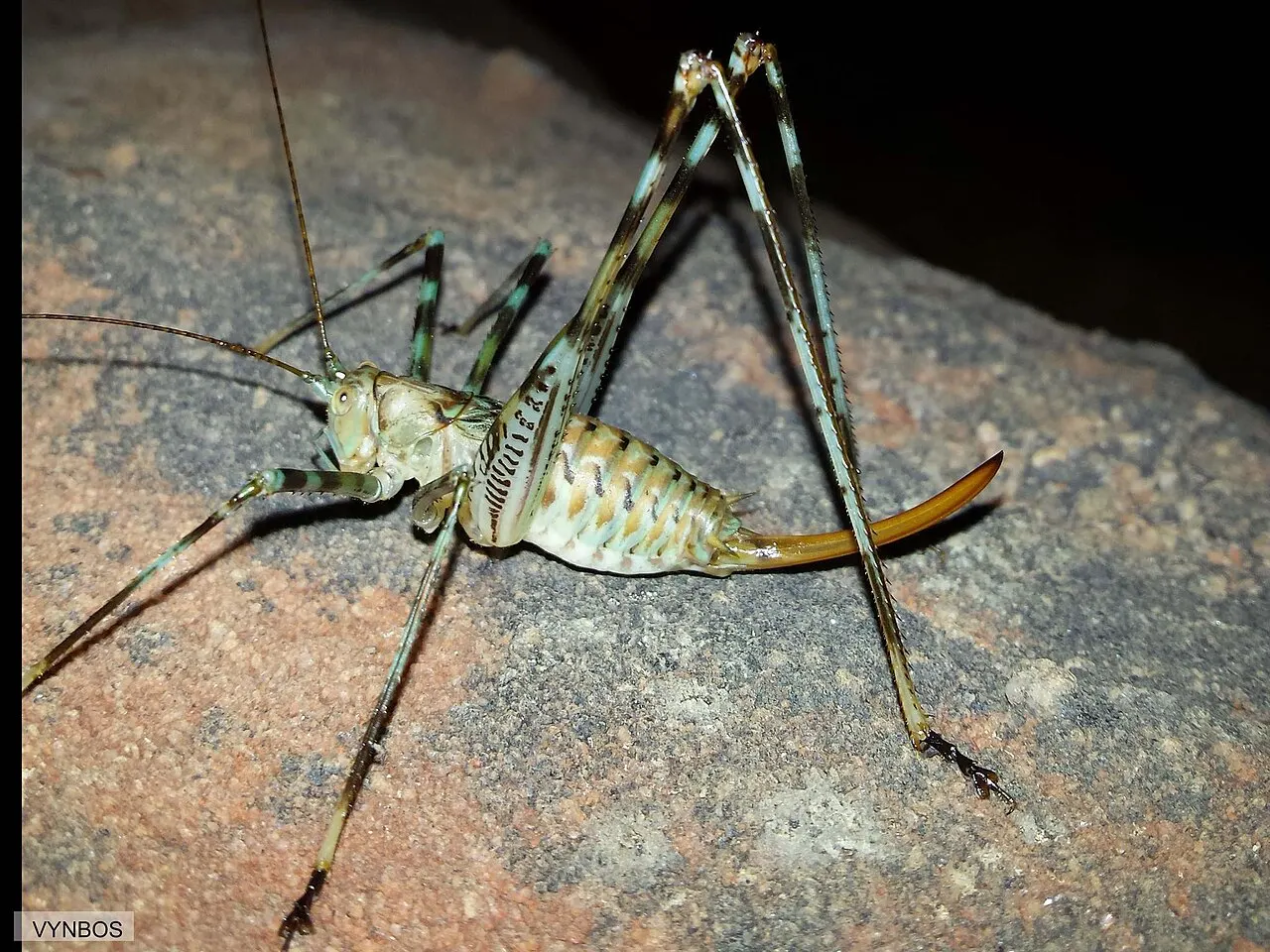
Critically Endangered
Cave Katydid
Cedarbergeniana imperfecta
The Cederberg cave katydid (Cedarbergeniana imperfecta) is a large, long-legged insect known only from a few cold caves in the Cederberg mountains of South Africa's Western Cape. The IUCN Red List assessed it as Critically Endangered in 2014. Its whole known range covers about 57 square km.
How to recognise it
It is a big, spidery katydid with long, striped legs and very long antennae. Its describer reports that the contrasting colours help it blend into the mottled rock around cave mouths, and that its sticky feet let it walk upside down across smooth cave ceilings.
Many of its relatives sing in long trills. This one reportedly makes only a short, ultrasonic click, which would suit life in an echoing cave.
Where it lives
The species is found only in South Africa, in the Cederberg of the Western Cape. Museum specimens were collected there in 1925, 1930 and 1935, and observers have logged it from sites such as Wolfberg Cracks (2019), Gabriels Pass (2021) and the Cederberg Wilderness Area (2023). GBIF holds 8 records in all, the latest from 2024.
The IUCN assessment gives an extent of occurrence of 57 square km across 5 locations and describes the population as severely fragmented. Caves are the only habitat it lists. The population trend is unknown, and no population size has been estimated.
Pins are Wikidata “endemic to” fields. Orange dots, when present, are GBIF occurrence tiles — survey bias included.
How it lives
Its describer reports that the caves stay around 12 degrees C all year, and that groups of roughly 20 to 30 insects of mixed ages share them. They go out at night to graze on grasses and other plants near the entrance, so they are plant eaters, not hunters. They move slowly in the cold but jump strongly when it is warmer.
Bats and rock hyraxes probably eat them, which may be why the katydids use caves those animals avoid. The describer has also suggested the species could be a relic from the colder climate of the Pleistocene.
Why it is in trouble
It is rare mostly because it is so tightly confined. Collector Keppel Barnard took the first specimens in September 1925 in the Wolfberg Cracks. All were immature, which is where the species name imperfecta comes from, and they sat in a museum for about 70 years before Piotr Naskrecki described the species in 1994.
The IUCN lists four ongoing threats across the whole range: shifting and altered habitat, storms and flooding, temperature extremes and drought. Naskrecki has raised climate change as a worry for an animal that may depend on cold refuges.
What is being done
The assessment reports that 91 to 100 percent of the population lies inside protected areas. It records no recovery plan, no systematic monitoring scheme and no captive population. Naskrecki reported finding the katydids thriving on a later visit, and found one more small cave where they live.
Sources
Written for this catalog in our own words from the sources below, checked against them on 12 November 2026. Population figures are estimates and carry the year they were made. Status and assessment year: IUCN. 2026. The IUCN Red List of Threatened Species. Version 2026-1. iucnredlist.org.




