Endangered
Cape Melville leaf-tailed gecko
Saltuarius eximius
The Cape Melville leaf-tailed gecko (Saltuarius eximius) is a 20 cm, big-eyed lizard known from a single patch of boulder-strewn rainforest in northern Queensland, Australia. Scientists described it only in 2013. The IUCN Red List rated it Endangered in 2018, and Australia lists it as Critically Endangered.
How to recognise it
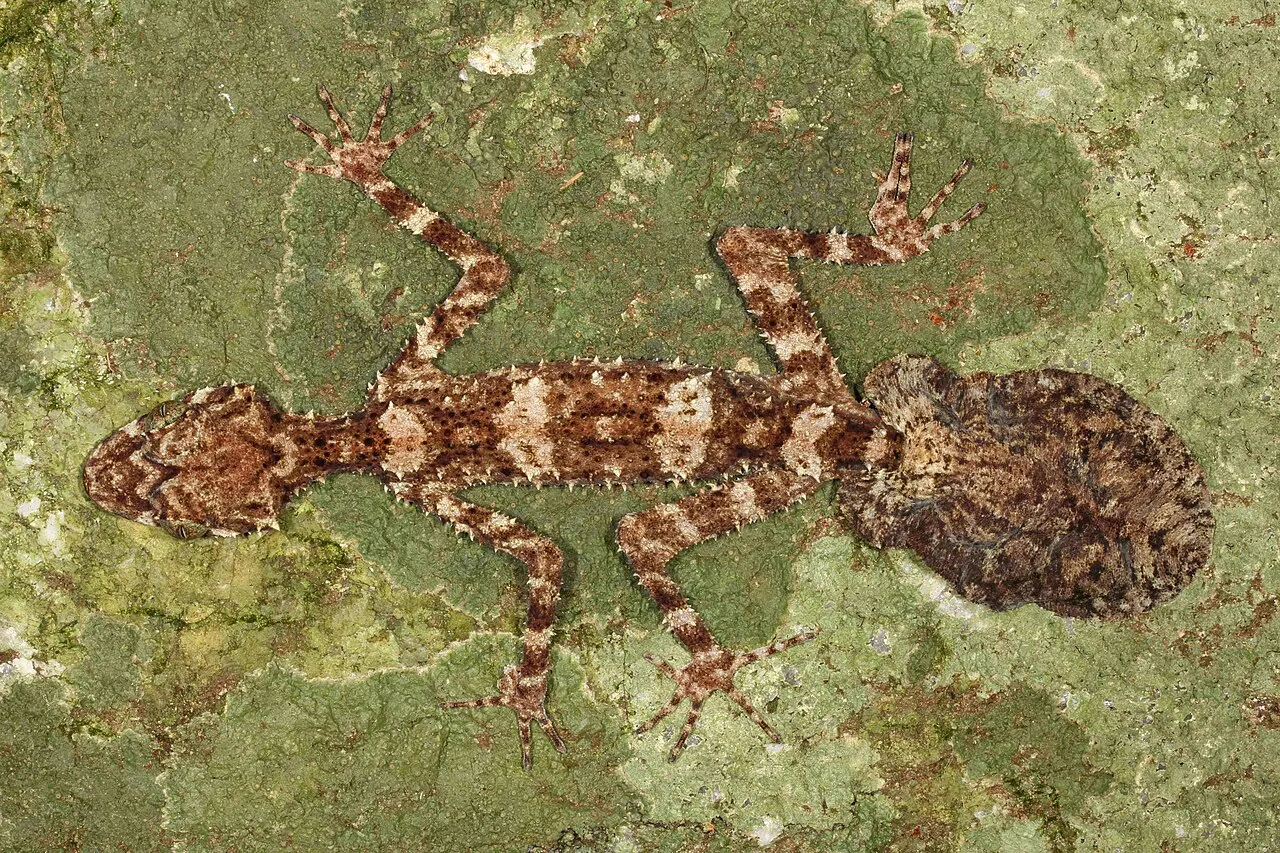
This is a big gecko, about 20 cm long, and an odd one. Compared with other leaf-tailed geckos in its genus it has a long, slender build, longer limbs, a narrower body and neck, and a small head. The eyes are very large and grey, without the patterning seen in its relatives. The tail has a frilled edge and ends in a short, fine tip.
The name eximius is Latin for extraordinary or exquisite, reportedly a nod to the animal's distinctive, camouflaged look.
Where it lives
The gecko is found only in the Melville Range on Cape Melville, on the Cape York Peninsula. The range rises to about 500 m. Its upland rainforest, and the gecko with it, are likely remnants of far larger rainforests that shrank as the region dried.
The IUCN counts a single location for the species. Within it, the gecko appears tied to upland rainforest growing among boulder fields. The holotype was a female collected on 20 March 2013 at about 500 m, in what is now Cape Melville National Park.
Pins are Wikidata “endemic to” fields. Orange dots, when present, are GBIF occurrence tiles — survey bias included.
How it lives
By day it hides in gaps between boulders. At night it comes out to hunt on rocks and trees, sitting motionless and head down to ambush passing insects and spiders. Its large eyes and slender body and limbs are thought to be adaptations to the dim spaces deep among the boulders.
The discovery team first spotted geckos one night, when lamplight caught their eyes on tree trunks during the walk back to camp. The animals stayed still long enough for photographer Tim Laman to photograph them.
Why it is in trouble
With all known animals in one small area, a single bad event could do great harm. The IUCN assessment gives a population figure of 249 individuals and lists drought as a threat. Australia's 2023 decision to list the gecko as Critically Endangered named climate change and severe weather, predation and invasive species.
Collecting is a second worry. The IUCN lists targeted harvesting of the species as a future threat, and the animal welfare group IFAW reports that rare Australian leaf-tailed geckos are sought after in the exotic pet trade. In a 2020 expert exercise published in Pacific Conservation Biology, the gecko ranked 9th among Australia's 20 most imperilled land-dwelling snakes and lizards, with a 39 percent estimated chance of extinction by 2040.
What is being done
The species lives within Cape Melville National Park, which gives its habitat some protection. The IUCN records no further measures specific to the gecko. The site is remote, and the 2013 expedition flew in by helicopter.
Sources
Written for this catalog in our own words from the sources below, checked against them on 12 November 2026. Population figures are estimates and carry the year they were made. Status and assessment year: IUCN. 2026. The IUCN Red List of Threatened Species. Version 2026-1. iucnredlist.org.
- IUCN Red List assessment
- Cape Melville leaf-tailed gecko (Wikipedia)
- Hoskin and Couper 2013, Zootaxa 3717 abstract (JCU)
- Harvard Gazette, Three days, three wild finds
- ScienceDaily, 28 October 2013
- Reptile Database, Saltuarius eximius
- Geyle and others 2021, Reptiles on the brink, Pacific Conservation Biology 27
- Explanatory statement, List of Threatened Species Amendment (387) Instrument 2023
- IFAW, Australian leaf-tailed geckos




