Endangered
Slenderclaw Crayfish
Cambarus cracens
The slenderclaw crayfish (Cambarus cracens) is a small stream crayfish found nowhere except two groups of creeks on Sand Mountain in northeastern Alabama. The IUCN Red List rated it Endangered in 2010. It is gone from four of its five original sites, and the U.S. government listed it as endangered in 2021.
How to recognise it
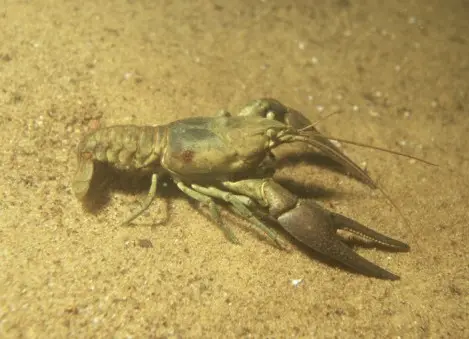
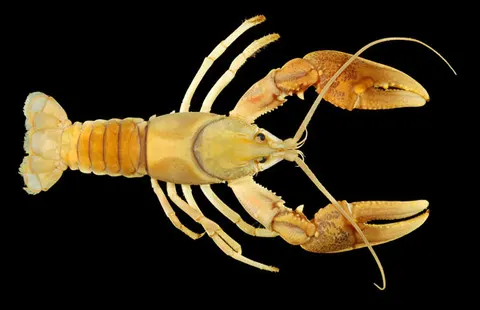
It's a small crayfish with a long, slender front claw, which gives it its name. The largest one recorded had a carapace (the shell over the head and body) 1.56 inches long, and the species was described in 1976 by Bouchard and Hobbs. Two colour forms are known: one mostly uniform olive green to rusty brown, the other mottled light gray to straw with rusty red to dark brown speckles.
Where it lives
It is endemic to Alabama, in DeKalb and Marshall counties, in tributaries that run into the south side of Guntersville Lake on the Tennessee River. There are two populations. The Short Creek population includes Short, Shoal and Scarham creeks, and the Town Creek population includes Town and Bengis creeks. The two are separated by the reservoir, and no slenderclaw crayfish has been found in the impounded water itself.
It lives in small to medium streams, generally under about 20 feet (6 m) wide and 2.3 feet (0.7 m) deep, with boulders and cobble on the bottom and intact native plants along the banks. It's cryptic, sheltering in the gaps between boulders and cobble, and it burrows when streams dry or when it needs to hide.
Pins are Wikidata “endemic to” fields. Orange dots, when present, are GBIF occurrence tiles — survey bias included.
How it lives
Very little is known about its biology. The U.S. Fish and Wildlife Service believes it matures within a year and lives two to three years, but those figures are inferred from other crayfish. Juveniles probably eat aquatic insect larvae and other small invertebrates, and adults probably eat both plants and animals.
Why it is in trouble
The Red List assessment, made in 2010, lists dams and the habitat change they cause as the threat and records the population trend as unknown. Later work pointed to a different main cause. The virile crayfish (Faxonius virilis), a larger and more aggressive invader from the Midwest, was first collected near the range in 1967. It turned up in 2015 at the creek where the slenderclaw was first described, a place the native species no longer occupies, and juveniles of the invader have been found in the Short Creek population.
Water quality is a second problem. Runoff from farming, including poultry operations, can carry nutrients, pesticides, bacteria and metals into the streams, and some in the area are listed as impaired. In the 1970s researchers collected 90 slenderclaws, 56 of them juveniles, from Short Creek. Surveys between 2009 and 2017 found 28 in the Short Creek population and 4 in Town Creek. A 2011 survey of 55 sites found it at just one, with about 0.037 animals per square metre, and none of the five original sites. Surveys from 2015 to 2017 found it at three new sites within the same range. None of these counts are population estimates.
What is being done
The U.S. Fish and Wildlife Service listed the species as endangered under the Endangered Species Act, effective October 8, 2021, and designated about 78 river miles (126 km) of critical habitat. A recovery plan followed in 2025. It calls for assessing how far invasive crayfish have spread, finding ways to limit them, and developing a controlled propagation plan, with captive rearing and reintroductions as options.
Sources
Written for this catalog in our own words from the sources below, checked against them on 12 November 2026. Population figures are estimates and carry the year they were made. Status and assessment year: IUCN. 2026. The IUCN Red List of Threatened Species. Version 2026-1. iucnredlist.org.
- IUCN Red List assessment, Cambarus cracens (2010)
- U.S. Fish and Wildlife Service species profile, slenderclaw crayfish
- Federal Register, final rule listing slenderclaw crayfish (8 Sep 2021, 86 FR 50264)
- USFWS Recovery Plan for the Slenderclaw Crayfish (2025)
- Kilburn, Taylor and Schuster 2014, Southeastern Naturalist 13(1)