Endangered
Cagle's map turtle
Graptemys caglei
Cagle's map turtle (Graptemys caglei) is a small freshwater turtle found only in Texas, mostly in the Guadalupe River and its tributaries. The IUCN Red List listed it as Endangered in 2011. Females grow far larger than males, and the two sexes eat very different food.
How to recognise it
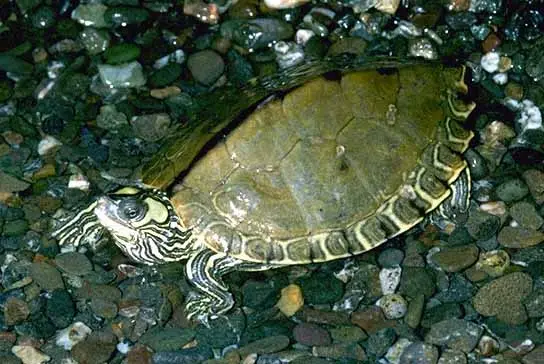
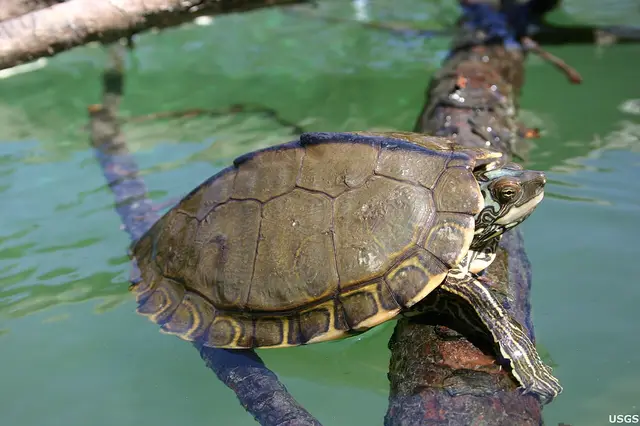
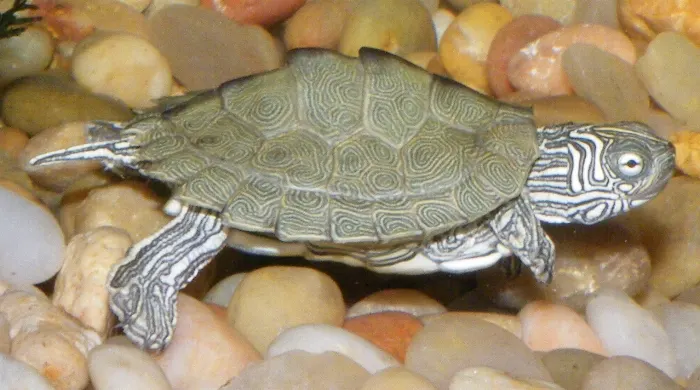
Like other map turtles, it has a patterned upper shell with fine lines that look like contours on a topographic map, and a serrated rear edge to the carapace. The pattern is what gives the genus its name.
The sexes differ a great deal. Adult males average about 7 to 12 cm in shell length, while females are much bigger. A Texas turtle reference gives maximum shell lengths of 12.6 cm for males and 21.3 cm for females.
Where it lives
The species was described in 1974 and named for the herpetologist Fred Ray Cagle. It lives only in rivers of the Guadalupe system in south-central Texas. A 2002 survey for the Edwards Aquifer Authority found it in segments of the Guadalupe and San Marcos rivers, from Kerr County downstream to the Victoria area, and reported it missing from the impoundments between New Braunfels and Seguin. Another source records it in the Blanco and Medina rivers and treats San Antonio River populations as gone.
The report divided the Guadalupe into three stretches. By an estimate published in 1992, about 82% of the turtles were in the middle stretch (226 river km), 11% in the upper and 7% in the lower. The same estimate put the total at 11,717 turtles, a figure that is now decades old. The IUCN assessment lists it from a single location, with an estimated area of occupancy of 120 square km.
Pins are Wikidata “endemic to” fields. Orange dots, when present, are GBIF occurrence tiles — survey bias included.
How it lives
These turtles spend most of their lives in the water. They favour stretches with a silt and gravel bed, long pools joined by gravel bars, and moderate flow, and they haul out to bask on fallen logs, rocks and cypress knees. A regional account links higher densities to flows of roughly 0.5 to 0.8 m/s, cobble bottoms and willows along the bank, since willow roots can hold large numbers of caddisfly larvae.
Males mostly eat insects. In a study near Cuero, insects made up 81% of an adult male's gut contents by weight, and one caddisfly genus alone accounted for 45%. Adult females ate mainly molluscs, and most of that was Asian clam. Juveniles ate roughly equal parts insects and molluscs.
Nesting is not well documented. Researchers have found nests from late March through August, in sand, sandy loam, clay loam and sand and gravel mixes. A mature female reportedly lays up to three clutches a year of one to six eggs.
Why it is in trouble
A 2002 report on the species named four problems: a very small range, fragmented habitat, possible loss of insect prey to altered flow, pollution and silt, and direct killing, including shooting and collecting for the pet trade, zoos and museums. The Red List criteria cite a decreasing population and a very small area of occupancy, and the assessment records habitat shifts, dams and water abstraction among the pressures.
A newer worry is hybridisation. Surveys of the upper Guadalupe found Texas map turtles (Graptemys versa), not previously recorded in the Guadalupe drainage, living alongside Cagle's over roughly 35 to 40 river km near Kerrville, and several turtles showed traits in between. Tarleton State University announced in September 2024 a genetic study to test for interbreeding.
What is being done
The turtle is listed on Appendix III of CITES, which means international trade is monitored. The IUCN lists site protection, habitat restoration, invasive species control and site management among the actions in place or needed, and calls for more research on population trends, habitat trends and life history.
Sources
Written for this catalog in our own words from the sources below, checked against them on 12 November 2026. Population figures are estimates and carry the year they were made. Status and assessment year: IUCN. 2026. The IUCN Red List of Threatened Species. Version 2026-1. iucnredlist.org.
- IUCN Red List assessment, Graptemys caglei (2011)
- Killebrew, Rogers and Babitzke 2002, Assessment of Instream Flow and Habitat Requirements for Cagle's Map Turtle (Edwards Aquifer Authority)
- Wikipedia, Cagle's map turtle
- Texas Turtles, Cagle's map turtle
- Tarleton State University, hybridization between endemic Texas map turtles (2024)