Critically Endangered
Burmese roofed turtle
Batagur trivittata
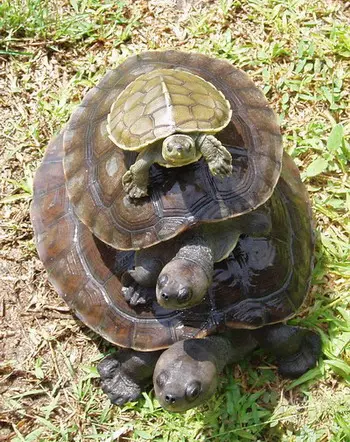
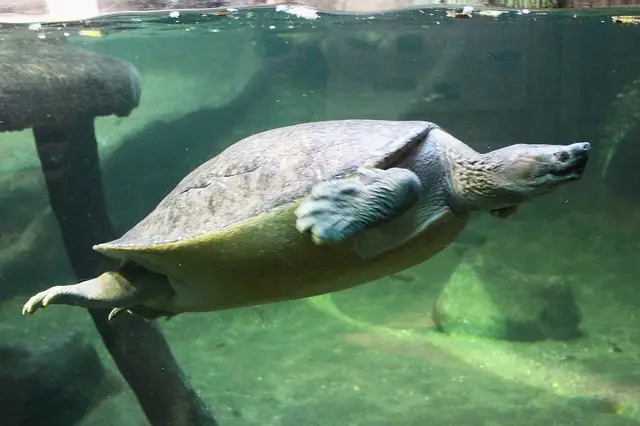
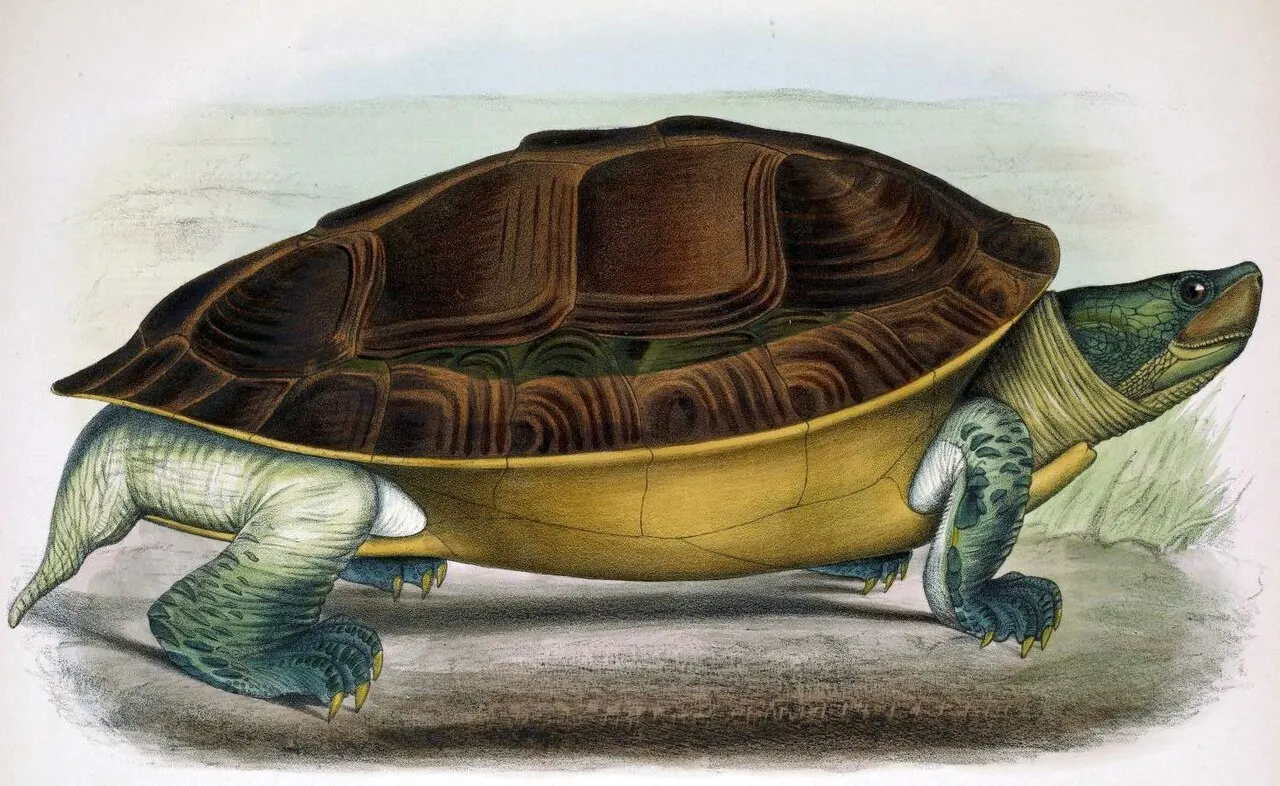
The Burmese roofed turtle (Batagur trivittata) is a large freshwater river turtle found only in Myanmar. Believed extinct for years, it was rediscovered in 2001. The IUCN Red List rated it Critically Endangered in 2019, with a population entry of about 10 mature individuals. Breeding males turn bright yellow-green on the head.
How to recognise it
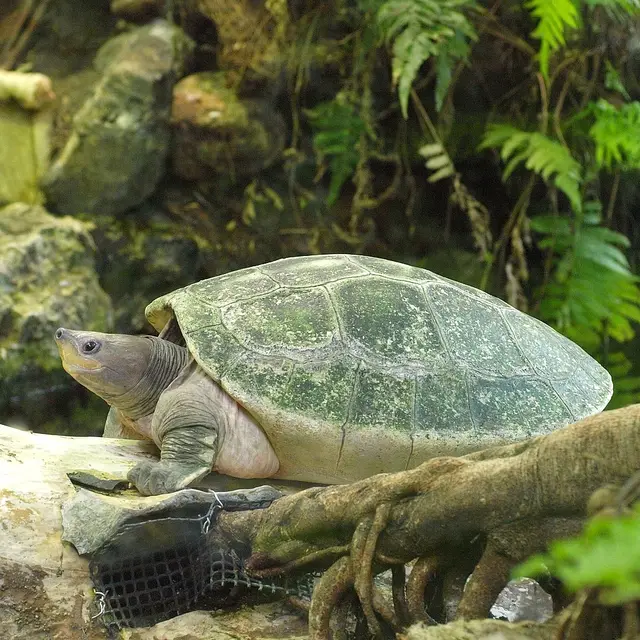
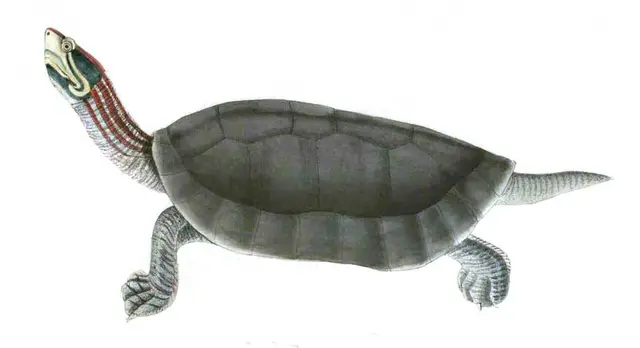
Adult males have an olive-green shell marked with a black stripe that runs from the top of the head down the neck, plus three more black stripes along the shell. The underside is ivory white, and the tail is longer than a female's.
A male's head is normally green, but in the breeding season it flushes bright chartreuse-yellow with bold black markings. Females grow noticeably larger than males, and their head, shell and underside range from dark brown to grayish-black.
Where it lives
This turtle is endemic to the rivers of Myanmar. Two small groups were found again in 2001, in the Chindwin and Dokhtawady rivers. The Red List treats the species as occurring at a single location, at about 150 to 200 m elevation, and lists river channels and sandbars as its habitat.
In the nesting season, turtles stay in a deep river pool that local people call an aike. Counts are grim. By 2018, fewer than 10 mature individuals had been documented, and a 2017 release from the Wildlife Conservation Society (WCS) put the number of wild females at fewer than five.
Pins are Wikidata “endemic to” fields. Orange dots, when present, are GBIF occurrence tiles — survey bias included.
How it lives
It eats plants, mainly aquatic and semi-aquatic vegetation. Wild females probably start breeding at around 20 years old, and a clutch averages 20 to 25 eggs. The Red List gives a generation length of about 25 years, so losses take a very long time to replace.
It's a dispersive animal. Released turtles tend to move downstream, which makes them hard to track, so teams have used soft releases that keep them on a sandbank for a while to make monitoring easier.
Why it is in trouble
Egg collection, poaching of adults and juveniles, and accidental capture in fishing gear have all taken a toll. In 2007, an illegally traded Burmese roofed turtle was identified in Qingping market in Guangzhou, China.
The Red List also names large dams, shipping lanes, mining and quarrying, shifting agriculture, small-scale aquaculture and storms and flooding. WCS has also linked gold mining to habitat loss. With so few animals left in the wild, any one of these pressures can matter.
What is being done
The turtle is protected nationally in Myanmar and sits on CITES Appendix II. Assurance colonies hold animals at Yadanabon Zoo in Mandalay, Lawkanandar Wildlife Sanctuary, Htamanthi Wildlife Sanctuary and Singapore Zoo. A 2022 Turtle Survival Alliance report put the combined total at well over 800 turtles of varying ages.
In April 2017, WCS and the Turtle Survival Alliance recovered 44 viable eggs from three clutches on the Chindwin. They were left to incubate in a protected sandbank site under round-the-clock watch. Hatchlings are raised in large pools for four to five years, until they are big enough to avoid most predators. Young males released in 2015 are believed to have fathered the wild eggs, which DNA tests were set to check.
The 2022 hatching season set a record of 68 hatchlings at the Limpha Village field station. Two groups of 30 genetically varied turtles have been released at two sites along the Chindwin. Health screenings in 2014 and 2018 found no sign of disease in animals being prepared for release.
Sources
Written for this catalog in our own words from the sources below, checked against them on 12 November 2026. Population figures are estimates and carry the year they were made. Status and assessment year: IUCN. 2026. The IUCN Red List of Threatened Species. Version 2026-1. iucnredlist.org.