Critically Endangered
Bugun Liocichla
Liocichla bugunorum
The Bugun liocichla (Liocichla bugunorum) is a small olive-grey songbird with yellow and red markings, found only in the eastern Himalayas of Arunachal Pradesh, India. Scientists described it in 2006. The IUCN Red List rated it Critically Endangered in 2024, putting the population at 25 to 250 individuals.
How to recognise it
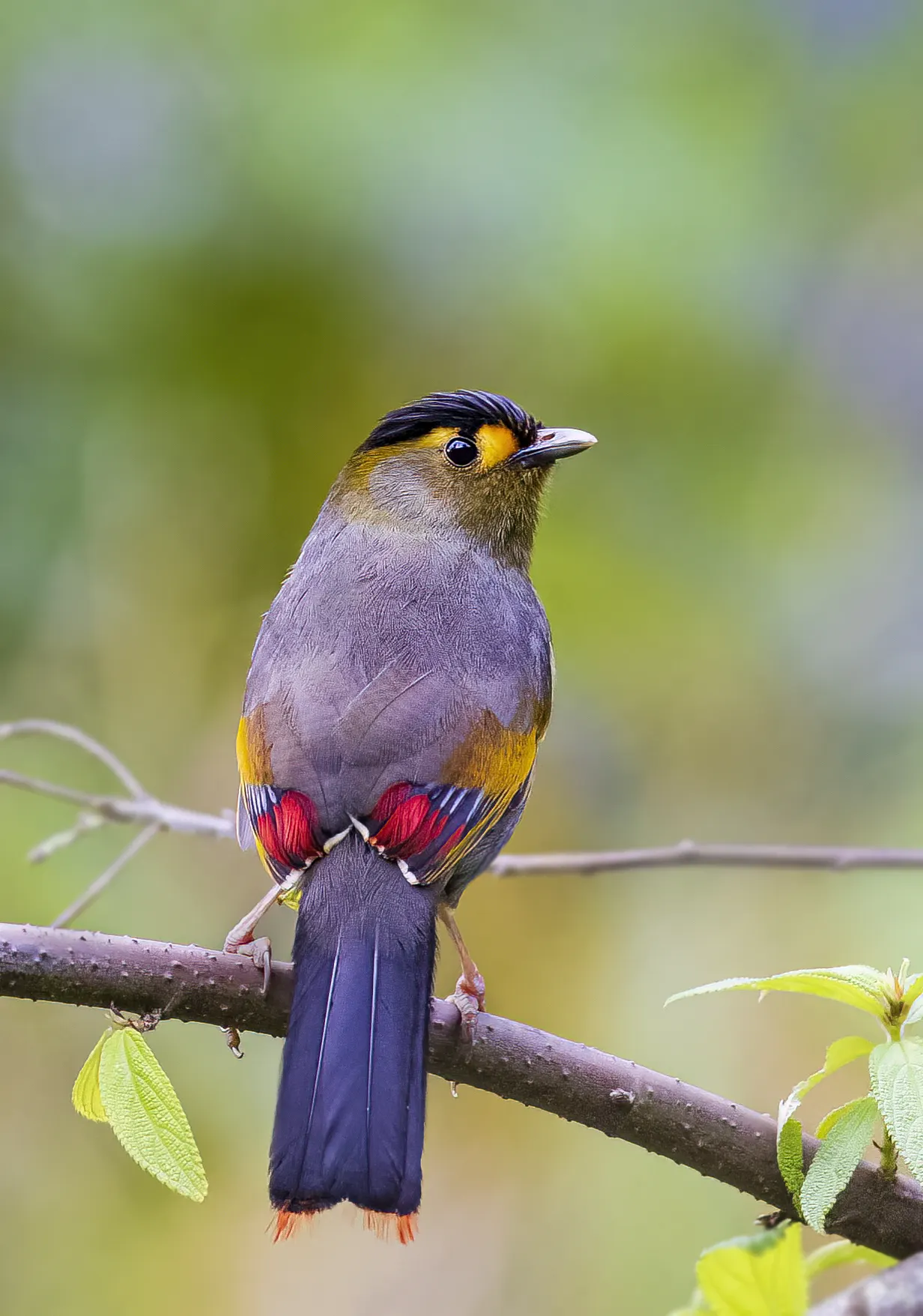
It is a bird of about 20 centimetres, olive-grey with a black cap, orange-yellow patches between the bill and eye, and yellow, red and white patches on the wings. The tail is black with crimson feathers underneath, the feet are pink, and the bill is black at the base, fading to pale. The voice is described as fluty.
A duller bird caught in a mist net was probably a female. Its closest relative is the Emei Shan liocichla (Liocichla omeiensis) of China, and the Hengduan Mountains may have separated the two.
Where it lives
The Bugun liocichla is known from a single area of West Kameng district, Arunachal Pradesh, around Singchung village and the Eaglenest Wildlife Sanctuary. The IUCN gives its elevation as roughly 2,060 to 2,340 metres and records it as a resident, not a migrant. A feature article describes it as confined to about 2 square kilometres of the 17 square kilometre community reserve.
It lives in moist montane forest, high-altitude shrubland and heavily degraded former forest. Most sightings have been on disturbed hillsides with shrubs and small trees, and one was at the edge of primary forest. Populations might exist elsewhere in Arunachal Pradesh or in neighbouring Bhutan, but none has been found.
Pins are Wikidata “endemic to” fields. Orange dots, when present, are GBIF occurrence tiles — survey bias included.
How it lives
Small flocks have been seen in January and pairs in May. Only three breeding pairs were known when the species was described. It can survive in degraded forest and scrub.
Little else is documented about its diet or breeding.
A very recent discovery
The first sighting dates to 1995 (one account says 1996) in the Eaglenest area, and the bird then went unseen for about ten years. The astrophysicist and birder Ramana Athreya found it again in January 2005, and it was described as a new species in 2006. Because so few birds existed, none was collected as a specimen. Photographs, recordings, notes and feathers served as the reference instead.
The name honours the Bugun people, whose community forests hold the bird.
Why it is in trouble
Population estimates are tiny and vary. An early count recorded about 14 birds, a feature article gives 14 to 20 breeding adults, and the 2024 IUCN assessment gives 25 to 250 individuals. The IUCN lists the population trend as unknown.
The IUCN names roads and railways, and accidental harm from small-scale subsistence harvest, as threats, with ecosystem conversion, degradation and disturbance as the stresses. A planned highway through its main habitat is a particular concern. Ornithologist Umesh Srinivasan expects warming temperatures to push the bird to higher ground.
What is being done
The Singchung Bugun Village Community Reserve, about 17 square kilometres in West Kameng, was established in 2017. Forest officers patrol it against poaching, illegal logging and hunting, and the community runs birdwatching camps and school awareness programmes.
The IUCN records that the species occurs in at least one protected area, but notes no recovery plan, no systematic monitoring scheme and no captive programme. Its suggested action is to keep habitat in the Kameng protected area safe by opposing further road building.
Sources
Written for this catalog in our own words from the sources below, checked against them on 12 November 2026. Population figures are estimates and carry the year they were made. Status and assessment year: IUCN. 2026. The IUCN Red List of Threatened Species. Version 2026-1. iucnredlist.org.




