Endangered
Buff-throated Purpletuft
Iodopleura pipra
The buff-throated purpletuft (Iodopleura pipra) is a small bird, about 10 cm long, of Brazil's Atlantic Forest, found in scattered coastal forest from the northeast to the south. The IUCN Red List lists it as Endangered (2023 assessment), with an estimated 1,000 to 2,499 mature individuals. It feeds mostly on mistletoe berries in the treetops.
How to recognise it
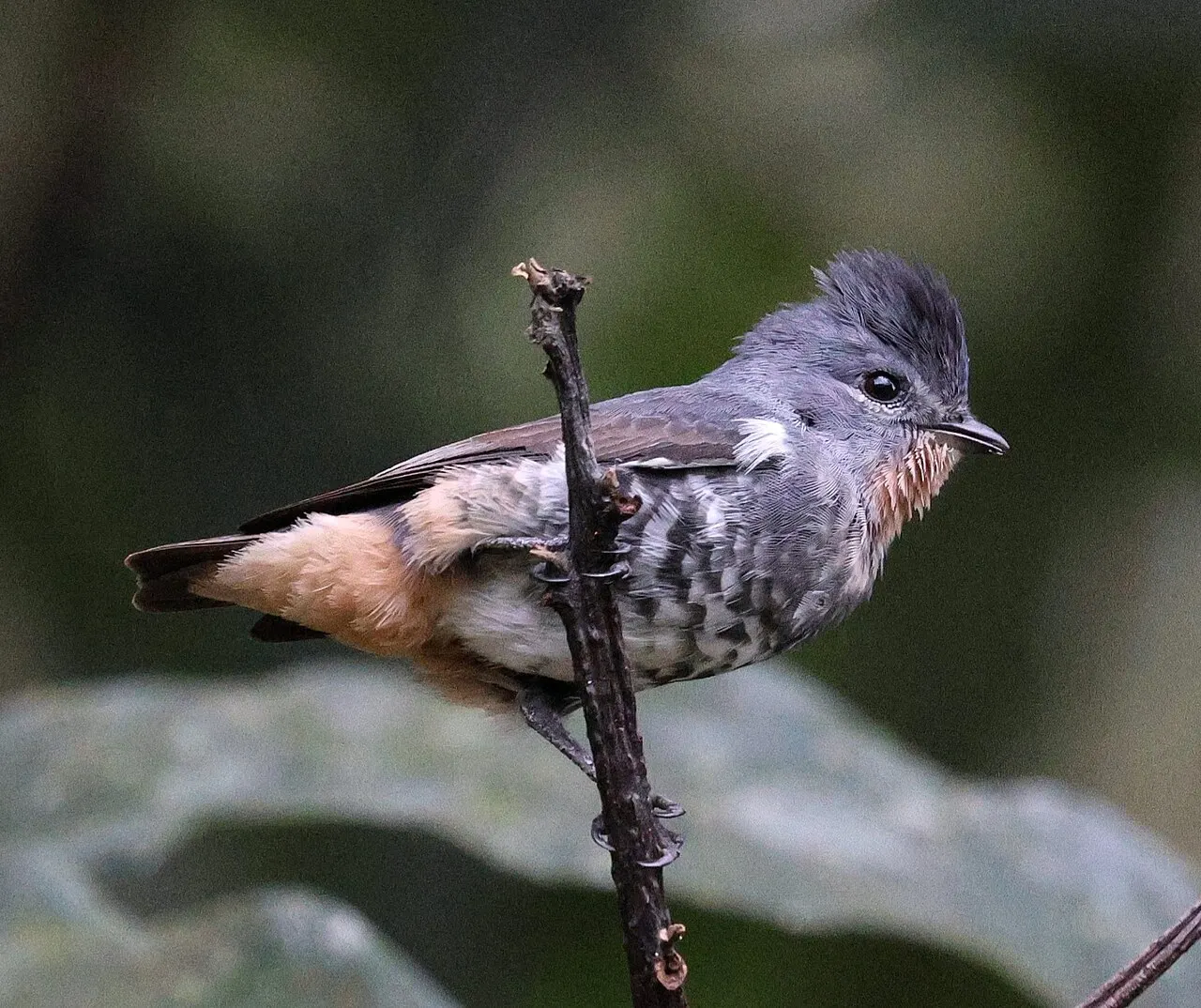
It's a small bird, about 8.7 to 10.5 cm long, and two weighed birds came in at roughly 10 g. The face and upperparts are gray, with a pale stripe over the eye and a broken white eye-ring. The throat and upper breast are cinnamon-buff, the belly is white, and the breast and flanks are mottled gray.
A white rump patch shows in flight. Males carry a small tuft of purple feathers on the upper flank, which females lack. The song is a very high, thin two-note whistle, written as "weeh-zwee". The species was long placed with the cotingas, and many current checklists now put it in Tityridae, the tityras and becards.
Where it lives
The species is endemic to Brazil and restricted to Atlantic Forest along the eastern coast. Two subspecies are recognised. The northern one (leucopygia) occurs patchily from Paraíba to northeastern Minas Gerais, and the nominate form ranges from Espírito Santo south to Paraná. Of about 2,150 records on GBIF, most come from São Paulo, with others from Bahia, Rio de Janeiro, Espírito Santo, Pernambuco and Alagoas.
It stays mostly below 1,000 m. The Red List lists moist forest, heavily degraded former forest and plantations as habitat, and other sources add cocoa plantations that keep tree cover and wooded clearings. The Red List counts 11 to 100 locations and 10 to 100 subpopulations, the largest holding an estimated 51 to 250 mature birds.
Pins are Wikidata “endemic to” fields. Orange dots, when present, are GBIF occurrence tiles — survey bias included.
How it lives
Purpletufts forage in the canopy. They pluck fruit from a perch or in short sallies, and take insects both while perched and in flight. Mistletoe berries are the main food, and the bird may depend on a tall, fine-leafed legume tree that often carries mistletoe clumps. It's thought to be a year-round resident, though there is some evidence of movements up and down slopes.
The nest is a tiny lichen cup on a horizontal branch, apparently built by the female alone. The clutch is a single egg, and both adults feed the chick. The nominate form seems to breed from about July to October. Incubation and fledging times haven't been recorded.
Why it is in trouble
Loss of Atlantic Forest is the main threat, with logging mostly for farming and property development. The Red List names small-holder and large-scale farming, housing and urban growth, and small-scale harvesting as ongoing pressures, and records a continuing decline in the area the bird occupies.
The Red List estimates a past, ongoing and future population reduction of 10 to 19 percent, inferred from habitat decline rather than counted directly. It does not class the population as severely fragmented, but the birds are split into many small subpopulations.
What is being done
The species occurs in at least one protected area, and one account says it is protected under Brazilian law. The Red List records no recovery plan and no systematic monitoring scheme. It calls for securing key sites, including around Ubatuba in São Paulo and Murici and Usina Serra Grande in Alagoas, and for restoring degraded forest to link subpopulations. It also asks for surveys to pin down the population trend.
Sources
Written for this catalog in our own words from the sources below, checked against them on 12 November 2026. Population figures are estimates and carry the year they were made. Status and assessment year: IUCN. 2026. The IUCN Red List of Threatened Species. Version 2026-1. iucnredlist.org.




